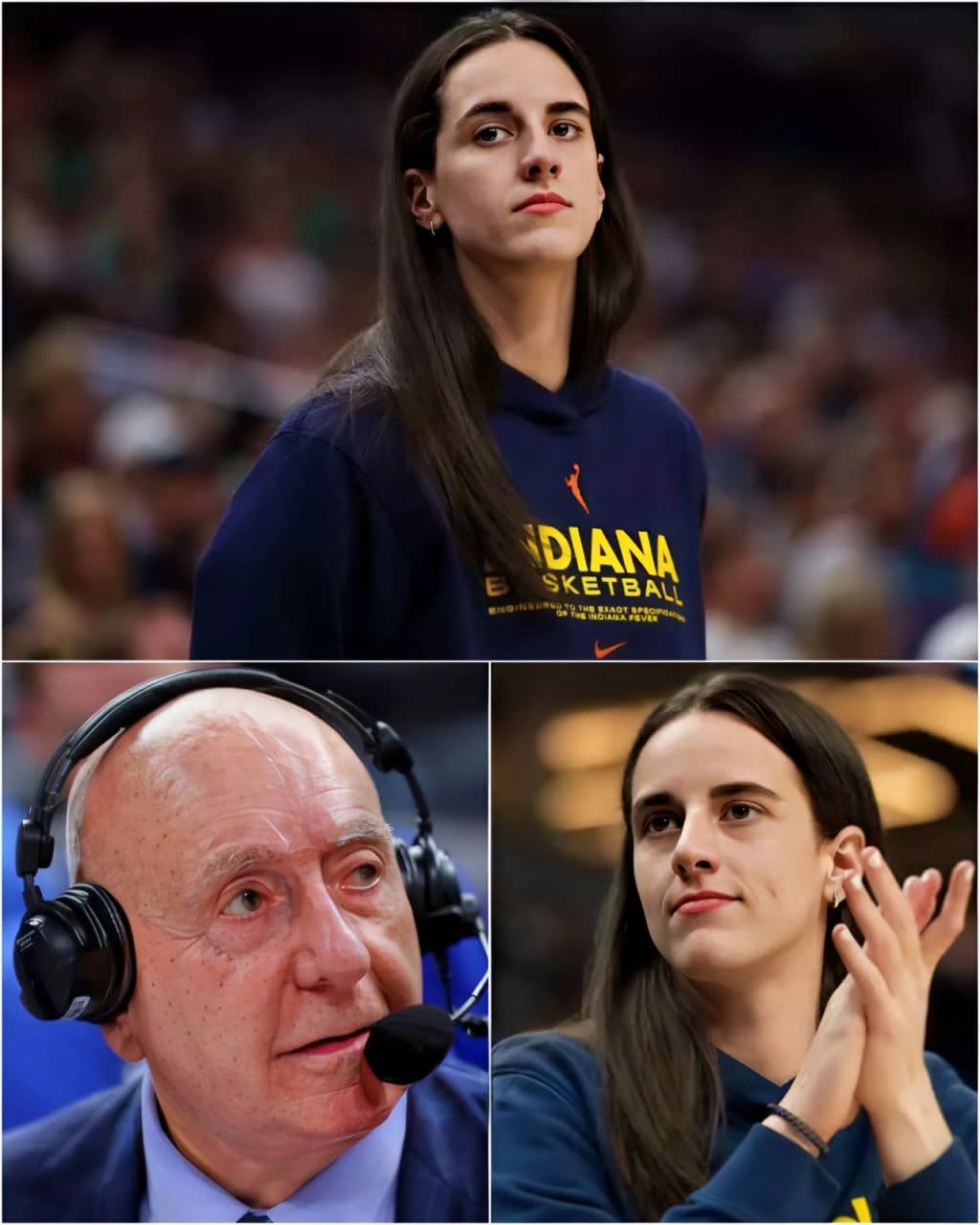
🔥 “I DIDN’T COME HERE TO BE QUIET.” — DICK VITALE’S DEFENSE OF CAITLIN CLARK HAS REIGNITED ONE OF THE WNBA’S BIGGEST DEBATES
Eight words.
One camera.
And supposedly, an entire television studio suddenly went silent.
That’s the extraordinary story spreading around Dick Vitale and Caitlin Clark—a viral narrative claiming the legendary broadcaster delivered a mysterious eight-word sentence so explosive that CBS immediately killed the feed and the WNBA went into crisis mode.
The story has everything social media loves.
A television blackout.
Panicked producers.
Secret league meetings.
A supposedly deleted interview.
And one sentence nobody is willing to repeat.
But there’s a major problem.
There is no credible evidence that this dramatic broadcast happened.
No authenticated CBS footage establishes that Vitale’s interview was abruptly terminated.
No reliable report confirms that WNBA officials demanded the segment disappear.
And the supposed eight-word statement remains conveniently absent from the very posts describing its allegedly enormous consequences.
Yet underneath that viral story is something real.
Dick Vitale has been publicly defending Caitlin Clark.
And he hasn’t exactly been subtle about it.
During the 2026 season, Vitale criticized what he viewed as excessive physical treatment of Clark, arguing publicly that she had every right to complain about hard contact that he believed wasn’t always being called.
That followed another strongly worded message in which the longtime college basketball broadcaster argued that Clark deserved considerably more appreciation for what she has brought to the WNBA.
His reasoning was straightforward.
Clark has generated extraordinary attention.
Television audiences follow her.
Fans fill arenas to watch her.
Her presence has helped make WNBA conversations part of mainstream American sports culture at a level rarely seen before.
To Vitale, that impact deserves recognition.
But recognition is different from special treatment.
And that’s where the debate becomes complicated.
Clark shouldn’t receive favorable officiating simply because she is famous.
Opponents should be allowed to defend her physically.
Professional basketball isn’t supposed to become non-contact basketball when a superstar possesses the ball.
At the same time, Clark’s fame shouldn’t mean officials tolerate illegal contact simply because they don’t want to appear protective of her.
The standard should remain the rulebook.
That sounds simple.
In practice, it has become one of the loudest debates surrounding the WNBA.
Every hard foul involving Clark is replayed repeatedly.
Every no-call becomes evidence for one side or the other.
Every interaction with an official is analyzed.
And every commentator who enters the discussion becomes another character in a controversy far larger than one possession.
Vitale’s involvement matters because his voice carries decades of basketball history.
He isn’t a new social-media personality chasing the latest trend.
His broadcasting career has made his enthusiasm almost synonymous with college basketball.
So when Vitale publicly says Clark is being treated unfairly, people notice.
But his statements are still opinions.
They aren’t proof of a league conspiracy.
They don’t establish that referees are deliberately ignoring fouls against Clark.
And they don’t demonstrate that other WNBA players collectively resent her.
Those distinctions are important because Clark herself has repeatedly tried to move the conversation back toward basketball.
During the 2026 All-Star period, she described the endless discourse surrounding her as emotionally exhausting.
She expressed frustration with narratives that make accusations about her character rather than discussing what happens between the lines.
That’s revealing.
Because while outsiders continue building increasingly dramatic stories around Clark, the player at the center of them keeps returning to something much simpler:
Basketball.
Win games.
Improve.
Compete.
Try to win a championship.
The league’s physicality is still a legitimate subject.
In 2026, the conversation became particularly intense after Alyssa Thomas made contact with Clark’s throat during a Fever-Mercury game. The WNBA later assessed Thomas a Flagrant 2 and a one-game suspension. Clark subsequently condemned the racist abuse and death threats Thomas received, emphasizing that basketball criticism should never become personal harassment.
That response complicates the simplistic “Clark versus the WNBA” storyline.
Clark can want appropriate officiating while rejecting abuse directed at opponents.
Fans can question a call without turning a player into a villain.
Vitale can defend Clark without proving that everyone inside the league is against her.
Those things can all be true simultaneously.
And perhaps that’s why the fabricated “eight words” story isn’t necessary.
Vitale’s actual public comments are already provocative enough.
He believes Clark has absorbed significant physical punishment.
He believes she deserves greater appreciation for her impact.
He has publicly backed her as an MVP contender during a strong 2026 campaign.
Those are real positions people can debate.
No emergency broadcast switch required.
And there is another reality that contradicts the image of a league supposedly frozen in terror.
The WNBA continues to expand its influence internationally. At the recent Women’s World Cup, 70 current and former WNBA players participated, and the league’s growing importance is helping reshape discussions around the global basketball calendar.
That’s not a league disappearing.
It’s a league experiencing growing pains under unprecedented attention.
Clark is a major reason that attention has intensified.
Vitale recognizes it.
Fans recognize it.
Broadcasters recognize it.
And the WNBA certainly recognizes it.
The difficult part is separating legitimate criticism from increasingly elaborate narratives manufactured around that attention.
So what were the mysterious eight words that supposedly forced CBS to cut away?
Based on the evidence available, there is no authenticated eight-word statement to reveal.
But Dick Vitale’s actual message has been clear enough without one:
He believes Caitlin Clark deserves respect, fair treatment and recognition for the extraordinary attention she has brought to women’s basketball.
That opinion can be challenged.
It can be supported.
It can be debated.
But unlike the mysterious deleted interview supposedly terrifying the WNBA, at least that conversation is real. 🔥🏀