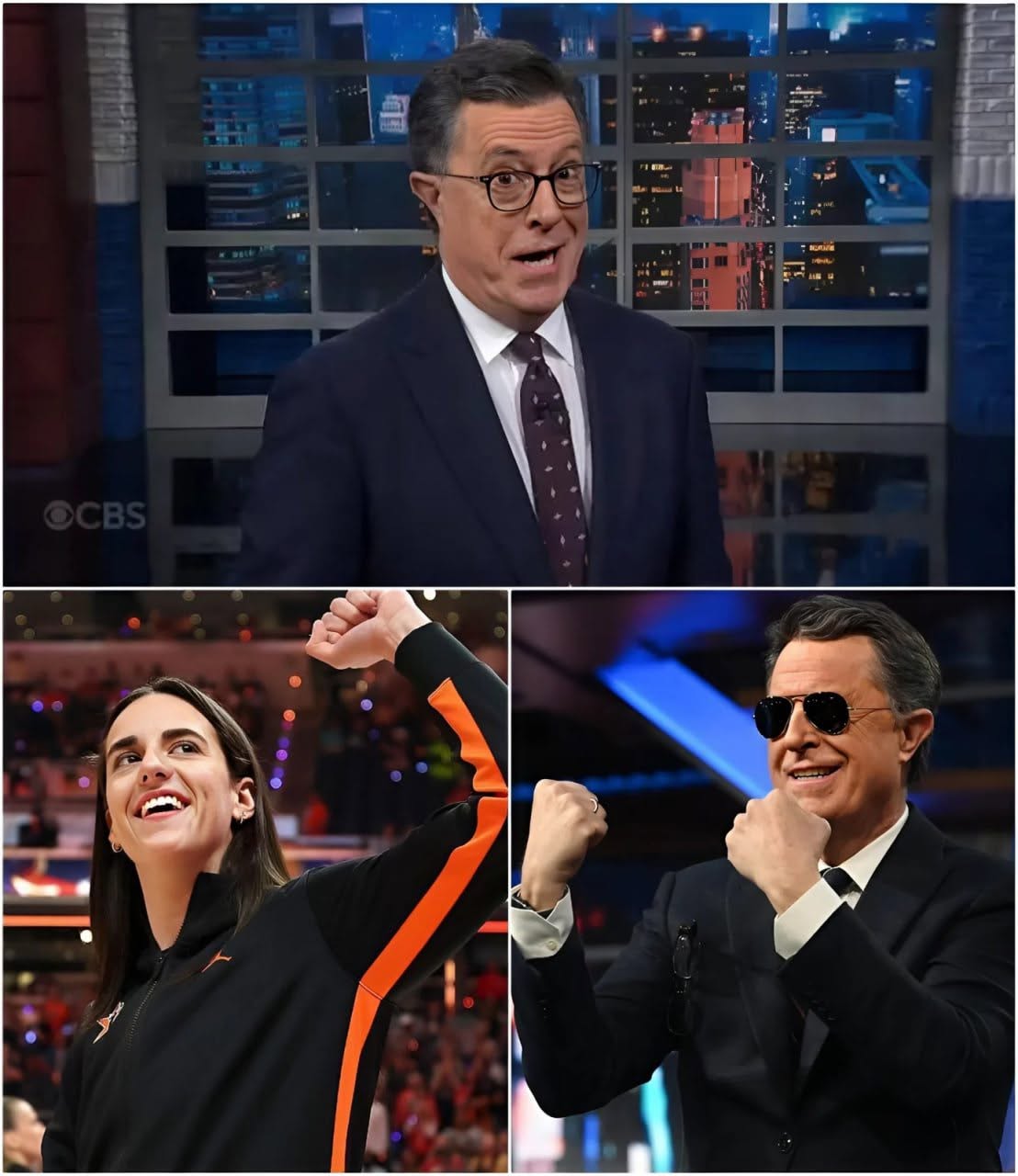
🚨 CBS SHOCKER? A VIRAL STORY CLAIMS STEPHEN COLBERT “EXPOSED” MEDIA BIAS AGAINST CAITLIN CLARK LIVE ON AIR — BUT THERE’S A MAJOR PROBLEM
The studio supposedly went silent.
Stephen Colbert looked directly into the camera.
Then, according to a viral story racing across social media, the legendary late-night host abandoned the script and delivered a blistering monologue about something millions of basketball fans have argued about for years:
The way Caitlin Clark is covered by the media.
The alleged moment has been described as explosive.
Colbert supposedly accused sports media of applying different standards to Clark, turning every disagreement involving her into controversy while refusing to acknowledge the enormous influence she has had on women’s basketball.
The audience, according to the posts, didn’t know how to react.
Then came the applause.
It is exactly the kind of television moment that would generate millions of views.
There’s just one enormous problem.
There is no credible evidence that this extraordinary monologue happened.
And the timeline makes the story even more questionable.
CBS ended The Late Show with Stephen Colbert in May 2026.
The official CBS episode archive lists the May 21 broadcast as “THE LATE SHOW with STEPHEN COLBERT Series Finale.”
So any viral post presenting this as a new live Late Show monologue should immediately face a basic question:
When exactly was this supposed to have aired?
That doesn’t mean the larger conversation surrounding Caitlin Clark and media coverage isn’t real.
It absolutely is.
Since Clark’s college career exploded into a national phenomenon at Iowa, almost everything involving her has generated enormous attention.
Her scoring records became national news.
Her NCAA tournament games attracted massive audiences.
Her arrival in the WNBA brought even more attention.
Then came the debates.
Was Clark receiving too much coverage?
Was she receiving unfair criticism because of her popularity?
Were other WNBA stars being overlooked?
Was every hard foul against her being exaggerated?
Or were some observers minimizing legitimate concerns about the physical treatment she received?
Those questions have produced thousands of television segments, columns, podcasts and social-media arguments.
And they reveal something important about Clark’s position inside modern basketball.
She isn’t simply an athlete anymore.
She is a media ecosystem.
A Clark story generates clicks.
A Clark controversy generates even more.
Put her name beside Angel Reese, and engagement rises.
Add officiating.
Add Team USA.
Add a television personality.
Suddenly an ordinary basketball discussion can become a national cultural argument.
That is precisely why the supposed Colbert story feels believable to some readers.
People already recognize the debate.
All the viral post has to do is place a famous voice inside it.
But recognizing a broader issue doesn’t prove a specific television event occurred.
The alleged monologue also reflects one of the most difficult questions surrounding Clark:
What would fair coverage actually look like?
Some Clark supporters believe the media has frequently treated her popularity as something suspicious rather than celebrating what she has brought to women’s basketball.
They point to moments when discussions about her performances quickly became arguments about race, privilege, teammates, opponents or fan behavior.
Others argue that Clark actually receives far more coverage than almost every other WNBA player—and that criticism naturally accompanies that extraordinary level of attention.
Both observations can exist within the same media environment.
Clark can receive enormous exposure while also facing unfair individual narratives.
Other players can legitimately want greater recognition without necessarily resenting her.
Journalists can criticize Clark without being biased against her.
And Clark supporters can challenge particular coverage without proving that the entire sports media industry is coordinated against her.
Reality is usually more complicated than a viral headline.
That’s why evidence matters.
If Colbert had actually delivered the explosive monologue being described, there should be a broadcast clip.
There should be an episode date.
There should be a transcript.
CBS should have a record.
Major sports and entertainment outlets would almost certainly discuss a nationally known television host suddenly entering one of basketball’s loudest debates.
Without those things, dramatic details like “the studio froze” and “the audience erupted” aren’t verification.
They’re storytelling.
And ironically, that makes this viral rumor itself an example of the media environment surrounding Caitlin Clark.
Her name has become so powerful that people don’t need an actual game to create a Clark controversy anymore.
They simply need a recognizable personality and a provocative claim.
Stephen Colbert “defends” Clark.
Michael Jordan “warns” the WNBA.
Another celebrity supposedly “breaks their silence.”
The formula works because the audience already has strong feelings before clicking.
People who believe Clark is mistreated see confirmation.
People who believe Clark receives excessive attention see another example.
And everyone starts arguing.
Meanwhile, the most basic question gets forgotten:
Did the person actually say it?
In this case, the available evidence doesn’t establish that Colbert delivered the supposed live-air attack on media bias.
But the conversation the story attempts to exploit isn’t going anywhere.
Caitlin Clark remains one of the most scrutinized athletes in women’s sports.
Her performances will be analyzed.
Her popularity will be debated.
Her influence will be measured.
And media outlets will continue competing for attention whenever her name enters the conversation.
That scrutiny creates a responsibility on both sides.
Journalists should distinguish legitimate criticism from manufactured controversy.
Fans should distinguish reporting from commentary.
And audiences should distinguish an authenticated television clip from a dramatic caption describing something they never actually saw.
Because sometimes the most explosive “live television moment” isn’t a moment at all.
Sometimes it’s simply a story written so convincingly that thousands of people begin remembering a broadcast that never happened.
The debate over Caitlin Clark and media coverage is real.