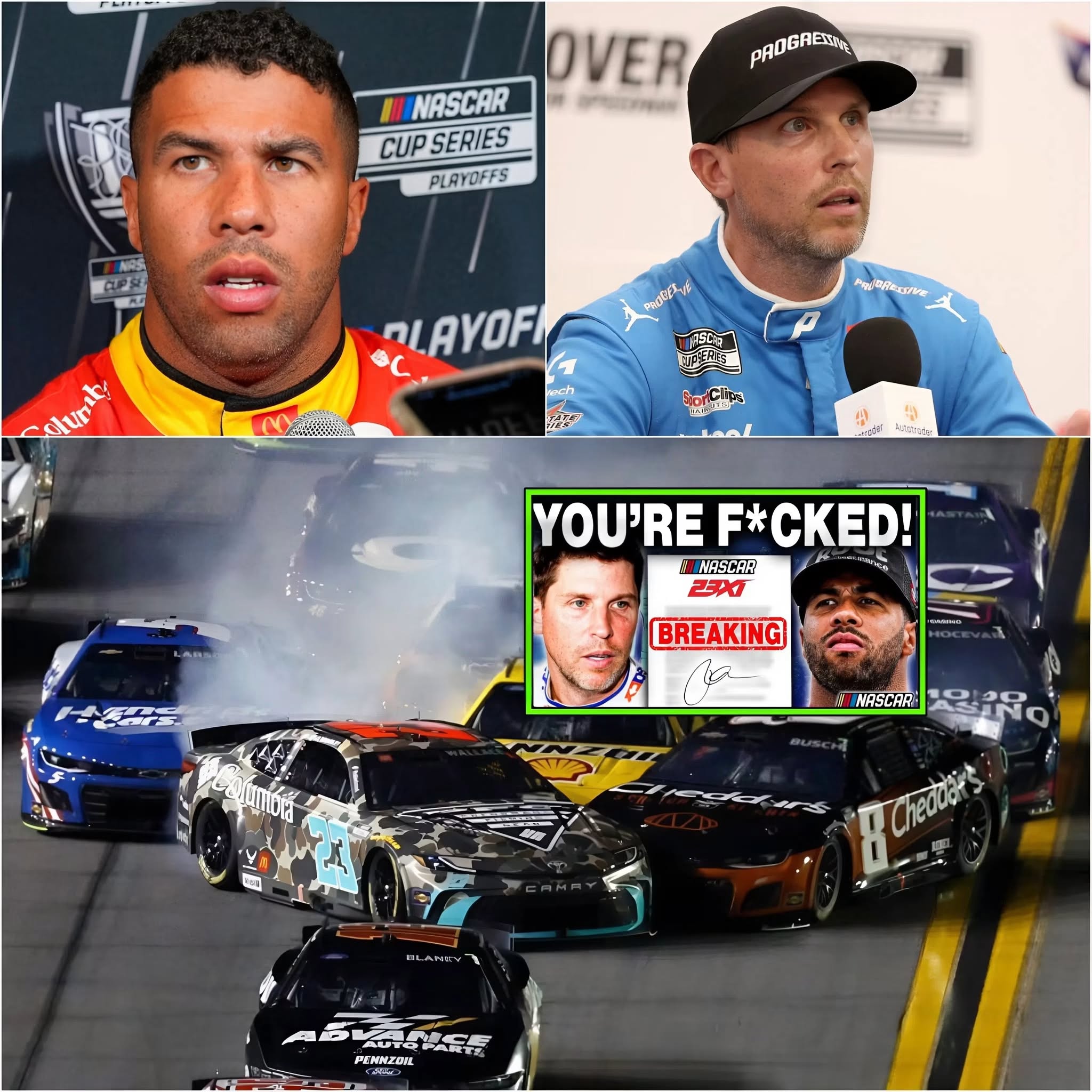
🔥 NASCAR HOT!! DENNY HAMLIN DROPS A BLUNT VERDICT ON BUBBA WALLACE AFTER DAYTONA CONTROVERSY — AND THEIR UNIQUE 23XI RACING RELATIONSHIP MAKES EVERY WORD HIT HARDER 🏁💥
Denny Hamlin has never been afraid to say exactly what he thinks.
That quality has made him one of NASCAR’s most compelling personalities — and occasionally one of its most controversial.
But when the driver he is criticizing happens to race for the team he co-owns, everything changes.
That is exactly why Hamlin’s comments about Bubba Wallace following the dramatic 2025 Daytona regular-season finale attracted so much attention.
The controversy centered on a major crash involving Wallace, Kyle Busch and Joey Logano.
Daytona had once again become exactly what NASCAR fans expect from a superspeedway: enormous speeds, tight drafting packs and almost no margin for error.
One wrong movement could involve half the field.
And that is essentially what happened.
When Hamlin later reviewed the incident, he did not simply defend Wallace because Wallace drives the No. 23 Toyota for 23XI Racing.
Instead, Hamlin pointed toward his own driver.
His assessment was that Wallace had squeezed Busch and Logano while not completely clear, contributing to the accident.
That immediately created an uncomfortable dynamic.
Because Hamlin wears two helmets figuratively every NASCAR weekend.
One belongs to the driver.
Hamlin races the No. 11 Toyota for Joe Gibbs Racing and wants to beat everybody.
The other belongs to the owner.
Alongside Michael Jordan, Hamlin helped establish 23XI Racing, the organization Wallace has represented since its first Cup season.
That means Wallace’s success benefits Hamlin.
But Hamlin has repeatedly demonstrated that ownership does not automatically mean unconditional public defense.
Sometimes he agrees with Wallace.
Sometimes he doesn’t.
And Daytona provided a perfect example.
The accident itself carried enormous consequences.
At superspeedways, drivers operate inches apart while moving at extraordinary speeds.
Drafting partners become rivals within seconds.
Drivers block because surrendering one lane can cost several positions.
But an aggressive block attempted at the wrong moment can create exactly the kind of chain reaction everyone fears.
Hamlin believed Wallace’s move crossed that line.
That does not mean he suddenly lost faith in Wallace.
It does not mean Wallace was being fired.
And it certainly does not prove that 23XI Racing was preparing some dramatic internal punishment.
Instead, it revealed something arguably more interesting:
Hamlin was willing to publicly criticize his own driver.
For NASCAR fans, that creates an unusual question.
Should a team owner protect his driver publicly and handle criticism privately?
Or is blunt accountability exactly what professional racing needs?
There are arguments on both sides.
Drivers operate under enormous pressure.
A superspeedway decision happens in fractions of a second.
Television replay allows viewers to analyze repeatedly what a driver had to decide almost instantaneously.
But Hamlin understands that better than almost anyone.
He has spent decades inside a Cup car.
He knows what Wallace saw.
He understands the closing speeds.
And he understands how quickly a driver can become trapped between committing to a move and realizing the opening has disappeared.
That experience gives his criticism additional weight.
Yet the Daytona episode also demonstrated why Wallace and Hamlin’s relationship is so fascinating.
They are not simply employee and boss.
They are competitors.
When Hamlin sees the No. 23 in front of him during a race, his responsibility as driver of the No. 11 does not disappear.
And that tension remains very real.
In fact, it surfaced again recently at Martinsville.
During the November 1, 2026 race, Hamlin became visibly — and audibly — frustrated while trying to pass Wallace for fifth place.
His radio reaction was profane and unmistakable: Hamlin was tired of fighting with the No. 23 while desperately trying to gain positions.
That moment again demonstrated how quickly the ownership relationship can disappear once the green flag waves.
Wallace had every right to defend fifth.
Hamlin had every reason to want it.
Neither competitor was obligated to make life easy for the other.
And perhaps that explains their relationship better than any sensational “feud” headline.
They can disagree.
Hamlin can criticize Wallace.
Wallace can race Hamlin aggressively.
But those moments do not automatically mean 23XI is collapsing internally.
Hamlin has previously shown that distinction clearly.
When Wallace received a controversial final-lap penalty at Atlanta in July 2026 for going below the double-painted line, Hamlin acknowledged that NASCAR had grounds to issue the penalty.
At the same time, he understood why Wallace attempted the move.
Wallace had been fighting for the win.
Hamlin’s attitude was essentially that if winning required taking the chance, then Wallace had to go for it — even if the execution ultimately resulted in a penalty.
That is not the language of an owner who expects perfection.
It is the perspective of a racer who understands risk.
And that distinction matters when looking back at Daytona.
Hamlin was not necessarily attacking Wallace personally.
He was analyzing a racing decision.
For Wallace, the challenge is equally complicated.
Driving for 23XI means one of the organization’s owners is also on the racetrack.
Most drivers never have to wonder whether their boss might be fighting them for position at 190 mph.
Wallace does.
Sometimes Hamlin is the owner watching from a business perspective.
Sometimes he is simply another driver trying to take the same piece of asphalt.
That contradiction guarantees tension.
It may also be part of what makes 23XI so compelling.
There is no artificial promise that everyone must agree.
The expectation is simpler:
Race hard.
Accept accountability.
Then move forward.
Daytona produced controversy.
Atlanta produced another disagreement.
Martinsville produced raw frustration.
But none of those moments alone proves that Hamlin and Wallace are headed toward some dramatic separation.
What they do demonstrate is that their partnership will never resemble a conventional owner-driver relationship.
Hamlin is too competitive.
Wallace is too competitive.
And when two racers built that way want the same position, business relationships become irrelevant until the checkered flag falls.
That may be the real bombshell.
Denny Hamlin can believe in Bubba Wallace enough to help build a team around him — and still tell the world when he believes Wallace got something wrong.
Because in NASCAR, loyalty and accountability do not always have to be opposites. 🏁🔥
DISCLAIMER: Hamlin’s criticism of Wallace following the 2025 Daytona incident and his November 1, 2026 Martinsville radio frustration are documented. This article does not claim Hamlin has announced Wallace’s firing, suspension, removal from 23XI Racing, or another unspecified new “bombshell.” Such claims would require separate confirmation.