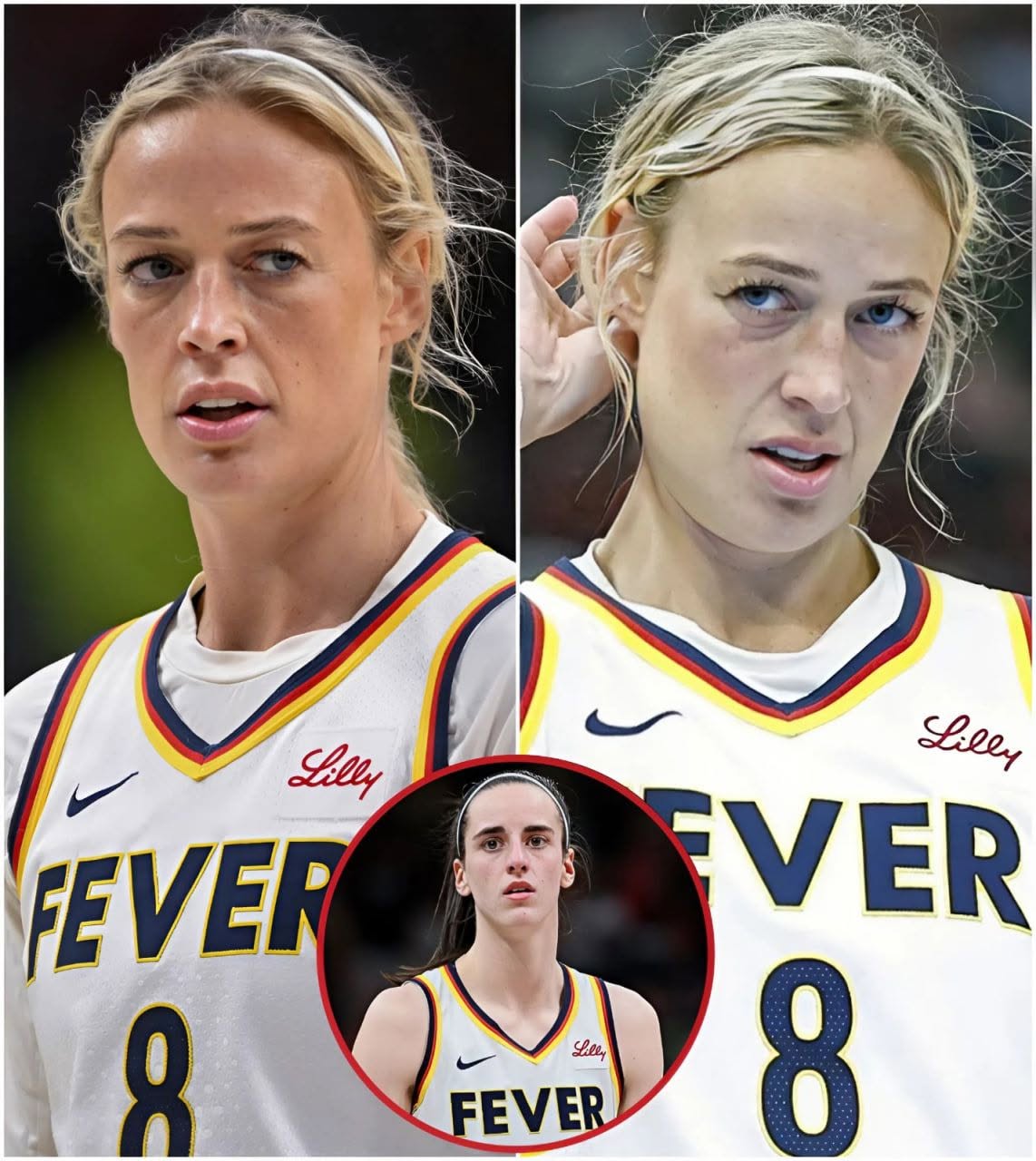
“THEY FINED HER — BUT THE REAL CONTROVERSY WAS JUST BEGINNING.” Sophie Cunningham’s Referee Battle Exposed a WNBA Debate That Wouldn’t Go Away
“THEY FINED HER — BUT LET THE DANGER SLIDE.”
A League’s Most Respected Veteran Took the Mic — and What Happened Next Split the WNBA in Two.
She didn’t need a dramatic press conference.
She didn’t need to name individual referees.
Sophie Cunningham had already made her frustration unmistakably clear.
During the 2025 season, the then-Indiana Fever guard became one of the WNBA’s most outspoken voices on officiating, repeatedly questioning what she viewed as inconsistency in the way games were being called.
And the league responded.
First came a $500 fine connected to a TikTok post criticizing referees.
Then Cunningham revealed that another round of comments had cost her $1,500.
Instead of ending the controversy, the penalties made it bigger.
Suddenly, the conversation wasn’t simply about whether one foul should have been called.
It became about a much larger question:
How much freedom should players have to publicly criticize officiating?
Cunningham’s frustration was straightforward.
On the debut episode of her Show Me Something podcast, she acknowledged that officiating is difficult and even admitted she wouldn’t want the job herself.
But then she delivered the criticism that became the center of the story.
She described the officials as “so inconsistent.”
Her argument wasn’t that referees should never make mistakes.
It was that players needed consistency.
If physical contact was allowed on one end of the floor, Cunningham believed similar contact should be permitted on the other.
If something obvious happened directly in front of an official, she wanted the call made correctly.
Those comments followed another incident that had already cost her money.
Cunningham had posted a TikTok in which she lip-synced to Sabrina Carpenter’s “Manchild,” adding text aimed at “some refs.”
The WNBA fined her $500.
Cunningham publicly laughed about the punishment and suggested there were more important issues for the league to worry about.
Then came the podcast.
And another fine.
This time, Cunningham said it was $1,500.
According to Cunningham, Fever general manager Amber Cox informed her after the league contacted the organization.
For many fans, that sequence transformed Cunningham into something larger than simply a player frustrated about a whistle.
She became part of a league-wide debate about officiating standards.
And she wasn’t alone in raising concerns.
During that period, Fever coach Stephanie White had also publicly discussed the quality of officiating, arguing that while players and teams continued improving, officials needed to improve as well.
That context mattered.
Cunningham’s criticism wasn’t occurring in isolation.
Players, coaches and fans had been debating physicality, technical fouls and inconsistent whistles throughout the season.
Indiana’s games attracted particularly intense attention.
With Caitlin Clark bringing enormous audiences to the WNBA, virtually every physical play involving the Fever superstar became a social-media debate within minutes.
Slow-motion replays circulated.
Fans analyzed contact from multiple angles.
Former players offered opinions.
Television commentators debated whether certain plays were ordinary basketball physicality or something more dangerous.
Cunningham found herself directly in the middle of that atmosphere.
Her physical altercation with Connecticut’s Jacy Sheldon became one of the most memorable examples.
During a heated Fever-Sun game, Cunningham committed a hard foul on Sheldon late in the contest and was eventually ejected after the play was upgraded to a Flagrant 2.
The incident followed earlier physical exchanges involving Sheldon and Clark.
For some Fever supporters, Cunningham’s foul immediately became symbolic.
They viewed her as someone willing to protect her teammate when officials couldn’t maintain control.
Others saw the play very differently.
To them, Cunningham had escalated the situation and deserved the punishment she received.
That disagreement captured the larger problem perfectly.
What one group called protection, another called retaliation.
What one fan considered dangerous contact, another viewed as ordinary WNBA physicality.
And standing between those interpretations were the officials.
That’s why Cunningham’s complaints resonated so strongly.
The real issue wasn’t whether every fan agreed with her.
It was whether players understood what level of contact officials would permit from one possession to another.
By 2026, Cunningham was still discussing the subject.
She joked that perhaps she deserved some of her money back after saying that players and referees had held meetings about improving officiating.
According to Cunningham, officials acknowledged in those discussions that they needed to improve.
That didn’t prove every previous complaint she made was correct.
But it demonstrated that officiating remained a subject the league’s players and referees themselves were actively discussing.
And that is where the viral version of this story needs an important correction.
There is no solid evidence supporting the more dramatic claims that Cunningham received “silence orders,” that league executives were secretly “pulling the strings,” or that another unnamed player was deliberately protected from punishment for a dangerous hit during the same week.
Those allegations require evidence.
What is documented is already compelling enough.
Cunningham criticized officiating.
The WNBA fined her.
She criticized it again.
She was fined again.
And rather than disappearing, the officiating conversation continued.
That’s what made the episode significant.
The fines could punish the comments.
They couldn’t erase the underlying debate.
By speaking publicly, Cunningham forced fans to confront a difficult question facing every professional sports league:
Where is the line between enforcing rules against public criticism of officials and allowing athletes to raise legitimate concerns about the way their games are being managed?
There isn’t an easy answer.
Officials deserve protection from personal attacks.
Players deserve consistent standards.
Coaches need clarity.
Fans want accountability.
And leagues need credibility.
Cunningham’s approach wasn’t always diplomatic.
She clearly understood that her comments could cost her money.
But she kept talking.
And months later, when discussions about improving officiating continued, the controversy that began with a $500 TikTok fine suddenly looked much bigger than one social-media post.
Because ultimately, the story wasn’t about $500.
It wasn’t even about $1,500.
It was about trust.
Trust that the whistle will mean the same thing on both ends of the floor.
Trust that dangerous plays will be handled consistently.
Trust that players understand where the boundaries are.
And trust that criticism can be separated from conspiracy.
They fined Sophie Cunningham.
But they couldn’t fine the conversation into silence.