“SHE’S JUST A BASKETBALL PLAYER.”
That explosive sentence is now being attached to Whoopi Goldberg in a viral story involving Caitlin Clark — a story that claims seven words from the WNBA superstar were enough to bring an entire television studio to a standstill.
There’s only one problem.
The dramatic confrontation itself has not been established as real.
The story spreading online describes an almost cinematic scene.
Whoopi supposedly dismisses Clark as “just a basketball player.”
Clark doesn’t immediately respond.
She sits quietly.
She listens.
She waits.
Then, according to the viral version, Whoopi continues pushing the conversation until Clark finally places her hands on the table, looks directly across the studio and delivers exactly seven words.
No shouting.
No argument.
No dramatic walkout.
Just seven words.
The story claims the room instantly goes silent.
Production staff supposedly stop moving.
Guests look toward the floor.
Even Whoopi — one of television’s most experienced hosts — allegedly has nothing to say.
It’s an extraordinary scene.
It’s also one for which there currently isn’t reliable evidence.
ABC’s recent official episode listings for The View identify guests appearing on the program, and Caitlin Clark does not appear in the recent lineup connected to this supposed viral confrontation.
There is also no authenticated full-length video establishing the exchange described in the posts.
That distinction matters.
Because the story feels believable precisely because it combines two very recognizable public figures.
Whoopi Goldberg has spent years discussing controversial topics on live television.
Clark has become one of the most intensely discussed athletes in American sports.
Put those two names together, add an inflammatory quote and a mysterious seven-word response, and the result is almost engineered for social media.
People immediately want to know:
What were the seven words?
But that question assumes Clark actually said them.
And that’s where viral storytelling can outrun reality.
A dramatic headline appears.
Another account repeats it.
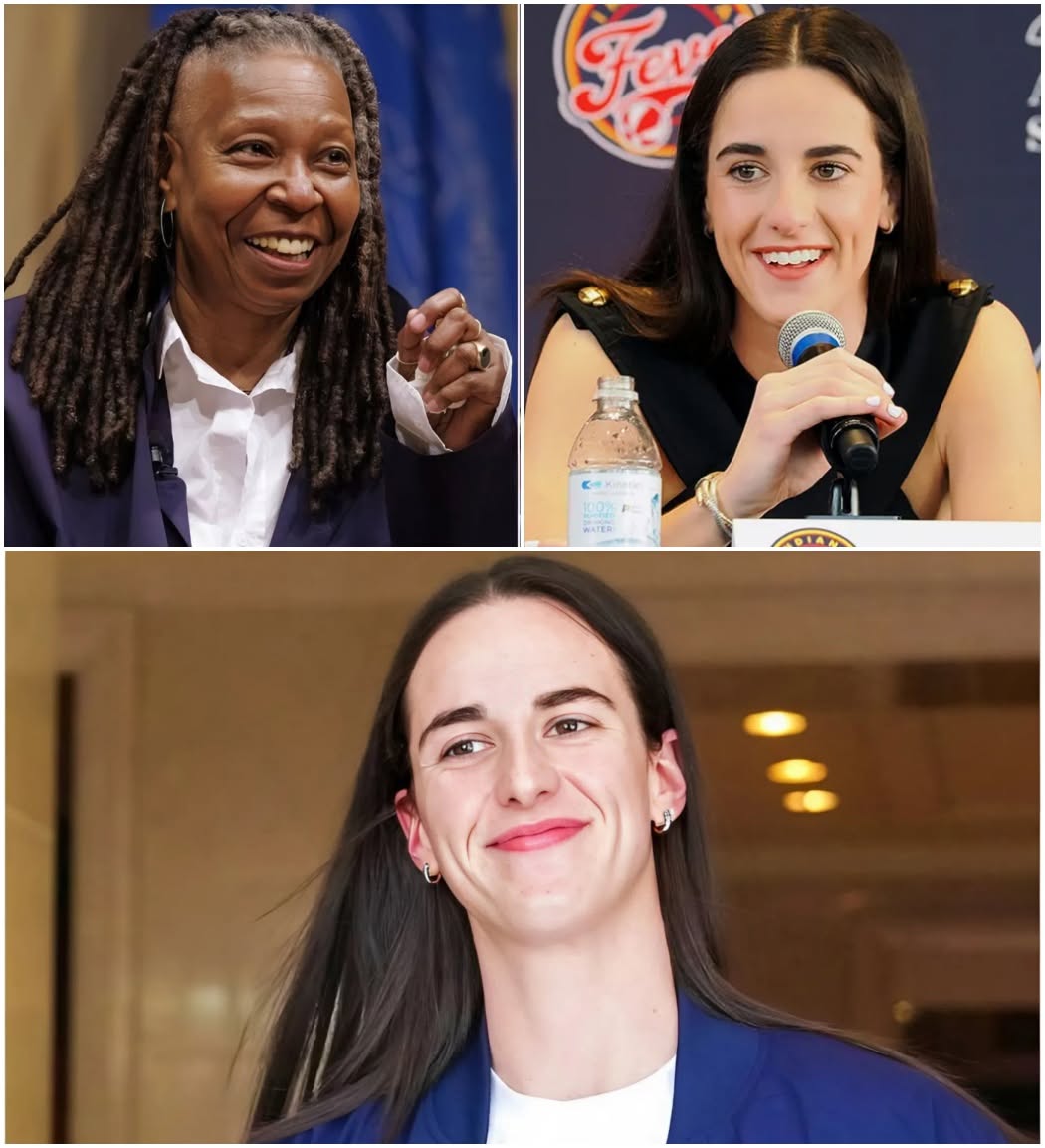
Someone creates an image showing Clark and Whoopi side by side.
Another page adds quotation marks.
A video may use unrelated footage.
Within hours, thousands of people can believe they’ve missed a television moment that never actually happened.
The irony is that Caitlin Clark doesn’t need a fictional confrontation to generate enormous attention.
Her basketball career already does that.
From her college years to professional basketball, Clark’s combination of long-range shooting, passing vision and aggressive playmaking has made her one of the most recognizable athletes of her generation.
Her games generate debate.
Her performances generate highlights.
Her struggles generate analysis.
Almost everything surrounding her becomes a conversation.
But Clark has also become something bigger in the culture surrounding women’s basketball.
People debate what her popularity means.
They debate media coverage.
They debate attendance and television audiences.
They debate rivalries.
They debate officiating.
They debate whether certain players receive too much attention or not enough.
Sometimes those discussions are thoughtful.
Sometimes they become tribal.
And sometimes completely fabricated quotes get dropped into the middle.
That’s why this Whoopi story spreads so effectively.
It taps directly into an existing argument:
Should Clark be viewed simply as an athlete, or has her influence moved beyond basketball?
There’s nothing wrong with discussing that question.
Her impact on fan interest and the enormous attention surrounding women’s basketball can be analyzed without inventing a television confrontation.
The phrase “just a basketball player” is especially provocative because professional athletes have always existed at the intersection of sports, business and culture.
Their influence can extend beyond statistics.
They sell tickets.
They attract sponsors.
They inspire young athletes.
They become fashion figures.
They appear in advertising.
And sometimes they become symbols in cultural debates they never asked to join.
Clark is experiencing that phenomenon in real time.
But that doesn’t mean every viral story involving her is true.
The alleged seven-word response is the biggest warning sign.
If a famous athlete genuinely delivered a devastating seven-word comeback on one of America’s most recognizable daytime programs, there should be something concrete to examine.
A full clip.
An official episode.
A transcript.
Credible reporting.
Instead, many versions of stories like this create suspense by refusing to reveal the supposedly unforgettable quote.
They repeatedly ask:
“What did she say?”
That technique keeps readers clicking because the answer is always somewhere else.
But if nobody can produce the original exchange, perhaps the better question is:
Did she actually say anything at all?
Whoopi Goldberg is a real person.
Caitlin Clark is a real person.
Neither should have fictional dialogue placed inside quotation marks and circulated as fact.
The same applies to claims that a director refused to say “continue,” that guests stared at the floor, or that backstage staff reacted in shock.
Those details make the scene vivid.
They don’t make it verified.
And the claim that Clark was labeled “a symbol of the wrong era” also requires an identifiable source before being attributed to anyone.
This doesn’t make the broader conversation less interesting.
Actually, the truth raises an even bigger question about modern celebrity culture.
Why are audiences so prepared to believe the confrontation happened?
Partly because conflict travels.
A normal interview might receive thousands of views.
A supposedly explosive confrontation can receive millions.
“Clark discusses basketball with Whoopi Goldberg” isn’t particularly dramatic.
“Clark DESTROYS Whoopi with seven words and freezes the studio” is built for algorithms.
One informs.
The other provokes curiosity, anger and tribal reaction.
And those emotions drive engagement.
Clark’s actual career doesn’t need that embellishment.
Neither does Goldberg’s television career.
If they eventually sit across from each other and have a genuine disagreement, audiences can watch the real exchange and decide for themselves what it means.
Until then, the legendary “seven words” remain exactly what the evidence suggests:
An unanswered element of an unverified viral story.
So what did Caitlin Clark say that supposedly left Whoopi Goldberg speechless?
Right now, there isn’t credible evidence showing that this dramatic exchange happened in the first place.
And sometimes the most revealing thing about a viral story isn’t the comeback everyone is waiting to hear.
It’s how quickly millions of people can start debating words nobody has proved were ever spoken.
#CaitlinClark #WhoopiGoldberg #IndianaFever #WNBA #TheView #CaitlinClarkFans #WNBANews #Basketball #ViralNews