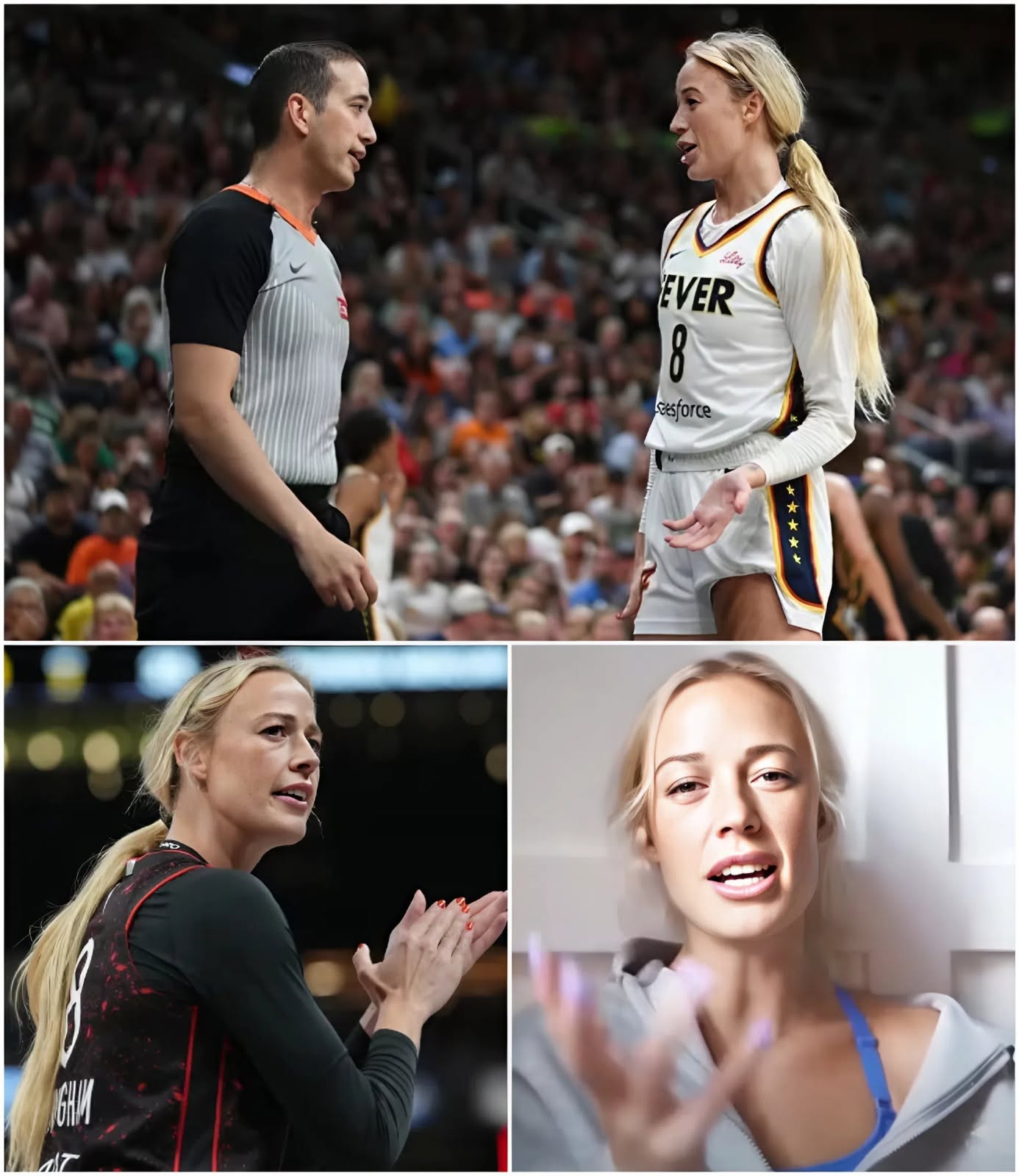
“SHE DIDN’T SNAP DURING THE GAME — SHE WAITED UNTIL THE CAMERAS WERE OFF.”
SOPHIE CUNNINGHAM GOES OFF AFTER FEVER’S CONTROVERSIAL LOSS TO DALLAS — AND HER COMMENTS ABOUT WNBA OFFICIATING IGNITED A FIRESTORM. 🔥🏀
She didn’t explode on the court.
She didn’t storm toward the officials.
She didn’t turn the postgame press conference into a shouting match.
Sophie Cunningham waited.
Then, away from the immediate chaos of the game, she said what was bothering her.
And the comments quickly traveled across the WNBA world.
The controversy traced back to Indiana’s razor-thin 81–80 loss to the Dallas Wings, a game that left Cunningham frustrated with how the contest had been officiated.
Her biggest complaint centered on the whistle surrounding Dallas star Paige Bueckers.
But Cunningham made one thing very clear before criticizing the officiating:
Her frustration wasn’t with Paige.
In fact, she praised her.
“I love Paige to death,” Cunningham said on her podcast, adding that Bueckers is an outstanding player whom she would even like to play alongside someday.
Then came the criticism.
According to Cunningham, the officials were giving Bueckers “every freaking whistle.”
She argued that defenders could barely touch the Dallas guard without risking a call.
And that’s where the conversation became much bigger than one player.
Cunningham’s point wasn’t that Bueckers didn’t deserve respect from officials.
Her argument was that Indiana’s players deserved the same standard.
If contact was going to produce whistles on one end of the floor, Cunningham wanted comparable contact called on the other.
That’s the frustration that fueled the controversy.
And Cunningham wasn’t alone in questioning the consistency.
Fever coach Stephanie White also publicly discussed what she viewed as a double standard in officiating, specifically pointing toward how Kelsey Mitchell and Aliyah Boston were defended.
For Cunningham, however, speaking publicly carried consequences.
She later revealed that the league had fined her over her comments.
It wasn’t even unfamiliar territory.
Cunningham joked that she had become “3-for-3” when it came to being fined by the WNBA.
That reaction tells you almost everything about her public personality.
She knows speaking openly can cost her.
She speaks anyway.
And that’s exactly why Cunningham has developed such a passionate following among certain Fever fans.
She isn’t interested in delivering perfectly polished answers every time a microphone appears.
When she’s frustrated, people usually know.
When she believes something isn’t right, she’s willing to say it.
That willingness has repeatedly placed her directly in the middle of debates surrounding WNBA officiating.
And it hasn’t stopped with Dallas.
Cunningham has also publicly criticized how officials and the league handle physical contact involving Caitlin Clark.
After a separate incident involving Clark and Phoenix’s Alyssa Thomas in 2026, Cunningham argued on her podcast that Clark was being targeted and that the league and referees weren’t doing enough to protect her.
Those comments generated another major discussion about physicality, officiating and player safety.
For Cunningham, there appears to be a consistent theme:
She wants consistency.
If something is a foul for one superstar, she believes comparable contact should be a foul for everyone.
If dangerous contact occurs, she wants officials to recognize it.
And when she believes that isn’t happening, she’s shown very little hesitation about saying so publicly.
That doesn’t automatically make every criticism correct.
Refereeing basketball is incredibly difficult.
Officials make decisions in fractions of a second while ten elite athletes move at extraordinary speed.
Fans watching slow-motion replays from several camera angles have advantages referees simply don’t have in real time.
There will always be disputed calls.
There will always be missed calls.
And there will always be disagreements over whether stars receive favorable whistles.
But Cunningham’s comments tapped into something bigger.
Consistency.
That’s what players want.
That’s what coaches want.
That’s what fans want.
They don’t expect every referee to be perfect.
They expect the same standard to apply at both ends.
And when a game is decided by a single point, every whistle becomes magnified.
One foul can change a possession.
One free throw can change the score.
One no-call can change momentum.
That’s why an 81–80 game naturally produces scrutiny.
But some of the viral storytelling surrounding Cunningham’s comments has gone far beyond what has actually been established.
There is no reliable evidence that she accused officials of literally “rigging” the Fever loss.
There is no confirmed quote showing her saying the league “protects narratives more than players.”
And there is no credible evidence that WNBA officials threatened to blacklist her.
Those details shouldn’t be confused with what Cunningham actually said.
The confirmed story is already provocative enough.
She criticized the officiating.
She specifically questioned the whistle Paige Bueckers was receiving.
She argued Indiana deserved comparable treatment.
And she subsequently revealed that the league fined her.
That is real.
And it illustrates the difficult line professional athletes walk when publicly criticizing officials.
Stay quiet, and fans may accuse you of accepting unfair treatment.
Speak up, and the league can discipline you.
Cunningham clearly chose the second path.
Whether people agree with her interpretation of the game or not, there’s little question that her willingness to speak openly has become part of her identity.
Some fans see that as reckless.
Others see authenticity.
Some believe players should handle officiating complaints privately.
Others argue public criticism is sometimes necessary to force attention toward recurring problems.
That debate isn’t disappearing.
Neither is Cunningham.
Every time she speaks publicly about officiating, the reaction demonstrates how closely fans are watching the league.
And perhaps that’s the most important takeaway from the entire controversy.
Sophie Cunningham didn’t need to accuse anyone of “rigging” a game to start a firestorm.
She simply said she believed the whistle wasn’t consistent.
The league responded with a fine.
Fans responded with debate.
And Cunningham?
She made it clear that being fined wasn’t necessarily going to make her stop talking.
That’s what makes the story compelling.
Not an invented conspiracy.
Not a supposed secret blacklist.
Just an outspoken player willing to criticize something she believes needs to improve — even when she knows there may be a price attached.
One game. One point. One outspoken player. And a debate about WNBA officiating that refuses to disappear. 🔥
#SophieCunningham #IndianaFever #WNBA #Fever #WNBARefs #PaigeBueckers #DallasWings #WNBANews #WomensBasketball
❤️ Follow our page for more daily Sophie Cunningham photos, videos, and WNBA highlights!