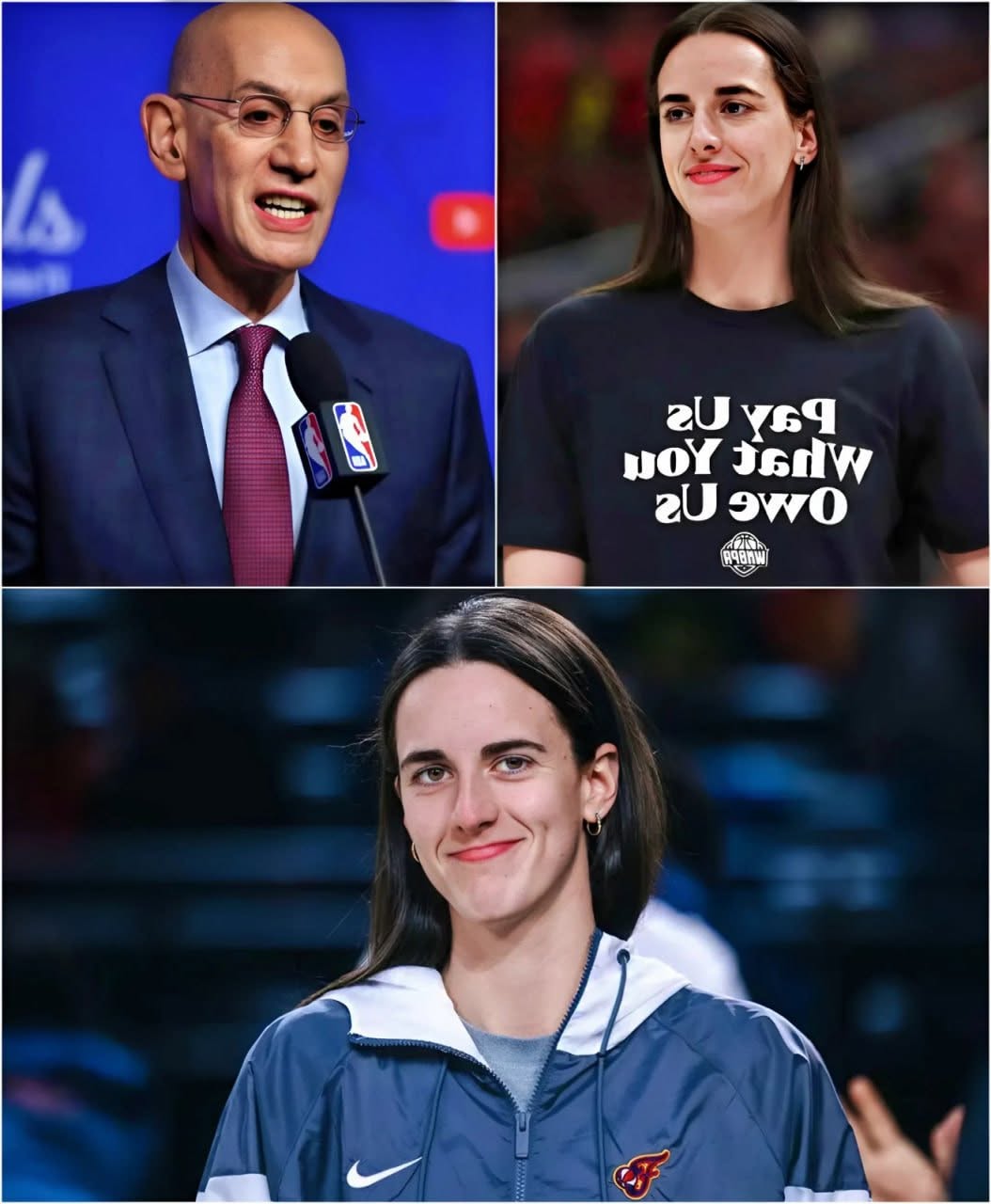
🚨 “This rotten system…” — Adam Silver EXPOSES WNBA Referees in a Massive Leak — and what he uncovered may end Cathy Engelbert’s career.
“It’s part of the game,” they said.
“She needs to learn how to take hits like a grown-up.”
They called it toughness.
They called it normal.
But that moment has passed.
Now — it’s the truth’s turn to speak.
The WNBA officiating scandal has officially detonated.
And the one taking action?
Not a player.
Not a coach.
But Adam Silver — the man now pointing directly at Cathy Engelbert in a first-of-its-kind internal investigation.
Caitlin Clark wasn’t just mistreated.
She was targeted.
Deliberately. Systematically.
And Silver?
He’s holding the file.
He’s no longer silent.
He’s not backing down.
He has pierced through every excuse, every slogan, every “nothing to see here” press release the league has clung to for months.
He’s never spoken like this before.
But now?
He’s done staying quiet.
That is the explosive version of the story spreading online. But behind the dramatic claims is a real controversy—and the documented version is complicated enough without inventing a secret file.
Adam Silver has publicly acknowledged problems with WNBA officiating. In July, amid intense debate surrounding the physical treatment of Caitlin Clark, the NBA commissioner said there was “no doubt” that WNBA officiating needed improvement.
But Silver did not announce that referees had deliberately targeted Clark.
He did not publicly reveal a dossier proving systematic misconduct.
And there is no reliable evidence establishing the supposed “massive leak” described in viral posts.
What did happen was significant.
During a June game involving Indiana and Phoenix, Alyssa Thomas made contact with Clark’s throat. No foul was called during the play, but the league later assessed a Flagrant 2 and suspended Thomas for one game for reckless contact.
Then the story became considerably more controversial.
Sports Business Journal reported, citing multiple sources, that Engelbert initially wasn’t planning to suspend Thomas and that Silver urged her to impose discipline. The WNBA strongly disputed that account, calling the report “absolutely false.” Silver himself declined to confirm whether he intervened.
That disagreement alone was enough to ignite fans.
Because the argument wasn’t simply about one foul anymore.
It was about accountability.
How does the league evaluate dangerous contact?
How consistent are those standards?
What happens when officials miss something significant during a game?
And how much transparency should fans receive afterward?
Those questions returned with enormous force during Indiana’s playoff elimination against Las Vegas on October 2.
Clark was struck in the mouth by an elbow while battling for a rebound. No foul was called, and Clark left the court bleeding before returning and confronting an official about what had happened. Fever coach Stephanie White was also visibly frustrated as the game continued following Clark’s injury.
For already frustrated Fever fans, the images were combustible.
Clark bleeding.
No whistle.
Another officiating controversy.
Another argument about whether the league was adequately protecting its stars.
But even those disturbing images do not prove that officials deliberately targeted Clark.
That is where the viral narrative goes beyond the available evidence.
Bad officiating and intentional corruption are fundamentally different accusations.
One can be demonstrated through missed calls, inconsistent standards and poor evaluation.
The other requires evidence of intent.
No credible evidence currently establishes that WNBA referees collectively conspired to harm Clark or diminish her success.
Silver himself has actually pushed against reducing the entire Clark debate to officiating.
Speaking publicly in July, he described Clark as an “incredible player” and said she had unfairly become a “political football.” He argued that the controversy surrounding her had grown into something much larger than individual whistles.
That doesn’t erase legitimate officiating criticism.
If anything, it makes the issue more important.
The WNBA is operating under extraordinary scrutiny.
Clark has helped bring huge attention to women’s basketball, and every controversial collision involving her is now analyzed frame by frame.
Fans expect consistency.
Players expect protection.
Coaches expect accountability.
And officials deserve evaluation based on what actually happened rather than accusations unsupported by evidence.
This is where transparency becomes critical.
If an official misses a dangerous foul, acknowledge the mistake when appropriate.
If replay demonstrates that a controversial no-call was correct, explain the standard.
If officiating performance isn’t meeting league expectations, improve training and review procedures.
Because unanswered questions create space for something much harder to control:
Conspiracy theories.
And once supporters begin believing the outcome isn’t simply affected by human error but by deliberate manipulation, confidence in competition can deteriorate rapidly.
There is also an important update to the Engelbert part of the viral narrative.
Her WNBA tenure is already scheduled to end on December 31, 2026. Reporting on her departure describes a complicated legacy: enormous league growth and expansion alongside persistent criticism over communication with players and other league issues.
So claims that this supposed Silver “leak” could suddenly end her career distort what is actually known.
The real story doesn’t need a secret conspiracy.
There are already serious questions worth asking.
How can WNBA officiating improve?
How should dangerous missed calls be handled?
How much postgame transparency should the league provide?
And how can the WNBA protect every player—not merely its biggest stars—without removing the physicality that defines professional basketball?
Those are questions Adam Silver, WNBA leadership, officials, coaches and players cannot solve through viral headlines.
They require evidence.
Accountability.
Consistency.
And transparency.
Caitlin Clark doesn’t need an imaginary secret file to make the officiating conversation matter.
The footage fans can actually see is already enough to keep that conversation alive.
And after another controversial moment left one of basketball’s biggest stars walking off the floor with blood on her mouth, the demand for answers isn’t disappearing anytime soon.