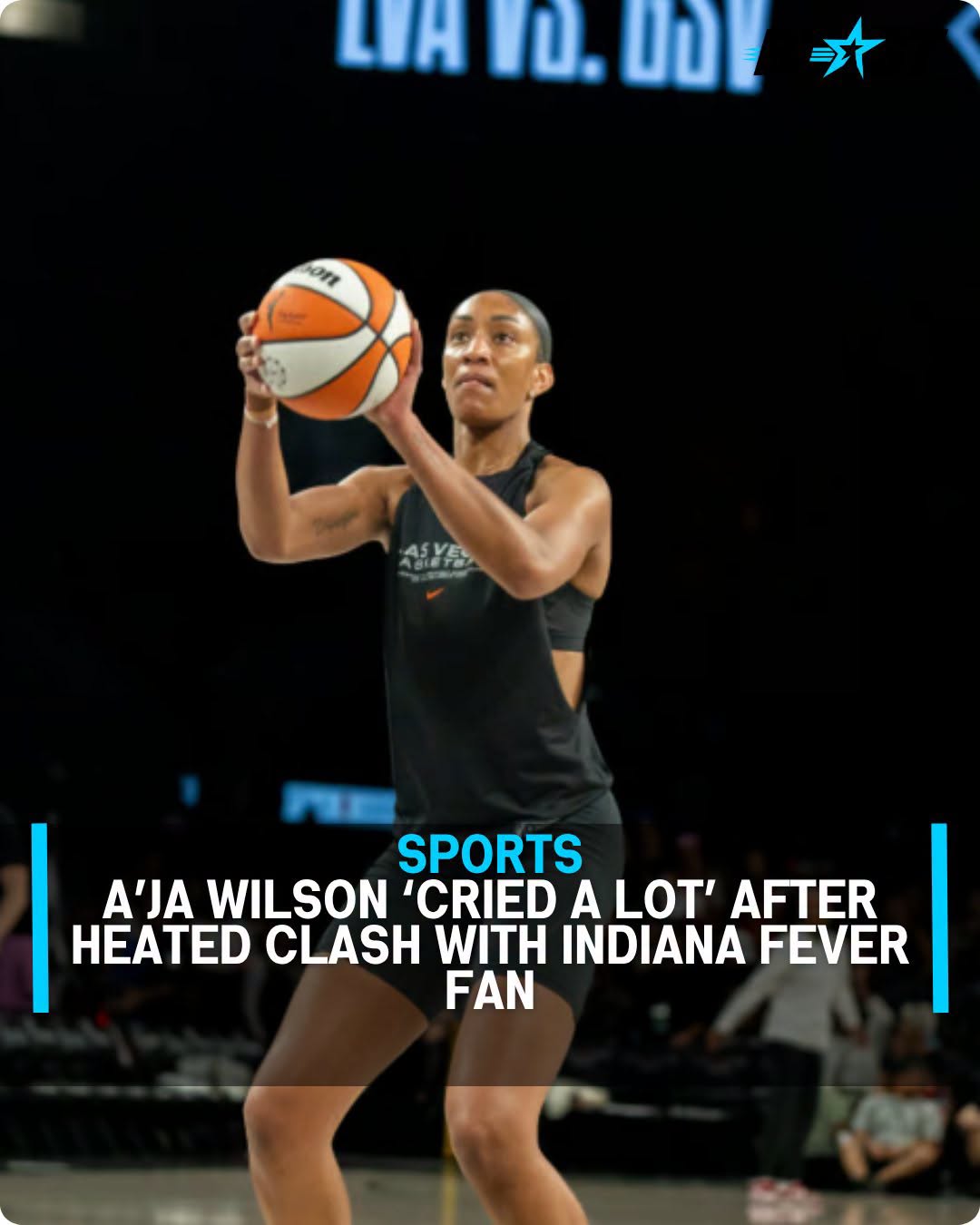
💔 A’ja Wilson Reveals She “Cried a Lot” After Heated Clash With Indiana Fever Fan — Then Responded When Her Team Needed Her Most
A’ja Wilson is opening up about the emotional toll of her heated clash with an Indiana Fever fan — and it affected her far more than fans may have realized. 💔🏀 The WNBA superstar admitted she “cried a lot” after the tense confrontation, before finding a way to refocus when her team needed her most.
Was A’ja right to stand her ground during the incident?

Behind the anger, pointing and technical foul was an emotional aftermath that television cameras couldn’t fully capture.
A’ja Wilson has now revealed just how deeply the controversial confrontation with an Indiana Fever fan affected her after Game 2 of the WNBA playoff series between the Las Vegas Aces and Indiana Fever.
And her admission was remarkably vulnerable.
“I cried a lot.”
The confrontation occurred late in Game 2 at Gainbridge Fieldhouse in Indianapolis.
After Wilson and Fever player Sophie Cunningham became involved in a physical sequence, a male fan seated near the baseline stood and pointed toward Wilson.
Wilson noticed.
Instead of walking away, she approached the area and pointed back as teammates and others moved between her and the spectator.
The situation quickly became one of the biggest talking points of the game.
Wilson received a technical foul.
Security temporarily removed the fan and a companion from their seats, although they were later permitted to return after arena security determined that no Fan Code of Conduct violation had occurred.
Wilson, meanwhile, made it clear afterward that she believed a boundary had been crossed.
She said she objected to a man stepping toward her and pointing at her, describing the behavior as unacceptable.
At the same time, Wilson acknowledged that receiving the technical foul hurt her team and apologized to her teammates for that part of the incident.
That combination is important.
Wilson wasn’t saying that every aspect of her reaction was perfect.
She was saying she believed she had the right to defend a personal boundary while also accepting the basketball consequences of how she reacted.
The WNBA subsequently reviewed the incident and did not suspend Wilson for Game 3.
The league determined that she remained within the designated player escape lane during the confrontation.
But avoiding additional punishment didn’t mean the incident simply disappeared.
Online reaction exploded.
Some fans supported Wilson, arguing that players shouldn’t have to tolerate spectators aggressively approaching or gesturing toward them simply because they bought a ticket.
Others believed Wilson overreacted and should have ignored the fan rather than risk a technical foul during a playoff game.
Then came Wilson’s revelation about what happened away from the cameras.
Following Las Vegas’ Game 3 victory, she acknowledged that the controversy had taken an emotional toll.
Wilson explained that she had her moment because she was human.
But she eventually realized she couldn’t allow the situation to become a distraction to herself or her teammates.
Then came the words that changed the tone of the entire conversation:
“I prayed a lot. I cried a lot.”
Wilson also said she spoke with many people and received an outpouring of support, including Bible verses that helped remind her that she was surrounded by people who cared about her.
It was a striking admission from one of basketball’s most dominant players.
Sports fans often see athletes at their most powerful.
They see the points.
The rebounds.
The championships.
The celebrations.
They see Wilson battling defenders, absorbing contact and carrying enormous expectations.
What they rarely see is what happens hours later.
When the arena empties.
When the adrenaline disappears.
When thousands of comments begin arriving.
When a ten-second confrontation becomes a national conversation.
Wilson’s comments offered a glimpse behind that curtain.
But she still had another basketball game to play.
And not just another game.
A decisive Game 3.
Las Vegas’ season was on the line.
Whatever Wilson felt emotionally, she had to find a way to put it aside long enough to compete.
She did exactly that.
Wilson erupted for 36 points and 10 rebounds as Las Vegas defeated Indiana 94–83 and advanced to the next round.
That performance doesn’t automatically prove Wilson was right about everything that happened with the fan.
Basketball statistics don’t settle questions about appropriate behavior.
But they do reveal something about her ability to compartmentalize.
She went from crying and processing an emotionally charged controversy to delivering the biggest performance of the series when elimination was staring her team in the face.
And that’s where the story becomes more complicated than the viral clip.
Was Wilson right to confront the fan?
Reasonable people can watch the footage and reach different conclusions.
One side will argue that professional athletes should walk away from spectators whenever possible. Engaging with a fan can escalate a situation, create safety concerns and potentially hurt the team through technical fouls or suspensions.
That argument has merit.
Wilson herself apologized for the technical.
But there’s another principle involved.
Buying a courtside ticket doesn’t eliminate boundaries.
Fans can cheer.
They can boo.
They can disagree with calls.
They can support their team loudly.
But athletes don’t surrender their right to feel safe or respected simply because they’re performing in public.
Wilson believed the fan’s movement and pointing crossed that boundary.
The fan was briefly escorted away, though arena security ultimately found no violation and allowed the spectators to return.
Those two facts can exist simultaneously.
Wilson can genuinely have felt threatened or disrespected while security, applying its own standards after reviewing the situation, can reach a different conclusion about whether the fan violated arena policy.
That nuance disappeared quickly online.
Instead, people chose sides.
Wilson was either completely justified or completely wrong.
The fan was either harmless or threatening.
Reality rarely fits so neatly into social-media arguments.
Perhaps the most revealing part of Wilson’s response wasn’t what happened during the confrontation at all.
It was what happened afterward.
She admitted the incident hurt.
She cried.
She prayed.
She leaned on people around her.
Then she walked back onto the court with her team’s season at stake.
Thirty-six points later, Las Vegas was moving on.
That doesn’t end the debate over the confrontation.
But it does add an important piece that wasn’t visible in the original clip.
Behind one of the WNBA’s fiercest competitors was a human being trying to process an ugly moment while preparing for one of the biggest games of her season.
Was A’ja Wilson right to stand her ground — or should she have simply walked away?