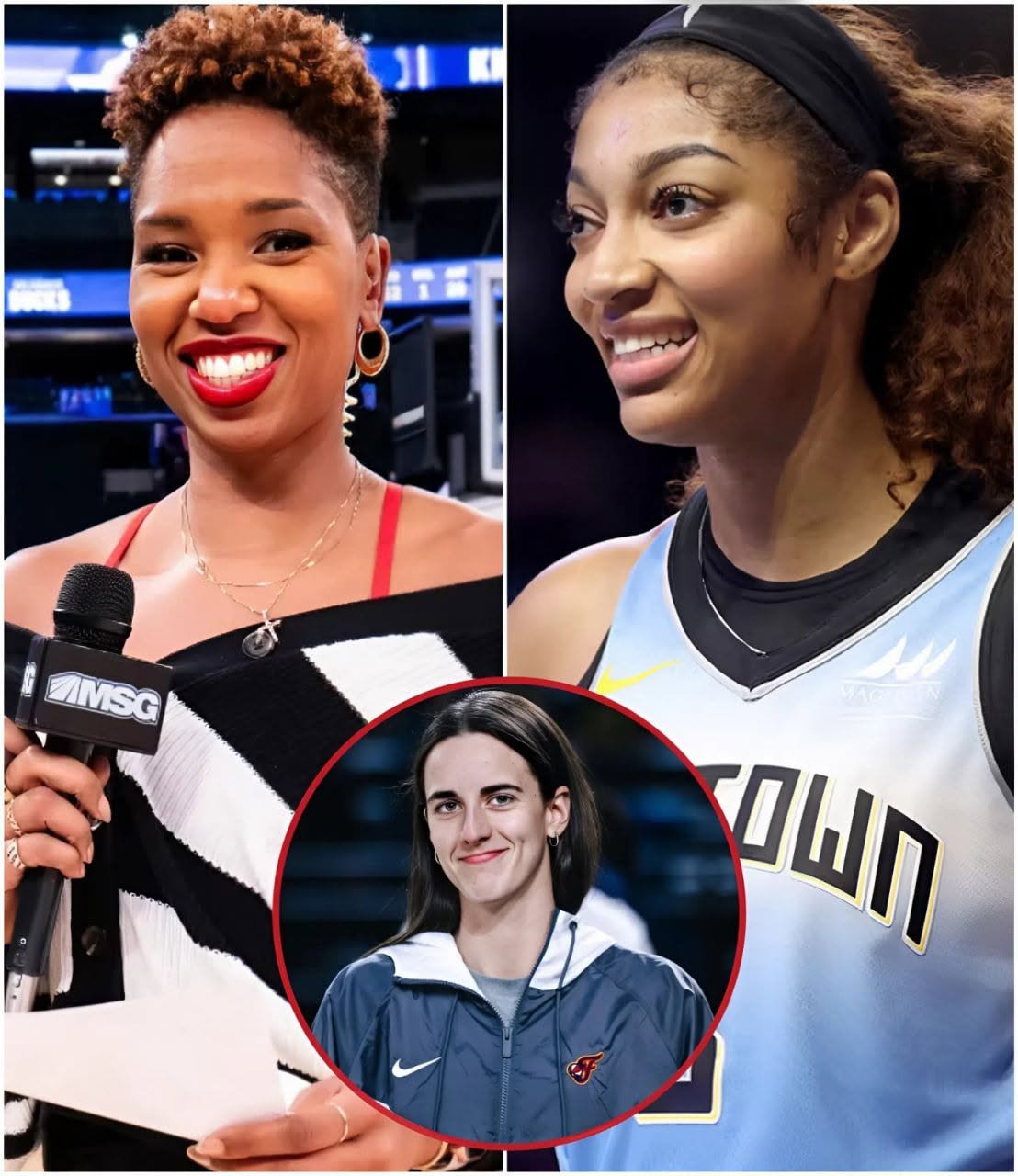
“IF ANGEL REESE WERE WHITE, SHE’D BE No.1 — NOT No.13.” — The Explosive Quote Going Viral Has Put Angel Reese’s All-Star Debate Under an Even Bigger Microscope
“IF ANGEL REESE WERE WHITE, SHE’D BE No.1 — NOT No.13.”
That sentence has been circulating online alongside the names of ESPN analyst Monica McNutt and Angel Reese, packaged as the kind of live-television bombshell capable of freezing an entire studio.
The viral version is dramatic.
No one claps.
Nobody interrupts.
Reese supposedly looks stunned.
The hosts attempt to move forward, but the comment has already escaped into the internet, where it immediately becomes bigger than whatever conversation supposedly produced it.
There’s just one major problem.
There is currently no reliable evidence establishing that McNutt actually delivered that exact statement on live television.
And some of the statistics being attached to the viral story don’t match the WNBA’s official numbers either.
That doesn’t mean there isn’t a fascinating Angel Reese debate.
There absolutely is.
But the real story is more complicated—and arguably more interesting—than the viral version.
Reese was one of the biggest names in the 2026 WNBA All-Star voting conversation.
Early fan returns showed her seventh overall with 204,643 votes and among the most popular frontcourt players in the league. In the second returns, she had climbed to 470,748 votes.
But she did not ultimately lead the fan vote.
According to the WNBA’s official starter results, Reese finished sixth among frontcourt players in the fan ranking.
And this is where the controversy becomes genuinely interesting.
She also ranked sixth among frontcourt players in media voting.
And sixth among players.
Sixth.
Sixth.
Sixth.
Her weighted score was 6.0.
Natasha Howard, who claimed the final frontcourt starting position, finished with a weighted score of 5.75.
That means Reese missed a starting position by an extraordinarily narrow margin.
She wasn’t ignored.
She wasn’t buried at No. 13.
And she wasn’t rejected despite supposedly dominating every voting category.
She simply landed immediately outside the starting group under the league’s voting formula.
That distinction matters.
But so does what happened afterward.
Reese still became an All-Star.
She was selected to the roster and eventually drafted sixth by Team Spoon.
And her season only became more impressive from there.
By the end of the 2026 regular season, Reese had produced numbers impossible to dismiss.
She averaged 16.4 points and a league-leading 12.1 rebounds across 43 games.
She recorded 32 double-doubles.
She finished with a record-setting 521 rebounds.
She added 77 steals.
And the Atlanta Dream’s defensive performance helped strengthen her case as one of the league’s most impactful players.
The result?
Angel Reese was named the 2026 WNBA Defensive Player of the Year, receiving 46 of 74 votes from the panel of sportswriters and broadcasters.
That’s the context that makes the earlier All-Star starter debate worth revisiting.
Not because an unverified quote proves Reese was treated unfairly because of race.
It doesn’t.
And not because one voting result proves the opposite either.
It doesn’t.
The real question is how basketball performance, popularity, media narratives and public perception intersect around one of the league’s most polarizing young stars.
Few WNBA players generate reactions as intense as Reese.
Her supporters see elite rebounding, relentless effort, defensive versatility and an unmistakable ability to affect games without needing to dominate scoring.
Her critics frequently focus on offensive efficiency, missed shots around the rim or the enormous social-media attention surrounding her.
Both conversations can become exaggerated.
A bad possession becomes proof that she “can’t play.”
A great game becomes proof that every critic was wrong about everything.
Reality is rarely that simple.
And race is an especially serious dimension to introduce without evidence.
If McNutt—or anyone else—actually argues publicly that racial bias affected Reese’s ranking, that argument can be examined on its merits.
What evidence did they present?
Which voting group supposedly demonstrated the bias?
How did comparable players rank?
Did media, players and fans evaluate Reese differently?
Those are questions worth discussing.
But attributing a highly inflammatory racial statement to a real broadcaster without an authenticated clip or transcript doesn’t advance that conversation.
It distorts it.
Ironically, the official voting data provides a much stronger foundation for debate.
Reese’s rankings were remarkably consistent.
Fans: sixth.
Media: sixth.
Players: sixth.
That doesn’t look like one voting constituency dramatically sabotaging her while another overwhelmingly supported her.
It looks like a player positioned almost exactly on the starter boundary across all three groups.
And she missed.
Barely.
Then she went out and produced a season that strengthened her résumé considerably.
That’s basketball’s answer to controversy.
Keep playing.
Keep rebounding.
Keep defending.
Keep building the case.
Months after missing that starting position, Reese wasn’t merely another social-media argument.
She was the league’s Defensive Player of the Year.
And perhaps that’s the most compelling version of this story.
Angel Reese didn’t need an invented television confrontation to make people reconsider where she belonged.
Her performance eventually forced that conversation all by itself.
The viral quote may keep spreading because controversy travels faster than context.
But the official numbers tell a different story.
Reese wasn’t No. 13.
She didn’t lead every category.
And there is no reliable confirmation that Monica McNutt delivered the explosive racial quote now being attributed to her.
What can be documented is more straightforward:
Angel Reese came painfully close to becoming an All-Star starter.
Then she kept playing.
She kept producing.
She broke records.
And by the end of the season, she had earned one of the biggest individual honors in the WNBA.
Maybe the most powerful argument for Angel Reese was never something anybody said on television.
Maybe it was what she did on the court. 🏀🔥