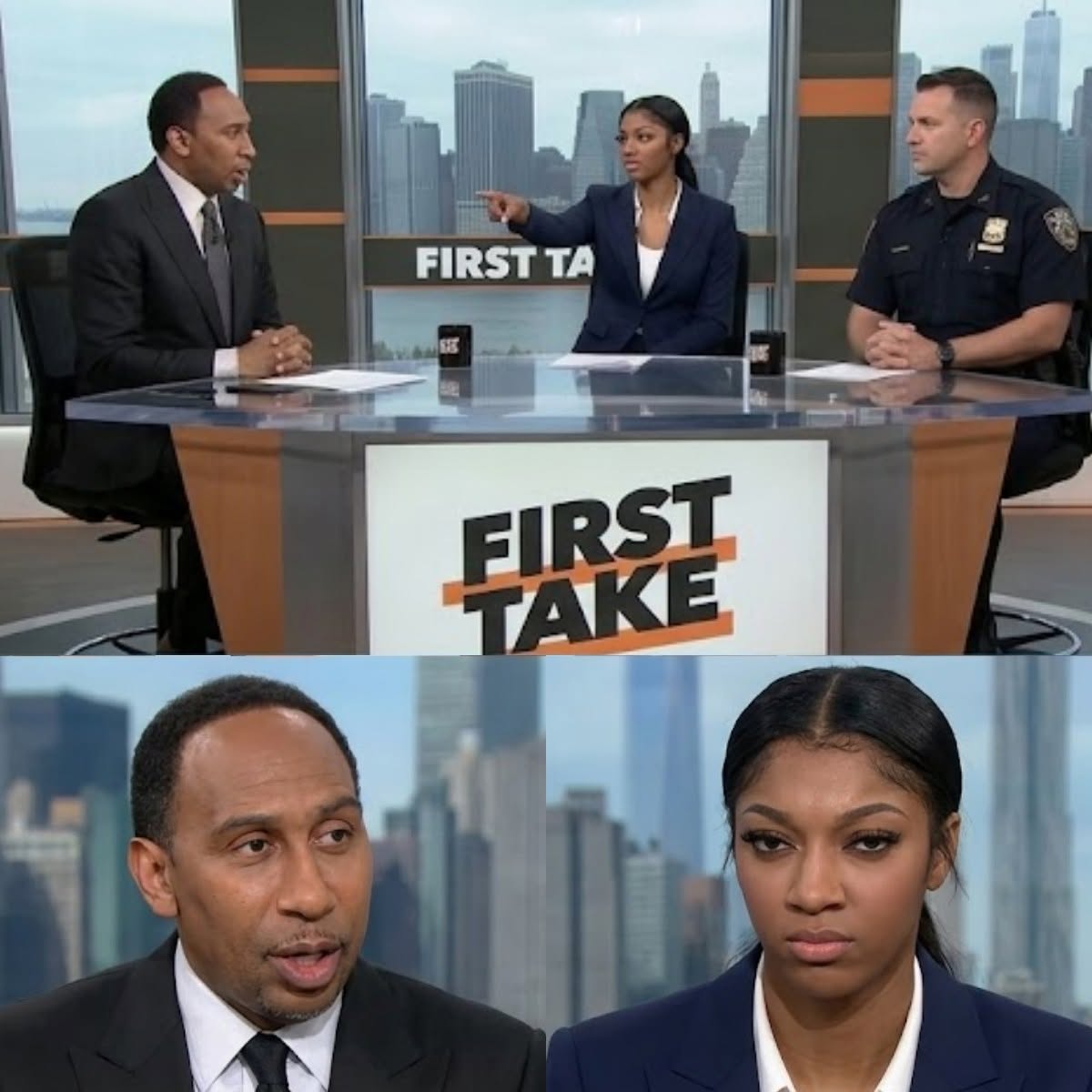
🚨 ESPN SHOCKER: Angel Reese of the Chicago Sky Defiantly Walks Off First Take Set After Heated Live Confrontation — But Did the Explosive Exchange Actually Happen?
Chicago Sky standout Angel Reese supposedly walked onto the First Take set with her trademark confidence and poise — unaware that minutes later, one of the most explosive confrontations in sports television was about to unfold.
At least, that’s the story now spreading online.
According to the viral version, no script anticipated what happened.
No control room could contain it.
And everything supposedly reached breaking point when Stephen A. Smith slammed his hand against the desk and shouted:
“SOMEBODY CUT HER MIC — NOW!”
Reese allegedly refused to retreat.
“LISTEN CLOSELY, STEPHEN A.,” she supposedly responded.
The confrontation escalated until Reese calmly unclipped her microphone, placed it on the desk and walked away.
It’s an extraordinary scene.
There’s only one enormous problem:
There is no reliable evidence that this exchange actually happened.
No authenticated ESPN broadcast matching the confrontation has surfaced.
There is no verified full-length First Take segment showing Reese making these statements.
And the dramatic quotations attributed to both Reese and Smith should not be treated as authentic without an original broadcast or credible reporting establishing their source.
The reason the fictionalized confrontation sounds so believable, however, is much more interesting.
Because the tension between Reese and Smith is not entirely imaginary.
The two really have become involved in a very public disagreement.
During the 2025 WNBA season, Smith discussed Reese while arguing about WNBA compensation and the commercial opportunities available to players.
His comments about Reese’s appearance drew significant criticism.
Reese responded publicly on social media.
“It’s literally a man that has daughters,” she wrote while criticizing Smith for discussing her in that manner.
The disagreement didn’t simply disappear.
Smith later defended himself and argued that Reese had misrepresented the context of his comments.
So when a dramatic story appeared portraying Reese confronting Smith face-to-face on First Take, audiences were already primed to believe it.
The ingredients were there.
A famous athlete who rarely avoids controversy.
A television personality whose career is built around forceful debate.
A genuine history of disagreement.
And a sports-media environment where confrontations routinely become viral clips.
Combine those ingredients, and the fabricated dialogue almost writes itself.
But the real story is already compelling enough.
Reese has become one of the WNBA’s most polarizing personalities.
Some fans love her confidence.
Others criticize it.
She has never appeared particularly interested in satisfying either group.
From her college career at LSU to her arrival with the Chicago Sky, Reese has embraced an identity centered on competitiveness and unapologetic self-belief.
That personality helped make her famous.
It also guarantees that virtually anything involving her can become controversial.
Smith operates similarly from the opposite side of the desk.
His job is to generate sports discussion.
He speaks forcefully.
He makes provocative arguments.
And First Take has spent years building its identity around disagreement.
A genuine Reese-Smith debate would therefore immediately attract attention.
But that is precisely why verification matters.
The supposed exchange contains every ingredient designed to maximize engagement.
Smith loses control.
Reese remains calm.
Producers panic.
The studio freezes.
Someone tries to intervene.
Reese delivers the perfect final line.
Then she removes her microphone and walks away just before the commercial break.
It’s almost cinematic.
Perhaps too cinematic.
Real television arguments are usually messier.
People interrupt each other.
Sentences overlap.
Arguments wander.
The perfect viral confrontation, by contrast, tends to have perfectly constructed dialogue and an emotionally satisfying ending.
Reese’s supposed final message illustrates the problem.
“I don’t respect environments that confuse volume with authority.”
It’s an excellent line.
It’s also exactly the type of quote that should immediately make readers ask:
Where is the video?
If an active WNBA star said something that explosive directly to Stephen A. Smith on ESPN before walking off First Take, there would almost certainly be multiple recordings.
Sports outlets would report it.
ESPN’s own platforms would have evidence of the segment.
Viewers would upload clips from different angles and timestamps.
The original footage would be easy to locate.
Without that evidence, the story remains a dramatic internet narrative rather than a documented television event.
Still, underneath the fictionalized confrontation is a legitimate issue.
Athletes increasingly control their own platforms.
They have podcasts.
YouTube channels.
Social-media audiences numbering in the millions.
They no longer depend entirely on traditional television networks to tell their stories.
That changes the balance of power between athletes and commentators.
A player who believes an analyst has misrepresented her can respond instantly.
She doesn’t need an invitation to the studio.
Reese has already demonstrated that.
When she disagreed with Smith, she responded publicly.
Smith responded back.
Millions watched the disagreement unfold without the two needing to sit across from each other at a television desk.
Perhaps that’s why the imagined walk-off became so appealing.
It transformed an existing media disagreement into the confrontation audiences wanted to see.
Reese versus Smith.
Athlete versus commentator.
Personal experience versus television analysis.
And then the perfect dramatic ending:
She doesn’t scream.
She doesn’t throw anything.
She simply removes the microphone and leaves.
But compelling storytelling isn’t the same thing as reporting.
Until authentic footage or reliable documentation establishes otherwise, the alleged First Take walk-off should not be presented as something viewers actually witnessed.
The real Reese-Smith disagreement already tells us plenty about modern sports media.
Athletes are pushing back.
Commentators are defending their analysis.
Fans are choosing sides.
And social media is increasingly erasing the boundary between what actually happened and what sounds like it should have happened.
Sometimes the most viral moment on television never happened on television at all.