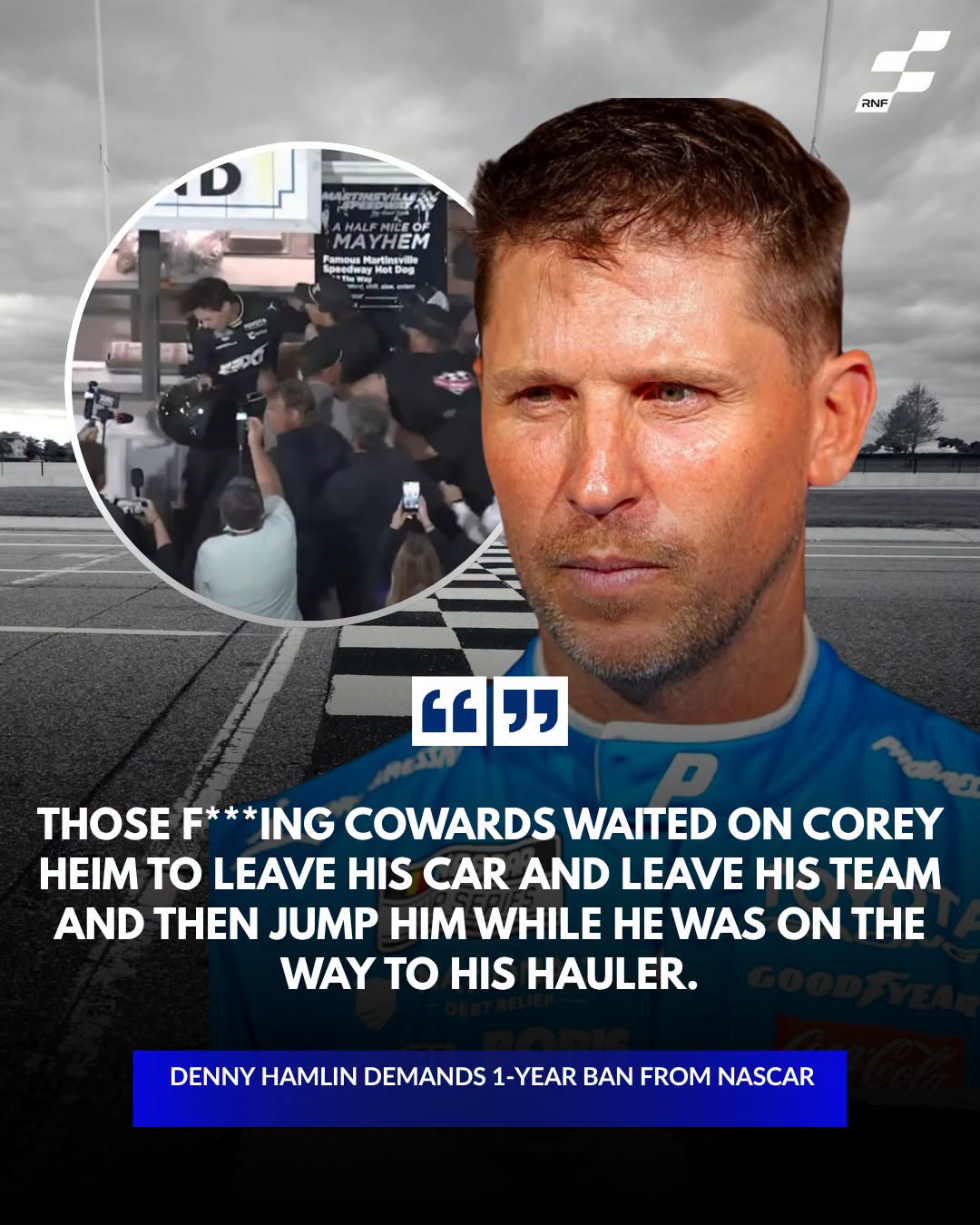
DENNY HAMLIN DEMANDS NASCAR TAKE ACTION AFTER COREY HEIM ATTACK — “THERE’S ABSOLUTELY NO WAY” THEY SHOULD BE ALLOWED BACK IN THE PIT LANE
Denny Hamlin wants NASCAR to suspend the people who attacked Corey Heim for at least a year.
Heim was surrounded and punched by multiple members of Chad Bryant Racing after the ValleyStar Credit Union 300 at Martinsville.
Hamlin called the incident “complete classlessness” and said none of those involved should be allowed in a pit lane for the next year.
He also criticized NASCAR Regional officials for allowing the situation to happen and demanded stronger rules around post-race fights.
“There’s absolutely no way that any of those guys should be in a pit lane for the next year.”
Those words captured just how furious Hamlin was after one of the ugliest post-race scenes of the Martinsville weekend.
What began as a tense night of Late Model racing escalated dramatically after the checkered flag at the ValleyStar Credit Union 300.
Corey Heim and Treyten Lapcevich had been fighting for position when their battle spilled beyond the finish. Contact between the two contributed to a crash after the checkered flag, but what happened later became the real story of the night.
Heim was making his way toward his hauler when members associated with Chad Bryant Racing confronted him near Martinsville Speedway’s famous hot dog stand.
Video of the incident spread quickly.
Instead of a simple argument between two drivers, the confrontation became physical, with Heim surrounded and struck during the altercation.
For Hamlin, that distinction was critical.
This wasn’t simply two drivers losing their tempers immediately after climbing out of their cars.
Speaking on his Actions Detrimental podcast, Hamlin described the conduct as “complete classlessness” and accused members of the rival organization of waiting until Heim was separated from his own team before confronting him.
Hamlin also said Heim had made clear that he wasn’t looking for a fight.
That only intensified his frustration.
And Hamlin had more than a casual interest in what happened.
He is a co-owner of 23XI Racing, the organization Heim is set to drive for full-time in the NASCAR Cup Series in 2027.
So when Hamlin watched the footage, his reaction went beyond frustration about racing etiquette.
He wanted consequences.
Serious ones.
He said the people involved should be kept out of NASCAR pit lanes for at least a year and demanded that NASCAR publicly explain whatever punishment it imposed.
Hamlin also directed criticism toward NASCAR Regional, arguing that officials need stronger control over post-race confrontations at events such as Martinsville.
In his view, fights cannot simply become an accepted extension of short-track racing.
Rubbing fenders?
Absolutely.
Hard racing?
Expected.
Angry conversations after the checkered flag?
Nothing unusual.
But waiting for someone away from his team and turning a dispute into a multi-person physical confrontation crosses another line entirely.
Hamlin’s comments quickly became part of the larger conversation surrounding the incident.
Then NASCAR responded.
And the penalties were significant.
NASCAR indefinitely suspended Chad Bryant, the owner of Chad Bryant Racing, and fined him $2,000. Bryant was also barred from the 2027 ValleyStar Credit Union 300, placed on probation for one year and required to complete anger-management training.
Steven Civitarese received a $1,000 fine and an indefinite NASCAR suspension, along with exclusion from the 2027 Martinsville event and a year of probation.
Ryden Lapcevich was fined $500 and placed on probation through the end of 2027.
Additional penalties were issued to Dylan Jenks, Brad Housewright, Chase Burrow and Ryan Burrow. In total, NASCAR disciplined seven individuals connected with the altercation.
That means Hamlin’s demand for substantial consequences did not disappear into the noise.
NASCAR acted.
The episode nevertheless leaves a larger question for short-track racing.
Where should officials draw the line?
Motorsports has always contained emotion.
Drivers compete inches apart at enormous speeds.
A single move can destroy someone’s race.
Months of preparation can disappear in seconds.
Tempers are inevitable.
In some ways, that intensity is part of what makes racing compelling.
Fans understand that competitors aren’t robots.
But there is a significant difference between confrontation and an apparent group attack.
Hamlin’s argument wasn’t that NASCAR should eliminate emotion.
It was that participants need to know there are consequences when that emotion becomes uncontrolled physical violence.
Without meaningful punishment, the concern is obvious.
If teams believe post-race retaliation carries little cost, the next confrontation could become even more dangerous.
And a pit area is not an ordinary environment.
Cars, equipment, concrete barriers and large groups of people can transform a fight into something far more serious very quickly.
Interestingly, Heim’s public reaction appeared considerably lighter than Hamlin’s.
After the incident, Heim posted a selfie giving a thumbs-up and joked about the confrontation. He also made light of the damaged hot dog stand menu that had become an unexpected part of the viral footage.
That humor didn’t change Hamlin’s position.
For him, the principle was bigger than whether Heim walked away able to joke about it.
Drivers should be able to leave their cars and return to their teams without expecting to be surrounded by members of another organization.
That’s the standard Hamlin wants NASCAR to enforce.
And now NASCAR’s response has sent its own message.
Some participants received probation.
Others received fines.
Two received indefinite suspensions.
For Chad Bryant, the consequences also include anger-management training and missing the next ValleyStar Credit Union 300.
Whether those penalties ultimately satisfy everyone around the sport is another question.
But one thing is no longer hypothetical:
NASCAR did respond.
And Hamlin made unmistakably clear why he believed it had to.
Because racing can be aggressive.
It can be emotional.
It can even become personal.
But in Hamlin’s view, what happened to Corey Heim wasn’t simply another example of competitors getting heated after a race.
It crossed the line.
And his message to NASCAR couldn’t have been clearer:
If that line doesn’t carry serious consequences, somebody will eventually cross it again.