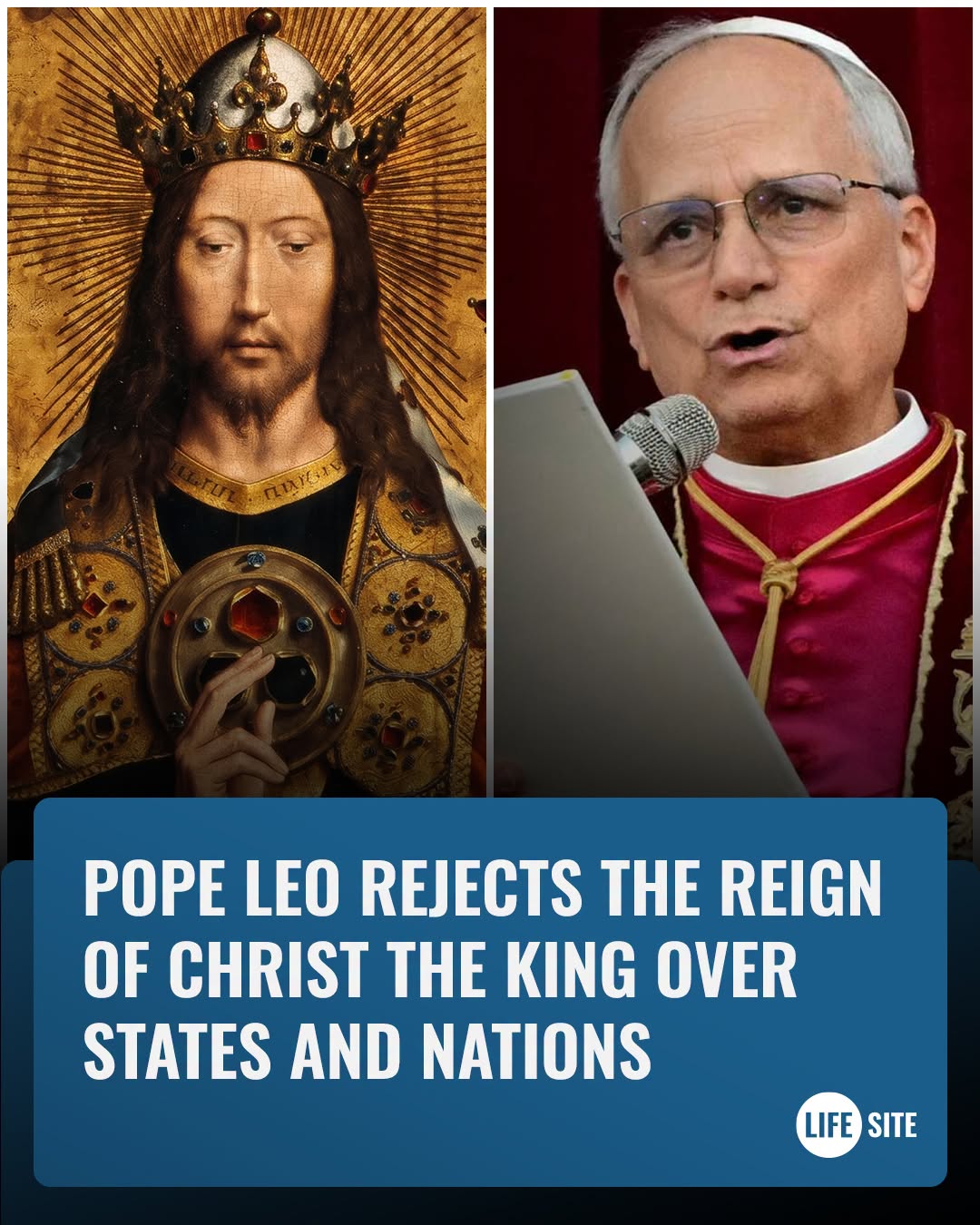
🚨⛪ CONTROVERSY ERUPTS OVER POPE LEO XIV’S MAGNIFICA HUMANITAS — DOES “AUTONOMY” FOR THE STATE CONFLICT WITH THE SOCIAL REIGN OF CHRIST THE KING?
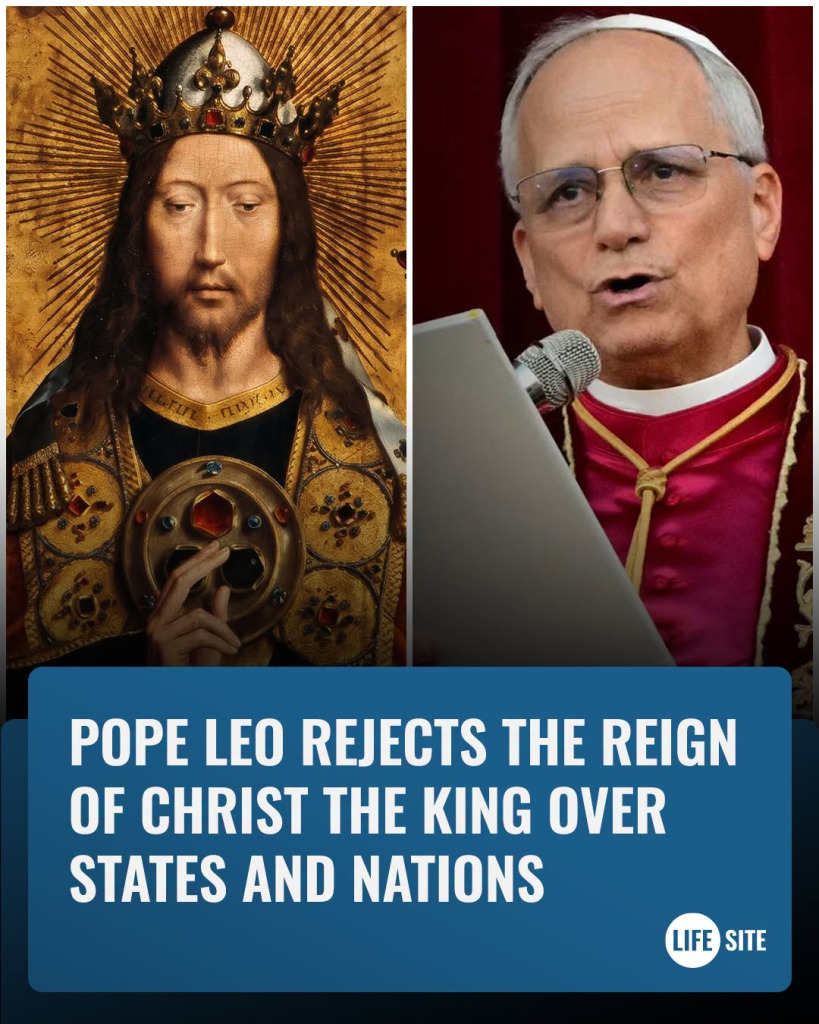
A theological controversy is unfolding around Pope Leo XIV’s first encyclical, Magnifica Humanitas, with some traditionalist Catholics raising a provocative question:
Has the Pope weakened—or even rejected—the traditional Catholic understanding of Christ’s kingship over societies and nations?
The controversy centers primarily on paragraphs 18–22 of the encyclical, published on May 15, 2026.
There, Leo XIV discusses the relationship between the Catholic Church, civil society and political institutions.
The Pope explicitly recognizes what he calls the “autonomy of earthly realities” and the distinction between ecclesiastical and political communities.
He then invokes the Second Vatican Council’s Gaudium et Spes, which taught that created things and human societies possess their own laws and values that must be understood and respected.
But one passage has attracted particular attention.
Leo writes that the Second Vatican Council affirmed a distinction between the ecclesial and political communities, with each operating with “full autonomy.”
For critics, those words immediately raise questions.
They point toward an older tradition of Catholic political theology—particularly the teaching associated with Pope Pius XI’s 1925 encyclical Quas Primas, which instituted the Feast of Christ the King.
Pius XI emphasized that Christ’s authority extends not merely over individual believers but over humanity as a whole.
From that perspective, critics ask:
If Christ is truly King, can political society ever be described as fully autonomous?
Does a state possess moral independence from divine law?
Can government legitimately organize itself without reference to God?
And does Leo XIV’s language represent a significant departure from older Catholic formulations?
Those are serious theological questions.
But there is an equally important distinction:
The text of Magnifica Humanitas does not explicitly say that Christ has no authority over nations.
Nor does it declare that governments are morally independent of God.
Instead, Leo’s argument concerns the distinct institutional responsibilities of Church and State.
The encyclical says the Church does not claim to assume functions belonging to the State.
Civil institutions have their own responsibilities.
The Church, meanwhile, has a different mission.
But Leo immediately adds something that complicates claims that he wants religion removed from public life.
He explicitly rejects the idea that religion should simply be confined to private devotion.
Drawing upon Pope Francis, the encyclical says religion cannot be restricted to the private sphere without influence on social and national life.
That point is crucial.
Leo’s model is therefore not straightforward secularism.
The Church isn’t supposed to govern the State.
But neither is she supposed to disappear from society.
Instead, Magnifica Humanitas presents the Church as an active moral voice within public life.
When politics fails vulnerable people, when economic structures violate human dignity or when science exceeds legitimate boundaries, Leo says the Church “must make her voice heard.”
The stated purpose isn’t domination.
It is the promotion of human dignity, communion and the common good.
That creates the real theological tension at the center of the controversy.
What exactly does autonomy mean?
If autonomy means governments can determine technical political questions without bishops functioning as civil rulers, then the principle has deep roots in modern Catholic social teaching.
But if autonomy were interpreted to mean that political authority has no responsibility whatsoever toward objective moral truth or divine law, traditional Catholic critics would argue that something fundamental had changed.
Magnifica Humanitas itself appears to reject that second interpretation.
Elsewhere, Leo describes natural law as consisting of objective principles that precede the interests of individuals and States.
He also describes political authority as responsible for pursuing the common good.
The State, therefore, isn’t presented as morally absolute.
Its authority exists within a larger moral framework.
That distinction matters when comparing Leo XIV with earlier Catholic teaching.
The Catholic understanding of Church-State relations has developed significantly across centuries.
Earlier eras often assumed explicitly confessional states.
The Second Vatican Council confronted a different political environment: constitutional democracies, religious pluralism and modern understandings of religious liberty.
Its declaration Dignitatis Humanae defended religious freedom as a right grounded in human dignity.
Leo explicitly reaffirms that framework.
For some Catholics, this represents legitimate doctrinal development: the Church continues proclaiming Christ while recognizing that faith cannot simply be imposed through government coercion.
For some traditionalist critics, however, the post-conciliar language risks obscuring the older doctrine of Christ’s social kingship.
That disagreement cannot be resolved simply by extracting the phrase “full autonomy” from one paragraph.
The entire document has to be considered.
And the complete encyclical paints a more complicated picture.
Leo XIV recognizes institutional separation between Church and State.
He supports religious liberty.
He rejects attempts by the Church to replace political institutions.
Yet he simultaneously insists that Christianity has public consequences.
He invokes objective moral principles.
He says the Church must participate in debates shaping society.
And Magnifica Humanitas itself begins explicitly with Jesus Christ, describing humanity’s true identity as becoming clear through the mystery of the Word made flesh.
So has Pope Leo XIV “rejected Christ the King”?
That conclusion goes further than the text itself.
What Magnifica Humanitas unquestionably does is embrace the Second Vatican Council’s framework of institutional autonomy and distinction between Church and political authority.
Whether that framework can be perfectly reconciled with older formulations of Christ’s social kingship is the deeper theological debate.
And nearly a century after Quas Primas, that debate clearly isn’t finished.
The explosive question isn’t simply whether the State has autonomy.
It’s what Catholics believe that autonomy means when they simultaneously proclaim: Christ is King. 👑✝️