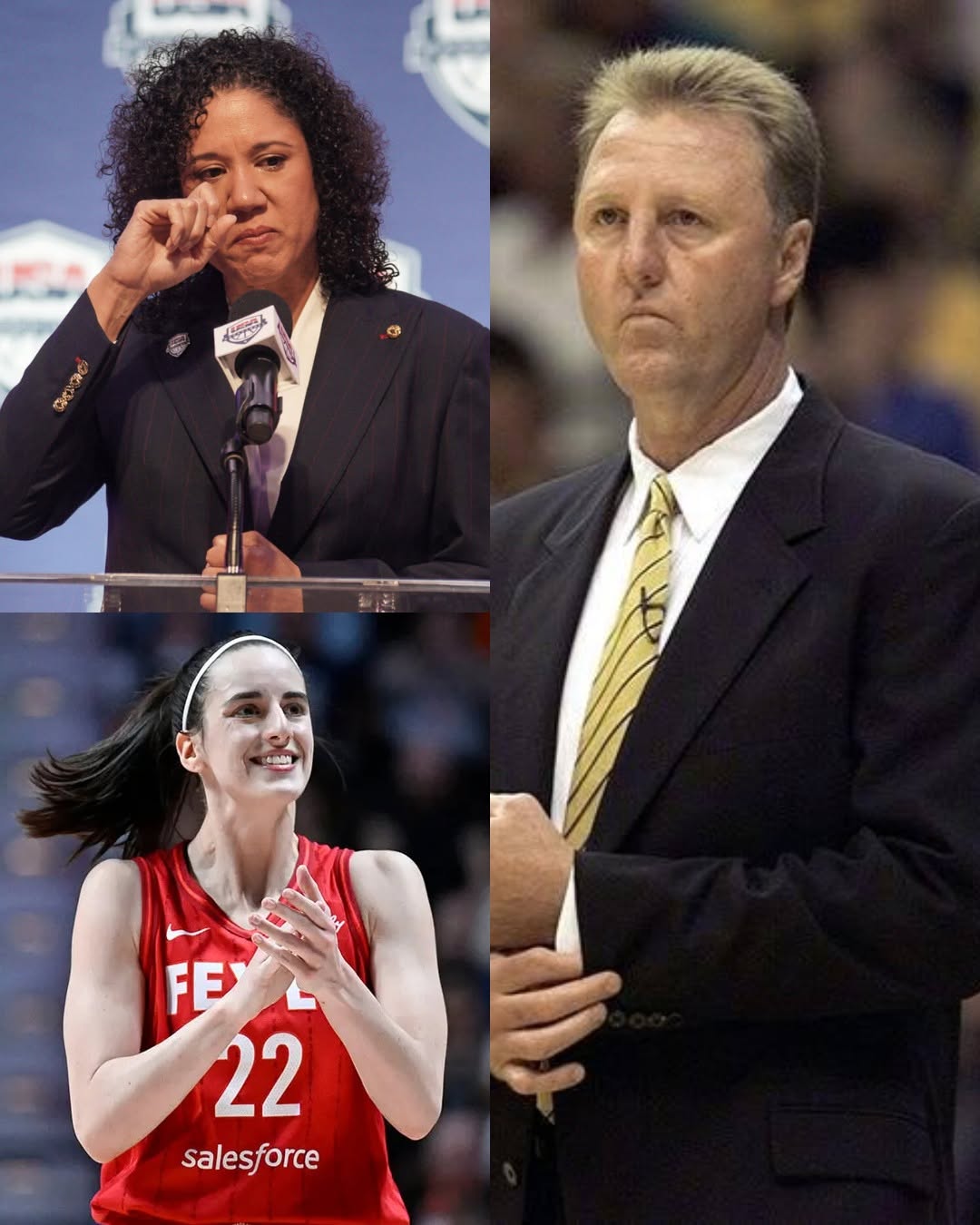
A sensational Larry Bird story has exploded across women’s basketball, promising confrontation, betrayal, and one devastating warning.
Viral posts claim the Celtics legend directly challenged Kara Lawson over her supposed mistreatment of Caitlin Clark.
According to those posts, Bird delivered eight ruthless words that left Team USA’s entire coaching staff speechless.
Some versions also promise a leaked transcript revealing how Bird supposedly exposed an organized plot against Clark.
There is only one enormous problem surrounding this emotionally irresistible breaking-news narrative currently dominating social platforms.
No credible publication, official representative, authenticated recording, or named eyewitness has confirmed that confrontation actually occurred.
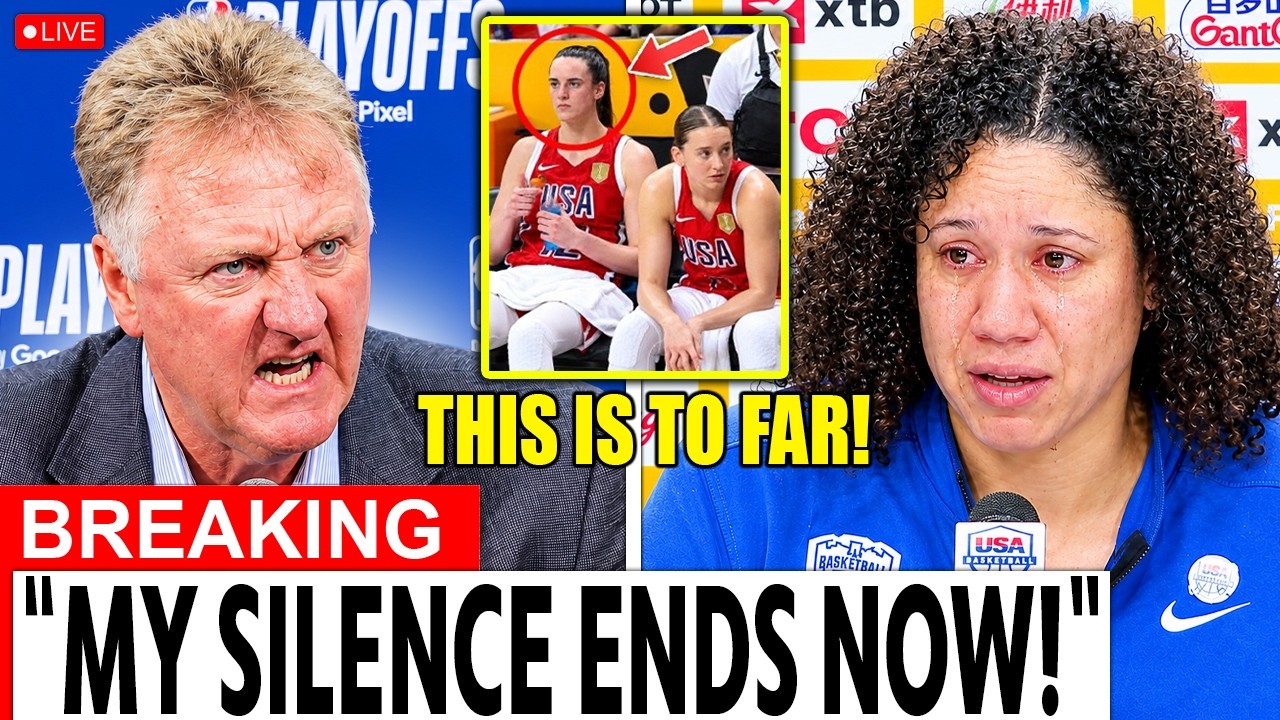
No verified transcript documents Bird warning Lawson, and no reliable source identifies the alleged eight-word message.
Current search results trace the allegation primarily toward YouTube commentary and recycled Facebook entertainment posts.
Those pages repeatedly use identical language involving Bird “destroying” Lawson after Clark’s supposed Team USA sabotage.
However, established sports outlets reporting from Berlin have not documented Bird contacting Lawson about Clark’s rotation.
USA Basketball has not announced any intervention involving Bird, Lawson, managing director Sue Bird, or Caitlin Clark.
Larry Bird’s representatives have not publicly authenticated the quotation currently being attributed to him across social media.
The explosive headline therefore combines a genuine basketball controversy with an apparently unsupported celebrity intervention.
Yet the verified story surrounding Clark’s reserve role remains compelling enough without inventing Bird’s participation.
Kara Lawson has kept Clark outside Team USA’s starting lineup throughout the 2026 Women’s World Cup.
Lawson continues opening with veteran Chelsea Gray, despite Clark repeatedly producing extraordinary playmaking from the bench.
That strategic choice has angered supporters who believe America’s most influential guard is being unnecessarily restrained.
The disagreement has grown because Clark’s production consistently makes her reserve designation appear increasingly difficult to justify.
Through America’s first four World Cup contests, Clark averaged 8.5 points and seven assists.
She also averaged 21.5 minutes, reportedly leading Team USA in playing time during three appearances.
Those numbers reveal an important contradiction overlooked by the most inflammatory sabotage allegations.
Clark is not starting, but Lawson is still trusting her with significant responsibility and extensive minutes.

The New York Post reported Clark remained positive while emphasizing the honor of representing America internationally.
That documented attitude differs sharply from viral portrayals describing Clark as furious, humiliated, and openly rebellious.
The rotation controversy began immediately when Team USA opened World Cup competition against China.
Lawson started Gray while Clark entered later as the primary creative leader of America’s reserve group.
Clark required little time to change the contest’s pace, spacing, and offensive imagination.
Across only ten first-half minutes, she delivered six assists without committing a turnover.
That assist total exceeded China’s complete first-half production and immediately demonstrated Clark’s exceptional international readiness.
When Lawson removed her, China responded with a dangerous 9–0 surge that reduced America’s control.
After Clark returned, Team USA produced a 19–6 answer that restored separation and confidence.
She completed the 94–61 victory with fourteen points, eleven assists, and a plus-thirty rating.
Clark also became the first American woman recording eleven World Cup assists without committing any turnover.
Her debut provided ammunition for everyone believing Lawson should immediately reorganize the starting lineup around Clark.
TalkSPORT reported supporters criticized Lawson after America’s momentum declined during Clark’s first-half absence against China.
However, strong production from reserve does not automatically prove deliberate sabotage or hostile personal motives.
Coaches frequently stagger playmakers to ensure every lineup contains somebody capable of organizing possessions.
Using Clark against opposing reserves could theoretically maximize her freedom while maintaining balance throughout America’s rotation.
Lawson also inherited a roster blending internationally experienced champions with several major-tournament newcomers.
Chelsea Gray, Breanna Stewart, Napheesa Collier, and Kahleah Copper understand the unique pressure surrounding elimination basketball.
Clark, Paige Bueckers, Angel Reese, and younger teammates represent America’s extraordinarily talented emerging generation.
Lawson must integrate both groups while pursuing the nation’s fifth consecutive Women’s World Cup championship.
Her assignment became harder when A’ja Wilson unexpectedly withdrew shortly before the tournament because of health concerns.
Kelsey Plum was also unavailable following an injury-disrupted season, further reducing America’s established perimeter depth.
Reuters described America chasing another championship while preparing for its most difficult World Cup challenge.
That context explains Lawson’s preference for continuity, although it does not place her decisions beyond criticism.
The debate should focus upon measurable strategy, rather than unsupported claims about disgraceful treatment and malicious intent.
America escaped Italy 55–52 during a performance exposing offensive hesitation, poor shooting, and inconsistent collective rhythm.
That narrow result transformed Clark’s starting status from an interesting discussion into a national controversy.
Team USA appeared uncomfortable whenever possessions slowed and defenders successfully removed initial attacking options.
Clark struggled from distance, but America also failed to maximize her transition passing and exceptional defensive gravity.
Critics argued Lawson’s structured approach restricted precisely the improvisational qualities making Clark uniquely dangerous.
Supporters asked why Gray’s experience outweighed Clark’s immediate ability to create efficient opportunities for teammates.
The coaching staff responded by maintaining its rotation instead of reacting toward outside demands.
Lawson explained she trusted her starting group because it consistently established productive beginnings.
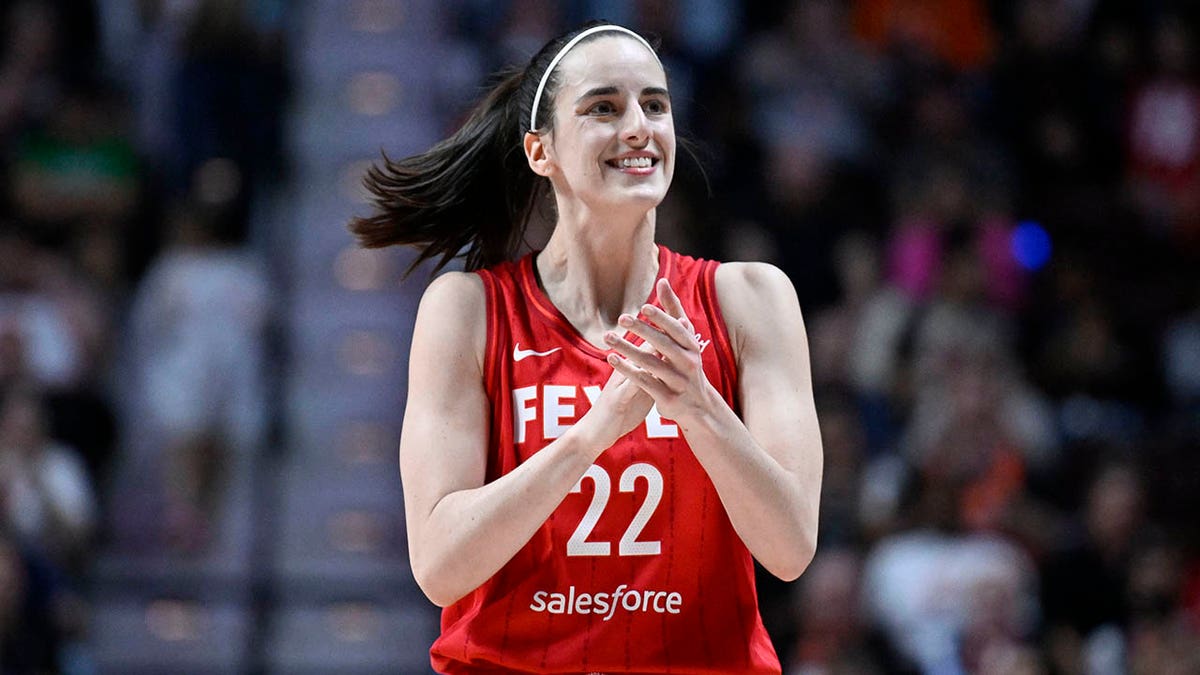
That position frustrated Clark’s supporters, particularly when her reserve minutes remained central to every American victory.
Nevertheless, Lawson’s decision also affected Bueckers and Reese, not only Caitlin Clark.
All three celebrated young stars accepted bench assignments while contributing significantly throughout the tournament.
That wider pattern weakens claims that Lawson designed her approach specifically to humiliate or sabotage Clark.
It instead suggests the coach divided her roster primarily between established veterans and emerging international contributors.
Whether that traditional hierarchy represents the optimal basketball decision remains genuinely debatable.
Whether it constitutes intentional sabotage requires evidence that no responsible source has currently produced.
America responded to its Italy scare by overwhelming Czechia 105–64 in the following matchup.
The improvement reduced immediate pressure without resolving larger arguments surrounding Clark’s long-term role.
Then Team USA dismantled Hungary 108–56 during Thursday’s quarterfinal and advanced comfortably into Saturday’s semifinal.
America scored fifty-nine first-half points, establishing a new Women’s World Cup record before intermission.
Collier led all scorers with nineteen points while adding six rebounds during another dominant performance.
Clark contributed ten points, nine assists, three rebounds, and two steals from Lawson’s reserve unit.
Reese supplied nine points, six rebounds, three assists, and relentless interior pressure beside Clark.
Their partnership became one of the quarterfinal’s most revealing and encouraging developments.
Clark repeatedly recognized Reese’s movements, delivering passes before Hungary could complete defensive rotations.
Reese also returned possession toward Clark whenever collapsing defenders removed her own scoring opportunity.
Their strongest connection arrived during the final seconds of America’s overwhelming third quarter.
Clark controlled possession outside while Reese flashed toward an opening near the interior.
The Indiana Fever guard immediately delivered a precise pass through Hungary’s collapsing defense.
Reese collected it, powered toward the basket, and scored before the quarter-ending buzzer sounded.
The sequence pushed America ahead 93–47 and visually summarized their rapidly developing chemistry.
Afterward, Reese said extensive competition helped them understand each other’s tendencies almost instinctively.
She described sharing passes with Clark and said their experience together had become enjoyable.
Reese also predicted they would remain Team USA teammates for many future international competitions.
Clark similarly dismissed narratives portraying their relationship as permanently hostile or personally fractured.
Their comments revealed a unified young group rather than players enduring an internally toxic environment.
People reported both stars were enjoying their partnership while learning to depend upon each other.
That verified development deserves greater attention than an imaginary Larry Bird confrontation inside Team USA.
Still, Bird’s name fits the viral narrative because his historical connection to Clark feels immediately believable.
Both became extraordinary basketball attractions after emerging from programs located within America’s Midwest.
Bird transformed Indiana State into a national phenomenon before becoming a Boston Celtics legend.
Clark transformed Iowa into appointment television through breathtaking shooting distance and imaginative passing.
Both players carried fearless confidence, exceptional court vision, and the ability to attract previously disengaged audiences.
Their popularity also generated complicated cultural discussions extending well beyond performance and statistical achievement.
The Associated Press previously compared Clark’s rise with Bird’s emergence forty-five years earlier.
That comparison concerned enormous attention, race-related narratives, and their influence upon basketball’s growing visibility.
However, comparison does not establish communication, endorsement, friendship, or a direct personal intervention.
Bird has historically maintained a private public profile and rarely participates within daily WNBA controversies.
A 2025 Sporting News fact-check found numerous fabricated Clark quotations had already been attributed to Bird.
That report concluded the Hall of Famer had publicly said relatively little about Indiana’s superstar guard.
This history makes another dramatic anonymous Bird quotation particularly deserving of skepticism.
Online creators understand that combining Bird and Clark instantly produces emotional credibility among Indiana basketball supporters.
Adding Lawson creates conflict, while an eight-word warning supplies suspense and an easily marketable promised revelation.
The resulting formula does not require evidence before attracting views, comments, outrage, and repeated sharing.
One channel publishes an unsupported claim before several pages repeat it using slightly altered language.
Repetition then creates the appearance of independent confirmation despite every post tracing toward identical speculation.
Within hours, audiences begin discussing the invented quotation as though Bird delivered it publicly.
The absence of video becomes explained as suppression, while missing sources become evidence of secrecy.
That pattern makes misinformation unusually difficult to correct after emotional investment has already formed.
The alleged eight-word warning has not appeared consistently across the posts promoting Bird’s supposed intervention.
Different creators promise a transcript without presenting matching language, location, date, or identified witnesses.
Some claim Bird addressed Lawson privately, while others describe a direct confrontation before Team USA.
Those contradictions further weaken the reliability of the original allegation.
A genuine intervention by somebody possessing Bird’s stature would create immediate reporting across national sports outlets.
Reporters would contact Bird, Lawson, USA Basketball, Clark, and Indiana Fever representatives seeking verification.
Television programs would replay the statement while analysts debated its significance throughout tournament coverage.
Instead, reputable reporting continues focusing upon Lawson’s rotation and Clark’s extraordinary bench production.
That absence does not mathematically prove Bird remained silent, but it strongly undermines the viral claim.
Responsible reporting therefore cannot present the confrontation or eight-word message as established fact.
It can examine why audiences found the allegation convincing and why Lawson faces such intense criticism.
The answer begins with Clark’s unprecedented influence upon American women’s basketball.
Her long-range shooting fundamentally changes where opposing defenders must begin applying pressure.
Her passing finds teammates before openings become visible to most professional guards.
Her transition decisions can transform defensive rebounds into scoring opportunities within seconds.
She also generates extraordinary attendance, television audiences, sponsorship interest, and social-media engagement.
Supporters therefore interpret every restricted possession as a wasted opportunity harming the entire sport.
When Lawson benches Clark, many viewers see more than a routine substitution.
They see institutional basketball leadership limiting the athlete responsible for unprecedented public growth.
That emotional reaction created ideal conditions for a Larry Bird rescue story to spread.
Bird represents traditional basketball authority, Indiana pride, championship credibility, and fearless competitive honesty.
Placing him against Lawson allows creators to transform tactical disagreement into moral judgment.
The imaginary warning becomes an audience fantasy where unquestionable authority finally validates their frustration.
But basketball decisions require deeper evaluation than one fictional sentence can provide.
Clark leads America creatively while remaining outside the starting group, creating a fascinating strategic contradiction.
Lawson can reasonably argue Clark’s reserve assignment strengthens multiple lineups across forty minutes.
Critics can reasonably respond that America should establish its most dynamic offense immediately.
Gray provides control, postseason experience, physicality, and familiarity with veteran teammates.
Clark provides tempo, unprecedented passing imagination, shooting gravity, and transformational audience energy.
Lawson’s task involves determining which qualities matter most during opening and closing stretches.
The numbers indicate Clark receives substantial playing time despite entering after the opening tip.
Through four matchups, she reportedly averaged more minutes than every other American player.
That reality complicates any claim suggesting Lawson intends to bury or embarrass her.
A coach attempting sabotage would not repeatedly entrust Clark with the largest workload.
However, minutes alone do not settle questions regarding timing, combinations, or creative authority.
Clark might play extensively while still operating within lineups that insufficiently maximize her abilities.
She might receive possession late within actions after defensive advantages have already disappeared.
She might share the floor with players less prepared for her unusually early passing reads.
These are legitimate forms of tactical limitation requiring careful film analysis.
Calling them sabotage assigns malicious motivation without evidence and weakens otherwise reasonable criticism.
Larry Bird’s supposed intervention distracts from that more important discussion.
The actual decision-makers surrounding Clark’s international future are Lawson and managing director Sue Bird.
Sue Bird, unrelated to Larry, oversees program construction while Lawson controls coaching execution.
Confusing their names occasionally helps misinformation appear plausible to less attentive audiences.
Sue Bird has extensive authority within USA Basketball and extraordinary international credentials.
She earned eleven FIBA gold medals, including five Olympic championships, across her legendary career.
Her program emphasizes identity, adaptability, communication, and players accepting responsibilities differing from franchise roles.
Washington Post reporting from America’s training camp highlighted those expectations across both veterans and newcomers.
Lawson challenged Clark physically during practices because international defenders would aggressively test her freedom.
Stephanie White explained coaches had limited time to install defensive principles, pace, and collective responsibilities.
The camp focused upon preparing every participant rather than protecting familiar superstar status.
Clark’s reserve assignment therefore fits a broader national-team philosophy requiring individual sacrifice.
That philosophy produced generations of American dominance but cannot become permanently immune from tactical evolution.
Clark plays differently from traditional American point guards and forces systems to adjust toward her strengths.
Her arrival may require Lawson to modernize how Team USA distributes creative control.
Resistance could produce unnecessary struggles, particularly against disciplined European defensive structures.
America’s narrow Italy victory already demonstrated what happens when talent becomes disconnected from rhythm.
The remaining World Cup rounds will determine whether Lawson can adapt before encountering greater danger.
France possesses athletic defenders, transition speed, creative guards, and powerful motivation after previous disappointment.
Germany combines home support, size, discipline, and growing confidence within Berlin’s charged environment.
Spain and Australia traditionally bring extensive international experience and sophisticated half-court execution.
America cannot assume its talent advantage will automatically overcome another prolonged offensive drought.
Without Wilson, the roster lacks its most dependable individual solution during difficult possessions.
That reality should increase Clark’s value because her passing creates efficient opportunities without demanding isolation scoring.
Lawson must decide whether Saturday represents the moment to finally change her starting group.
Maintaining continuity could preserve stability following America’s fifty-two-point quarterfinal triumph.
Changing now could signal responsiveness while placing greater early pressure upon the semifinal opponent.
Either decision will produce enormous reaction before the opening possession even begins.
If Clark starts, supporters will claim outside pressure finally forced Lawson to acknowledge obvious reality.
If she remains reserved, every early mistake will immediately intensify accusations of stubbornness or favoritism.
If America wins comfortably, Lawson’s strategic credibility will strengthen regardless of online dissatisfaction.
If America loses, her refusal to start Clark could define public discussion for years.
That pressure is real, unlike Bird’s currently unverified confrontation.
Lawson understood scrutiny accompanied leadership of America’s historically dominant women’s national program.
She accepted responsibility extending through the 2028 Los Angeles Olympic cycle.
Every World Cup decision therefore helps shape an Olympic roster expected to feature Clark prominently.
Reese, Bueckers, and other younger stars will also compete for larger future responsibilities.
This tournament functions simultaneously as a championship pursuit and generational transition.
Veterans deserve respect for creating America’s extraordinary international winning tradition.
Young players deserve opportunities reflecting current performance rather than only previous accomplishments.
Finding that balance represents Lawson’s most difficult responsibility throughout Berlin.
The coach cannot surrender completely toward public demands, because popularity should never determine every lineup.
She also cannot ignore overwhelming performance evidence merely to preserve traditional hierarchy.
Clark’s World Cup impact has already strengthened her argument more effectively than any outside legend could.
Fourteen points and eleven assists against China delivered a historic opening statement.
Nine assists during the Hungary quarterfinal proved her creativity survived elimination pressure.
Her connection with Reese demonstrated she can organize younger teammates unfamiliar with established combinations.
She has also maintained a professional public attitude despite constant questions regarding reserve status.
Nothing credible indicates Clark requested Larry Bird’s involvement or endorsed attacks against Lawson.
Nothing confirms Bird viewed Lawson’s decision as sabotage or contacted anyone within Team USA.
The “one eight-word message” remains an unsupported promotional device rather than verified sporting history.
Inventing its exact wording would transform speculation into fabricated quotation.
That would mislead readers and unfairly attribute personal accusations toward a private basketball legend.
The stronger article instead asks what Bird’s historical example might contribute to the debate.
Bird understood that elite basketball intelligence cannot be reduced to conventional positional expectations.
He dominated through anticipation, passing, spacing, confidence, and relentless competitive awareness.
Clark shares those broader qualities without needing to become a direct female copy of him.
Both athletes made teammates better while forcing defenses to reconsider traditional spatial boundaries.
Both also attracted new audiences whose interest extended beyond established professional fan communities.
A coach handling either player must create enough structure without suffocating the instincts making them transformative.
That principle does not require Bird personally criticizing Lawson to remain relevant.
Lawson’s challenge involves constructing freedom within collective discipline rather than choosing only one.
Clark should understand defensive responsibilities, lineup balance, and America’s wider championship standards.
Lawson should recognize that Clark’s creativity represents a competitive advantage requiring encouragement, not excessive control.
Their relationship can grow through honest tactical communication instead of externally manufactured hostility.
The available evidence suggests precisely such a professional process remains underway.
America is undefeated, Clark is playing major minutes, and Lawson continues relying upon her.
The team experienced one severe scare before responding with two overwhelmingly convincing victories.
Those facts neither prove perfect coaching nor reveal an internally collapsing program.
They show a championship favorite still discovering its strongest identity under compressed tournament conditions.
Viral coverage often lacks patience for development because uncertainty produces less immediate engagement than scandal.
A secret Bird warning promises instant resolution where complex evidence requires continued observation.
It offers a hero, villain, victim, confrontation, and supposedly decisive verdict.
Real basketball provides fewer simple answers but ultimately delivers more meaningful conclusions.
Saturday’s semifinal will reveal whether America’s improved ball movement survives stronger defensive resistance.
It will show whether Lawson trusts Clark during stretches where every possession carries greater consequence.
It will test whether Gray and Clark can complement rather than symbolically replace each other.
It will reveal whether Reese’s chemistry with Clark becomes a reliable second-unit weapon.
Those answers will influence America’s championship prospects far more than an invented celebrity transcript.
If Lawson times her substitutions correctly, the bench controversy may gradually lose importance.
If she leaves Clark seated during another opposing run, criticism will become significantly more justified.
If Clark struggles, Lawson must decide whether patience or immediate adjustment best protects America.
If Clark dominates, the coach must resist predetermined rotations and follow the competitive evidence.
Great tournament coaching requires preparation, but also flexibility when reality contradicts initial assumptions.
Lawson’s reputation will depend upon demonstrating both qualities when pressure reaches its highest point.
Clark’s reputation will depend upon continuing to prioritize Team USA despite individual frustration.
So far, her statements and performance suggest she understands that responsibility.
She has emphasized representing America rather than publicly demanding starting recognition.
Her teammates appear engaged with her, especially Reese during their increasingly effective shared minutes.
There is no verified evidence showing Team USA’s locker room became silent following Bird’s warning.
There is abundant evidence showing Clark’s passing repeatedly leaves opposing defenses confused and motionless.
That distinction captures the difference between manufactured drama and authentic basketball consequence.
Larry Bird has not been reliably shown “destroying” Kara Lawson through eight unforgettable words.
Caitlin Clark has been reliably shown challenging Lawson’s choices through undeniable production.
That is the confrontation visible on every box score and every meaningful stretch.
Clark does not need an NBA legend rescuing her from America’s coaching staff.
Her performance possesses enough authority to demand continued tactical consideration without invented endorsements.
Lawson does not need protection from criticism simply because Team USA remains undefeated.
She must explain and defend decisions carrying major consequences for American basketball’s immediate future.
Critics should challenge those choices forcefully while avoiding unsupported accusations of intentional personal sabotage.
Bird’s name should not become a weapon unless Bird actually chooses to enter this discussion.
Until authenticated evidence appears, the alleged transcript should remain clearly labeled unverified.
Its eight promised words cannot responsibly be quoted because no credible source establishes them.
The truth may feel less explosive, but it creates a far more important basketball story.
America’s greatest young playmaker remains a reserve while producing starter-level influence throughout a global championship.
Lawson believes balance, experience, and strong openings justify maintaining her established group.
Clark’s performances continue applying greater pressure upon that belief after every successful appearance.
The semifinal will place both coach and player beneath their most unforgiving spotlight yet.
A victory could validate strategic patience and America’s unusually deep rotational structure.
A defeat could transform reasonable questioning into an overwhelming national reckoning.
No Larry Bird intervention is necessary for those stakes to feel enormous.
The scoreboard, substitutions, and Clark’s own decisions will provide every message basketball needs.
If she controls another decisive run, Lawson may finally face an unavoidable tactical truth.
You cannot permanently contain a player whose vision keeps expanding every possibility around her.
And that verified reality carries more force than any fabricated eight-word warning could ever deliver.