Novak Djokovic has spent most of his career answering questions that once seemed impossible.
Could he challenge Roger Federer and Rafael Nadal? He did.
Could he become the most decorated Grand Slam champion in men’s tennis history? He did that too.
Could he remain competitive against a younger generation of players well into his late 30s? Once again, Djokovic has continued to find a way.
But according to former world No. 1 Andy Roddick, there is still one major question surrounding the Serbian legend — and it has little to do with whether Djokovic is capable of beating the best players in the world on any given day.
The real test is whether he can still survive the brutal physical demands required to win another Grand Slam title.
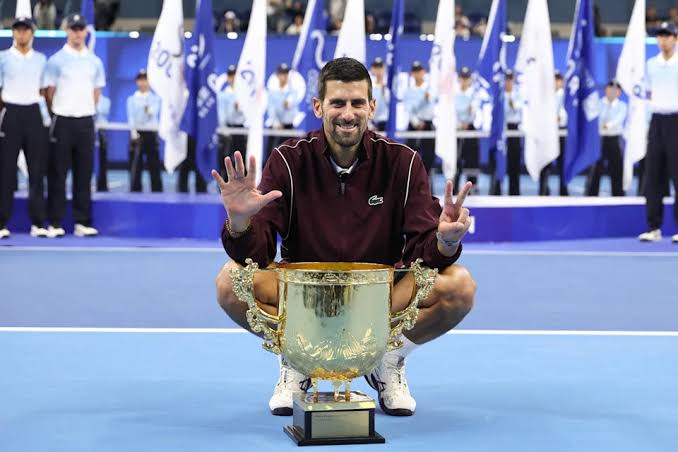
Djokovic offered another reminder of his extraordinary longevity at the 2026 China Open in Beijing. At 39 years old, the 24-time Grand Slam champion defeated Alexander Zverev in the quarterfinals before eventually claiming the title after Alex de Minaur was forced to retire from the final because of a left groin and adductor injury.

The victory extended Djokovic’s remarkable undefeated record in Beijing to 34-0.
For many players, winning a major ATP title at 39 would be considered an extraordinary achievement on its own.
For Djokovic, however, the standard is very different.
Every strong performance immediately raises the same question: Can he win another Grand Slam?
Roddick Says Djokovic Can Still Beat Anyone
Speaking on his “Served” podcast ahead of the China Open final, Roddick explained why he believes the conversation surrounding Djokovic is often misunderstood.
Roddick does not question whether Djokovic can still produce elite-level tennis.
In fact, the American believes Djokovic has already demonstrated that repeatedly.
Despite competing on a reduced schedule compared with earlier stages of his career, Djokovic has continued to reach the latter rounds of major tournaments and challenge many of the best players on the ATP Tour.
That alone, Roddick suggested, is remarkable considering Djokovic’s age and limited match schedule.
The Serbian no longer plays week after week like many younger players. Instead, he carefully selects tournaments, with Grand Slams remaining his primary focus.
Yet even with fewer matches, he continues to reach major semifinals and finals.
That is why victories over players such as Zverev or Daniil Medvedev do not surprise Roddick.
Djokovic has spent nearly two decades showing that, when his game is functioning properly, he can defeat almost anyone.
The larger concern is endurance.
The Grand Slam Question
Winning one difficult match is very different from winning seven matches across two weeks.
That distinction becomes especially important at Grand Slam tournaments, where men’s singles matches are played in a best-of-five-set format.
To win a major, Djokovic may need to compete for three, four or even five hours on multiple occasions.
He may also need to recover quickly before returning to the court two days later.
At 39, recovery has inevitably become a bigger factor than it was during Djokovic’s physical prime.
Roddick’s central question is therefore simple: Can Djokovic maintain championship-level tennis through seven best-of-five matches over a two-week period, potentially in difficult conditions?
That remains uncertain.
Djokovic may still have the technical ability, tactical intelligence and mental strength required to defeat almost any individual opponent.
What remains harder to predict is whether his body can repeatedly recover from the physical stress required to win another major.
That difference could ultimately determine whether Djokovic adds another Grand Slam trophy to his historic collection.
A Lighter Schedule Has Advantages — and Risks
Djokovic’s reduced schedule has helped him preserve his body, but Roddick believes it also creates another challenge.
Match fitness cannot always be recreated in training.
Before the US Open, Djokovic had reportedly played only one competitive match during the previous six weeks.
For a younger player, arriving at a Grand Slam with limited preparation might already be risky.
For an older player attempting to compete in best-of-five-set matches, the challenge becomes even greater.
Roddick believes Djokovic remains capable of producing deep runs under those circumstances, but several factors may need to work in his favor.
A favorable draw could help.
Shorter early-round matches could help.
Avoiding extreme heat and physically exhausting battles could also make a significant difference.
But relying on those conditions is very different from entering a tournament fully prepared through consistent competitive play.
That is why Roddick believes Djokovic could benefit from playing more lead-up tournaments before major events.
Beijing May Be the Perfect Example
Djokovic’s China Open run may have provided exactly the type of preparation Roddick believes he needs.
Winning matches does more than improve ranking points or confidence.
It creates rhythm.
Players begin to rediscover competitive instincts that are difficult to reproduce on the practice court.
Serving under pressure, managing important points and adapting to different opponents become habits again.
That competitive momentum could become especially valuable as Djokovic moves from Beijing toward other major tournaments on the calendar.
Roddick believes success can build upon itself.
When a player begins winning regularly, confidence and routines often follow.
For Djokovic, that pattern could be crucial during the final years of his career.
The challenge is finding the correct balance.
Playing too many tournaments could increase the risk of fatigue or injury.
Playing too few could leave him short of the match preparation required to survive a Grand Slam.
That balance may now be one of the most important strategic decisions Djokovic and his team must make.
Djokovic Continues to Defy Expectations
There is also a reason why tennis fans have learned not to underestimate Novak Djokovic.
Throughout his career, he has repeatedly overcome situations that appeared to place him at a disadvantage.
His return game remains one of the best in tennis.
His movement, anticipation and court awareness allow him to compete efficiently even against younger opponents.
His ability to read matches and adjust tactics remains exceptional.
And perhaps most importantly, few players in tennis history have matched his confidence in the biggest moments.
Those qualities are not easily erased by age.
That is why another Grand Slam title cannot be dismissed.
Djokovic may no longer enter every major as the overwhelming favorite, but opponents still understand the danger of seeing his name on the other side of the draw.
The Serbian has already proved that he can still defeat top-ranked players.
Now comes the harder question.
Can he defeat enough of them, across seven matches and two demanding weeks, to lift another major trophy?
Roddick believes that answer is still unknown.
And until Djokovic either proves that he can do it again — or finally reaches the physical limits of his extraordinary career — that question will continue to follow him into every Grand Slam tournament.
Because at this stage, Djokovic is no longer trying to prove that he can still play great tennis.
Everyone already knows he can.
The final challenge is proving that he can sustain it long enough to become a Grand Slam champion once again.