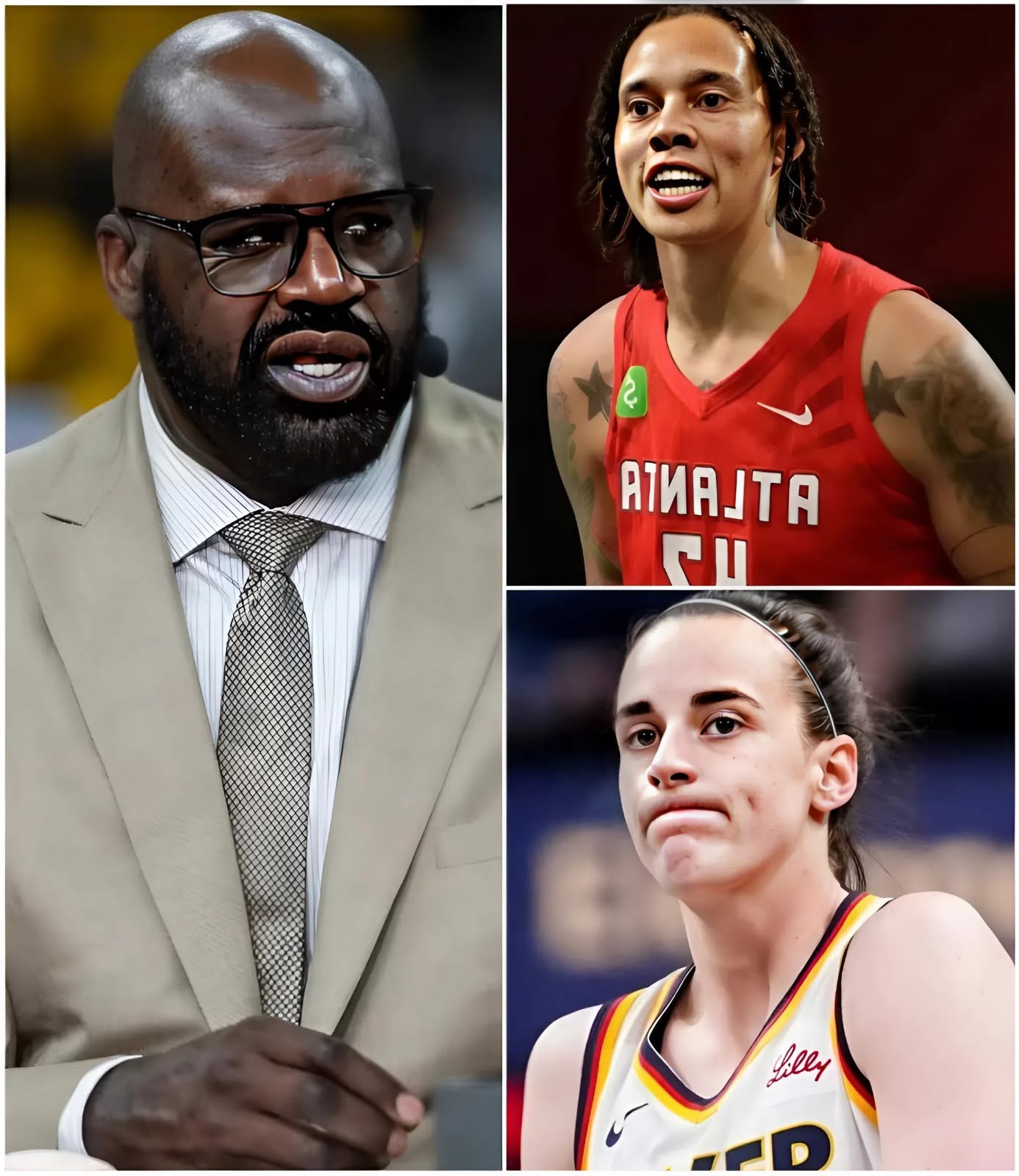
“TRASH WHITE GIRL…” — THE VIRAL BRITTNEY GRINER–CAITLIN CLARK CLIP EXPLODED ONLINE, BUT THE STORY BEHIND IT IS FAR MORE COMPLICATED THAN THE HEADLINES SUGGEST
“Trash white girl.”
Those words have followed Brittney Griner around the internet ever since a courtside video from an Atlanta Dream–Indiana Fever matchup exploded across social media.
The short clip showed an obviously frustrated Griner after she fouled out late in Indiana’s 81–76 victory over Atlanta. Cameras captured her speaking as she returned to the bench, but there was one enormous problem with the viral interpretation:
The broadcast did not provide clear audio establishing exactly what she said.
That uncertainty didn’t stop the clip from spreading.
Within hours, social-media users were attempting to read Griner’s lips. Some became convinced she had referred to Caitlin Clark as “trash” before using a racially charged description.
Others watched exactly the same footage and reached a completely different conclusion.
They argued Griner was complaining about the officiating and had said words resembling “wack call.”
The difference is crucial.
One interpretation would constitute an inflammatory personal remark involving Clark’s race.
The other would simply be an angry basketball player criticizing a referee’s decision.
Without clear audio, however, the viral video itself could not conclusively settle the argument. Reports at the time specifically noted the competing interpretations surrounding the footage.
Then Griner herself addressed it.
When directly asked whether she could have used the racial language attributed to her online, Griner rejected the allegation.
She acknowledged being angry after fouling out and said she couldn’t remember her exact words, but firmly denied making the alleged remark.
“I know it wasn’t that because I wouldn’t use that type of language,” Griner said.
She also stated there was “no place” for such language in the league.
That should have clarified at least one part of the controversy: Griner was publicly and explicitly denying the viral interpretation.
But another story was already beginning to spread.
This time, it involved Shaquille O’Neal.
Posts began circulating claiming the NBA legend had finally broken his silence over the controversy.
According to versions of the story shared online, Shaq supposedly delivered six devastating words to Griner:
“Watch your mouth. Respect the game.”
It sounded perfect for social media.
Short.
Dramatic.
Confrontational.
And coming from Shaq, one of basketball’s most recognizable personalities, it carried enormous weight.
There was just one major problem.
The quote wasn’t verified.
A fact-check examining the viral claim found no legitimate interview, video, social-media statement or credible news report showing O’Neal saying those words about Griner or responding to this particular controversy.
In other words, the dramatic “six-word response” circulating online appears to have been manufactured rather than taken from an actual Shaq statement.
That distinction changes the entire story.
There was no verified moment in which Shaq delivered those six words and stunned a locker room.
There is no reliable evidence that Griner’s teammates suddenly “stopped defending her” because of that supposed statement.
And there is no documented basis for claiming WNBA insiders universally regarded Shaq’s alleged response as the moment “everything cracked open.”
Those elements belong to the viral narrative, not the established record.
Interestingly, Shaq has discussed Caitlin Clark and controversies surrounding physical treatment in the WNBA more recently.
In an August 2026 interview, O’Neal addressed debate surrounding Clark’s treatment on the court. But that genuine discussion should not be retroactively treated as confirmation of a different viral quote attributed to him in the Griner controversy.
The episode illustrates something larger about modern sports media.
A silent video can become a controversy.
An interpretation can become a headline.
A headline can become an accusation.
And then an invented quote from a famous basketball legend can be attached to the story until thousands of people believe they witnessed an exchange that apparently never happened.
That doesn’t mean fans cannot debate what they believe they saw in the original footage.
They can.
It doesn’t mean criticism of players, officiating or league decisions is somehow illegitimate.
It isn’t.
But there is a difference between interpretation and evidence.
The evidence establishes that Griner was visibly frustrated after fouling out.
The footage generated widespread debate over what she appeared to mouth.
Griner later denied using the racially charged language attributed to her.
And the dramatic six-word Shaq response that subsequently circulated online has not been authenticated.
Those facts may be less explosive than the viral version.
But they tell a much more important story.
Because sometimes the biggest controversy isn’t what happened on the basketball court.
It’s what happens to the story after the clip reaches the internet.