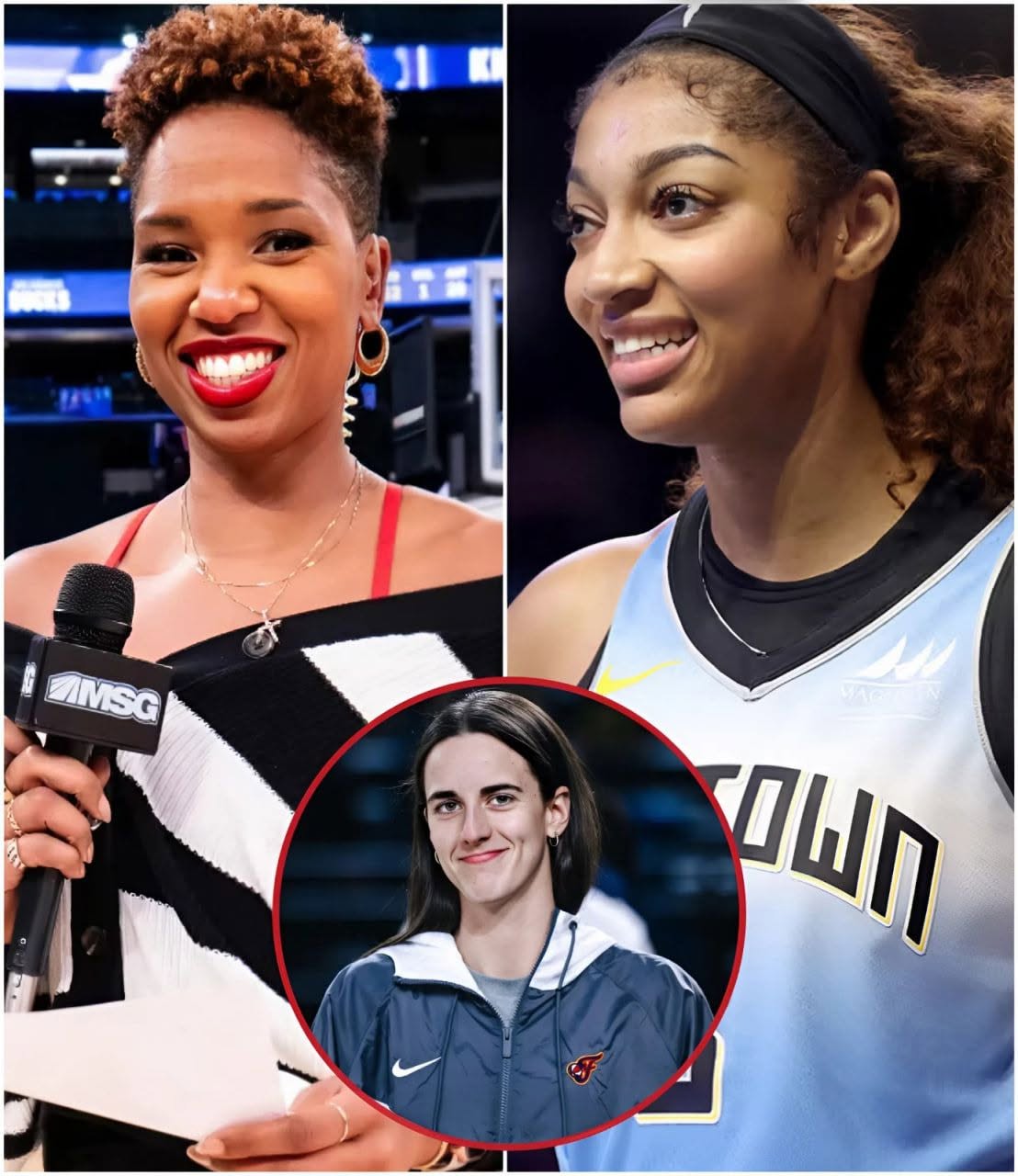
🚨 “IF ANGEL REESE WERE WHITE…” — The Explosive Monica McNutt Quote Going Viral Has a Major Problem, but Reese’s All-Star Snub Was Very Real
“IF ANGEL REESE WERE WHITE, SHE’D BE No. 1 — NOT No. 13.”
That sentence is now being attached to ESPN analyst Monica McNutt across social media, alongside an explosive story claiming she delivered it live on television while Angel Reese sat stunned nearby.
According to the viral version, the studio immediately went silent.
Nobody applauded.
Nobody moved.
The cameras kept rolling while the hosts desperately attempted to change the subject.
It sounds like the kind of television moment that would instantly dominate the sports world.
But there is one major problem.
There is no reliable evidence establishing that McNutt actually made that statement.
No verified broadcast clip has surfaced supporting the dramatic scene as described, and the available official voting numbers also contradict important parts of the viral story.
What is real, however, is interesting enough.
Angel Reese had a legitimate case to be discussed among the WNBA’s leading All-Star candidates in 2026 — and she ultimately missed the starting lineup.
That outcome generated plenty of conversation without requiring a fabricated television confrontation.
Reese, now playing for the Atlanta Dream, was having another outstanding rebounding season.
During the second published return of fan voting, she had received 470,748 votes, placing seventh among all WNBA players.
That’s enormous support.
But it wasn’t first.
Aliyah Boston led that return with 683,996 votes, followed by Caitlin Clark, A’ja Wilson, Paige Bueckers and Breanna Stewart.
Reese nevertheless remained firmly among the league’s most popular players.
Then came the part of the system that is sometimes misunderstood.
Fan voting alone does not determine WNBA All-Star starters.
Fans account for 50 percent.
Current WNBA players account for 25 percent.
A media panel accounts for the remaining 25 percent.
Players are ranked within their positional groups, and those rankings are combined using the league’s weighted formula.
That process produced six starting frontcourt players in 2026:
A’ja Wilson.
Breanna Stewart.
Jessica Shepard.
Aliyah Boston.
Gabby Williams.
Natasha Howard.
Reese narrowly fell outside that group.
That doesn’t mean voters decided she wasn’t an All-Star.
It means she didn’t finish among the six frontcourt players with the best combined starter score.
And the next stage proved the distinction.
WNBA head coaches selected Reese as a reserve.
It became her third consecutive All-Star selection.
So the accurate headline isn’t that the league somehow erased Angel Reese from the All-Star Game.
She made it.
The real debate concerns why a player with her production and popularity didn’t start.
Reese had a powerful statistical argument.
She was leading the WNBA in rebounding at 11.8 rebounds per game when the reserves were announced.
Her ability to attack the glass has been one of the defining characteristics of her professional career.
Offensive rebounds create extra possessions.
Defensive rebounds end possessions.
Those contributions don’t always produce the same highlight clips as deep three-pointers or spectacular scoring performances, but coaches understand their value.
Reese also possesses something difficult to quantify.
Attention.
Few young WNBA players generate discussion at her level.
Supporters defend her intensely.
Critics analyze virtually everything she does.
Her fashion draws attention.
Her interviews travel across social media.
Her celebrations become clips.
Even ordinary plays can generate thousands of comments.
That combination of production and visibility has made Reese one of women’s basketball’s most recognizable figures.
But does her failure to earn a starting position prove racial discrimination?
The published voting data, by itself, cannot establish that conclusion.
Race and representation in sports media are legitimate subjects for analysis, and people can reasonably examine whether Black female athletes are described, marketed or evaluated differently.
But proving discrimination in one particular voting result requires evidence beyond the final ranking.
And the 2026 process involved three separate voting constituencies rather than one mysterious decision-maker behind closed doors.
That’s precisely why the actual numbers matter.
There was another twist.
Reese wasn’t even the only Atlanta star excluded from the starting group.
Allisha Gray and Rhyne Howard also missed out despite Atlanta’s strong season.
Reese herself publicly defended her teammates, describing their exclusion from the starting lineup as “a slap in the face.”
That was real.
That was attributable.
And that gave the All-Star debate plenty of genuine fuel.
Eventually, all three Atlanta players received All-Star recognition: Reese, Gray and Howard were selected as reserves.
When the rosters were later drafted, Reese landed on Team Coop alongside stars including Paige Bueckers and Breanna Stewart.
Perhaps the larger controversy isn’t a single explosive sentence.
It’s the structure of All-Star voting itself.
Should fans have even more influence because the event exists largely for them?
Should players have more influence because they compete against these athletes every night?
Should media members retain 25 percent?
Should statistical production outweigh popularity?
There is no formula that completely eliminates disagreement.
And Angel Reese is exactly the kind of player who exposes those tensions.
Her supporters see elite rebounding, enormous popularity and a player whose impact extends far beyond traditional scoring numbers.
Others may rank different frontcourt players higher based on efficiency, defense, team performance or broader statistical profiles.
That’s what voting systems produce:
Debate.
What they don’t automatically produce is proof of discrimination.
So the viral Monica McNutt quote shouldn’t be treated as authentic without evidence.
The supposed silent studio shouldn’t be presented as something that definitely happened.
And Reese did not lead the 2026 fan voting.
But strip those embellishments away and a genuinely fascinating story remains.
Angel Reese was one of the WNBA’s most popular players.
She was leading the league in rebounding.
She missed the starting lineup.
Then coaches made sure she was still an All-Star.
Maybe the most revealing controversy isn’t an explosive sentence someone supposedly said on television.
Maybe it’s how differently fans, players, media and coaches can look at the exact same superstar — and reach different conclusions about where she belongs.
👇 FULL STORY IN THE FIRST COMMENT.