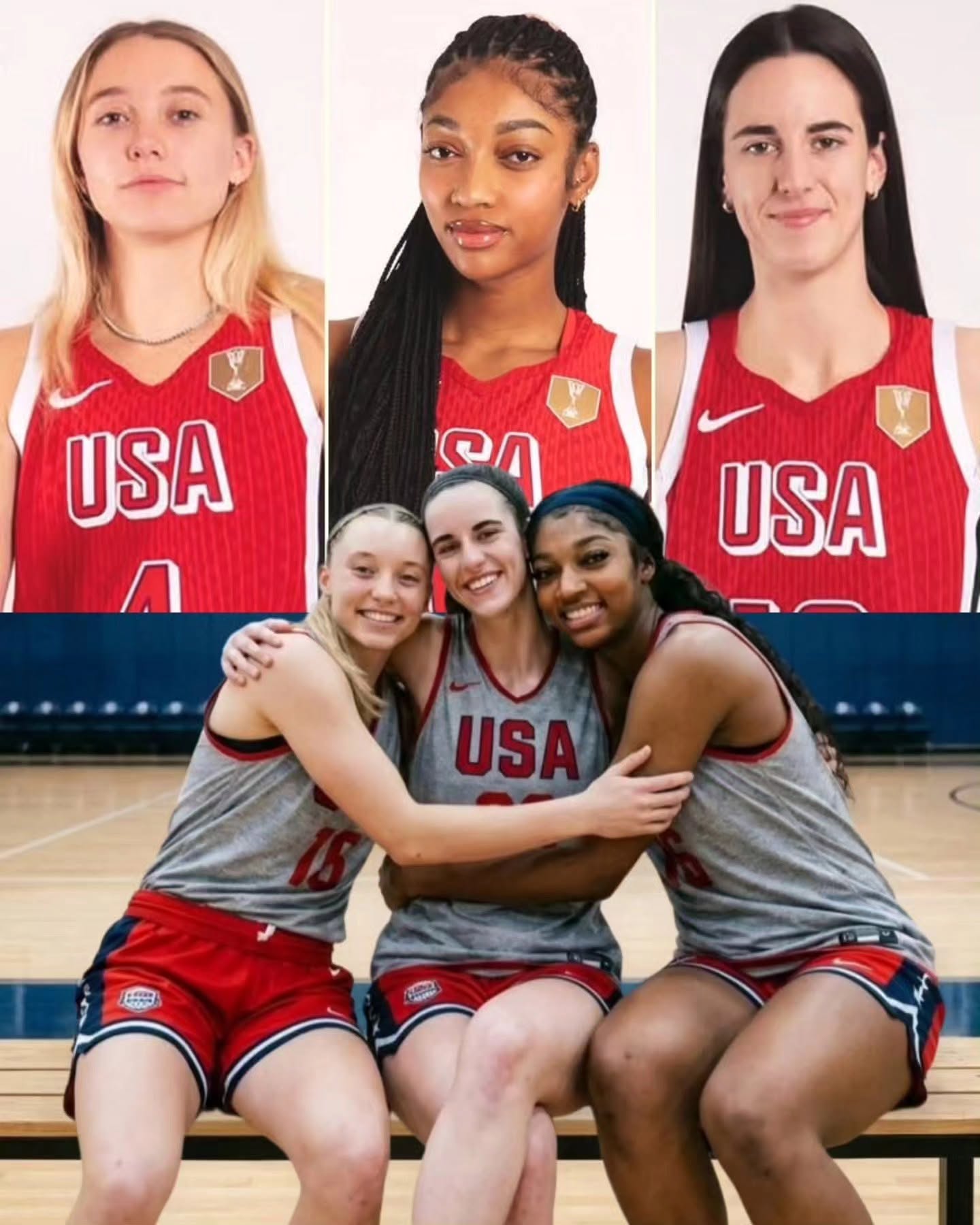
❤️ ANGEL REESE, PAIGE BUECKERS, AND CAITLIN CLARK PLAYING TOGETHER IS THE CLOSEST THING WE’LL EVER GET TO WORLD PEACE ❤️
Good to see the three superstars unite for the World Cup to lead Team USA 🇺🇸
For years, women’s basketball fans imagined what would happen if three of the biggest young names in the sport — Caitlin Clark, Angel Reese and Paige Bueckers — stopped competing against one another and started chasing the same goal.
In 2026, they finally got the answer.
The three stars joined forces for Team USA at the FIBA Women’s Basketball World Cup in Berlin, creating one of the most fascinating combinations in recent women’s basketball history.
Different personalities.
Different playing styles.
Different journeys.
One jersey.
And one goal: bringing another gold medal home to the United States.
For fans who followed their college careers, seeing Clark, Reese and Bueckers standing together in USA uniforms felt almost surreal.
Clark became a national phenomenon at Iowa, captivating audiences with deep three-pointers, extraordinary passing and an unapologetically competitive personality.
Reese built her own enormous following with physical rebounding, relentless energy and the confidence to embrace every challenge placed in front of her.
Bueckers developed a reputation for smooth scoring, creativity and an ability to control games with remarkable composure.
Their paths frequently became intertwined.
Sometimes through basketball.
Sometimes through comparisons.
And sometimes through media narratives that attempted to transform ordinary competition into personal conflict.
Clark and Reese, in particular, have spent years being portrayed as rivals.
Their famous college battles helped drive enormous interest in women’s basketball, but the conversation surrounding them occasionally became bigger than what was actually happening between the players.
Then Team USA changed the picture.
Suddenly, Clark wasn’t trying to beat Reese.
She was trying to find her with a pass.
Reese wasn’t battling Clark for possession.
She was setting screens, attacking the glass and creating second opportunities for the same team.
Bueckers wasn’t another superstar being compared with either player.
She was another weapon standing beside them.
The jerseys changed everything.
Red, white and blue replaced the colors of their respective WNBA teams.
Individual narratives became secondary.
Winning became everything.
And perhaps that is why fans enjoyed watching the trio together so much.
For once, nobody needed to choose a side.
You could be a Caitlin Clark fan and cheer for Angel Reese.
You could love Paige Bueckers and celebrate a Clark three-pointer.
You could appreciate Reese dominating the boards while waiting for Bueckers to create something spectacular on the next possession.
That feeling inspired the playful description spreading among basketball fans:
“This is the closest thing we’ll ever get to world peace.”
Obviously, it’s a joke.
But there is something meaningful underneath it.
Sports rivalries are entertaining because they create emotional investment.
Fans choose teams.
They choose favorite players.
They argue over statistics.
They debate awards.
They defend their stars.
But international basketball can temporarily erase many of those divisions.
The same athletes who battle throughout the WNBA season suddenly become teammates.
And the same supporters who argue online find themselves cheering for the exact same result.
Clark, Reese and Bueckers also represented something larger than one tournament.
They symbolized the next generation of American women’s basketball.
Each entered the World Cup as a first-timer at the senior global championship level, sharing the stage with accomplished veterans and learning what it means to carry USA Basketball’s enormous expectations.
And those expectations are unlike almost anything else in the sport.
Team USA doesn’t simply arrive hoping to compete.
The standard is gold.
Anything less immediately becomes a national basketball story.
That pressure made the sight of the young stars working together even more significant.
They weren’t participating in an exhibition.
They were contributing to one of basketball’s most successful international programs.
And they delivered.
The United States completed the tournament undefeated and defeated France 97–79 in the championship game, securing a fifth consecutive Women’s World Cup title.
Clark made her presence felt throughout the competition as a facilitator, finishing as Team USA’s leading player in assists per game.
Reese supplied rebounding and interior energy.
Bueckers provided another dynamic scoring and playmaking option.
But the lasting image may not be any individual statistic.
It may simply be the three of them together.
Three players who have generated countless debates.
Three fan bases that don’t always agree.
Three careers that will likely intersect repeatedly for years.
Yet in Berlin, none of that mattered.
They were teammates.
Clark and Reese even addressed the exaggerated narrative