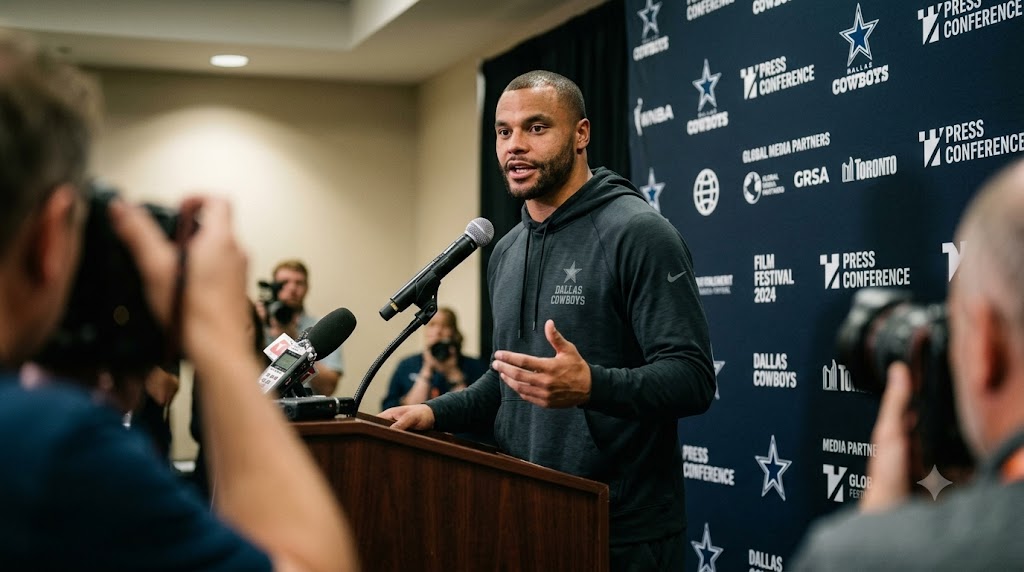
🚨 COWBOYS NIGHTMARE OPENER: Dallas Falls 28–20 to Giants as Dak Prescott’s Troubling Career Trend Returns
The Dallas Cowboys lose 28–20 to the New York Giants. Dak Prescott’s record when trailing by a touchdown at halftime now stands at 13–37 for his career. Prescott’s career record in season openers falls to 4–7.
Both the offense and defense continue to be consistently inconsistent. This team looks seemingly weaker than it did last year, and at this point, it doesn’t appear to be a dominant team in the NFC East—let alone the NFC.
There’s still a lot of football left to play, but there is clearly a lot of work to be done.
For a Cowboys team entering the season hoping to establish itself as a legitimate NFC contender, this was hardly the statement Dallas wanted to make.
Losing 28–20 is frustrating enough. Losing to the New York Giants—an NFC East opponent Dallas desperately needed to handle—is significantly more concerning.
The biggest problem wasn’t one catastrophic mistake. It was the collection of inconsistencies that appeared on both sides of the football.
There were moments when the offense looked capable of finding rhythm, only for a promising possession to stall. There were flashes when the defense appeared ready to seize control, only for New York to answer with another productive drive.
Dallas simply never looked completely comfortable.
And when the Cowboys needed somebody to change the momentum, that defining moment never arrived.
Naturally, much of the conversation will center around Dak Prescott.
Quarterbacks receive disproportionate praise when their teams win and disproportionate criticism when they lose. That’s particularly true in Dallas, where every Prescott performance is examined as though it were a postseason game.
The statistic circulating after the defeat will only intensify that scrutiny: Prescott’s career record when trailing by a touchdown at halftime is now 13–37.
Numbers like that don’t tell the entire story of a quarterback’s career. Football outcomes depend on offensive lines, receivers, coaching decisions, defensive performance, special teams and countless situational factors.
But the statistic does highlight a concern Cowboys fans have expressed repeatedly.
When Dallas falls behind, can Prescott consistently drag the team back into the game?
That question becomes even louder after another disappointing opener.
Prescott’s reported career record in season openers falling to 4–7 adds another layer to the frustration. Opening games don’t determine championships, but they often reveal whether a team is prepared to immediately establish its identity.
Dallas didn’t.
Instead, the Cowboys looked like a team still searching for answers.
The offense showed enough potential to make the loss frustrating rather than hopeless. Dallas reached 20 points and generated stretches of productive football, but sustained execution remained elusive.
That’s the difference between showing potential and controlling a football game.
Championship-level offenses don’t merely produce occasional highlights. They repeatedly finish drives, protect the football, convert crucial downs and capitalize when momentum is available.
Dallas couldn’t consistently do those things.
The defensive performance may be equally concerning.
A franchise with serious postseason aspirations cannot routinely surrender scoring opportunities and expect the quarterback to rescue the game every week.
Giving up 28 points to a divisional opponent immediately puts pressure on the offense.
Against stronger NFC teams, that formula becomes even more dangerous.

The Cowboys need defensive consistency—particularly in high-leverage situations where one stop can completely change the direction of a game.
Instead, New York repeatedly found ways to keep Dallas uncomfortable.
That’s why this loss feels bigger than an ordinary Week 1 disappointment.
It’s not simply the 0–1 record.
It’s what the performance suggested.
Dallas entered the season needing evidence that the roster had improved enough to challenge the conference’s best teams. After this performance, fans are understandably asking the opposite question:
Did the Cowboys actually get worse?
One game cannot definitively answer that.
NFL seasons are long, unpredictable and frequently strange. Teams that look terrible in September can become dangerous by December. Injuries change everything. Young players develop. Coordinators make adjustments. Offensive lines develop chemistry.
But Dallas cannot use the length of the season as an excuse.
The NFC East doesn’t provide much room for prolonged experimentation.
Divisional losses are particularly costly because they influence both the standings and potential tiebreakers later in the year.
If Dallas wants to become a genuine contender, the correction process must begin immediately.
Prescott needs better consistency around him, but he also needs to deliver the type of commanding performances expected from a franchise quarterback.
The offensive line must provide stability.
Receivers need to create separation and capitalize on opportunities.
The running game needs to give the offense balance.
The defense must stop allowing opponents to dictate crucial stretches of games.
And the coaching staff needs to ensure the same problems don’t repeatedly surface.
Because eventually, inconsistency becomes an identity.
That’s the danger facing Dallas.
For years, Cowboys fans have heard about talent, expectations and potential. Every season begins with discussion about whether this could finally be the year Dallas makes a serious postseason breakthrough.
But potential doesn’t win the NFC East.
Execution does.
And against New York, Dallas simply didn’t execute consistently enough.
There is still plenty of football remaining, and declaring the season finished after one defeat would be ridiculous.
But dismissing the warning signs would be equally foolish.
The Cowboys have time to recover.
They have time to fix the offense.
They have time to stabilize the defense.
They have time to prove Prescott can lead another successful season.
What they don’t have is unlimited time.
The rest of the NFC isn’t waiting for Dallas to figure things out.
The Cowboys wanted to begin the season looking like a contender.
Instead, they leave Week 1 facing uncomfortable questions about their quarterback, their defense, their roster and whether this team is genuinely capable of competing with the NFC’s elite.
One game doesn’t define a season.
But sometimes, one game reveals exactly how much work remains.
And after a 28–20 loss to the Giants, the Dallas Cowboys clearly have plenty of it.