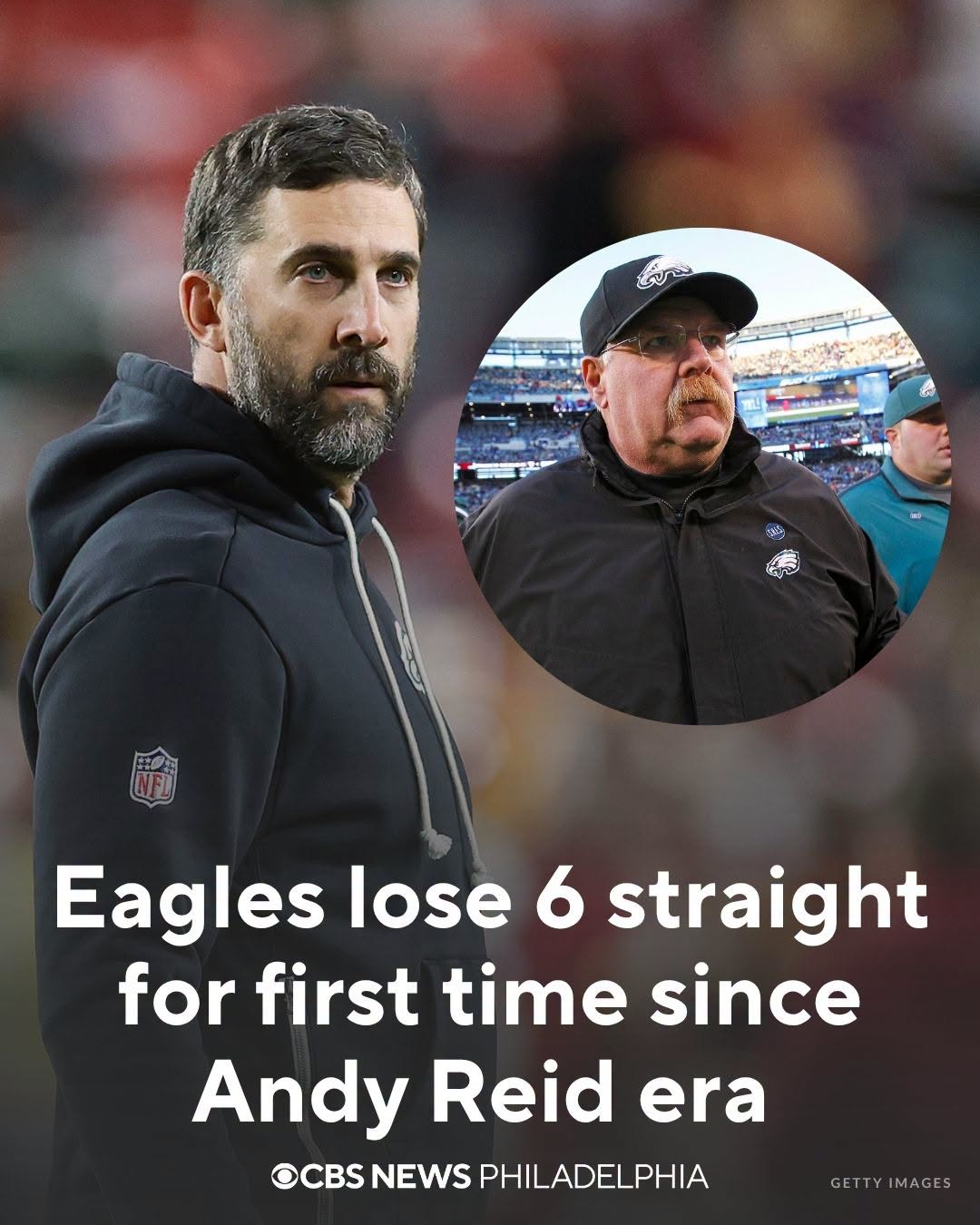
🚨💔 PHILADELPHIA EAGLES HIT A LOW NOT SEEN SINCE ANDY REID’S FINAL SEASON — SIX STRAIGHT LOSSES HAVE TURNED A NIGHTMARE START INTO A FULL-BLOWN CRISIS 🦅🏈
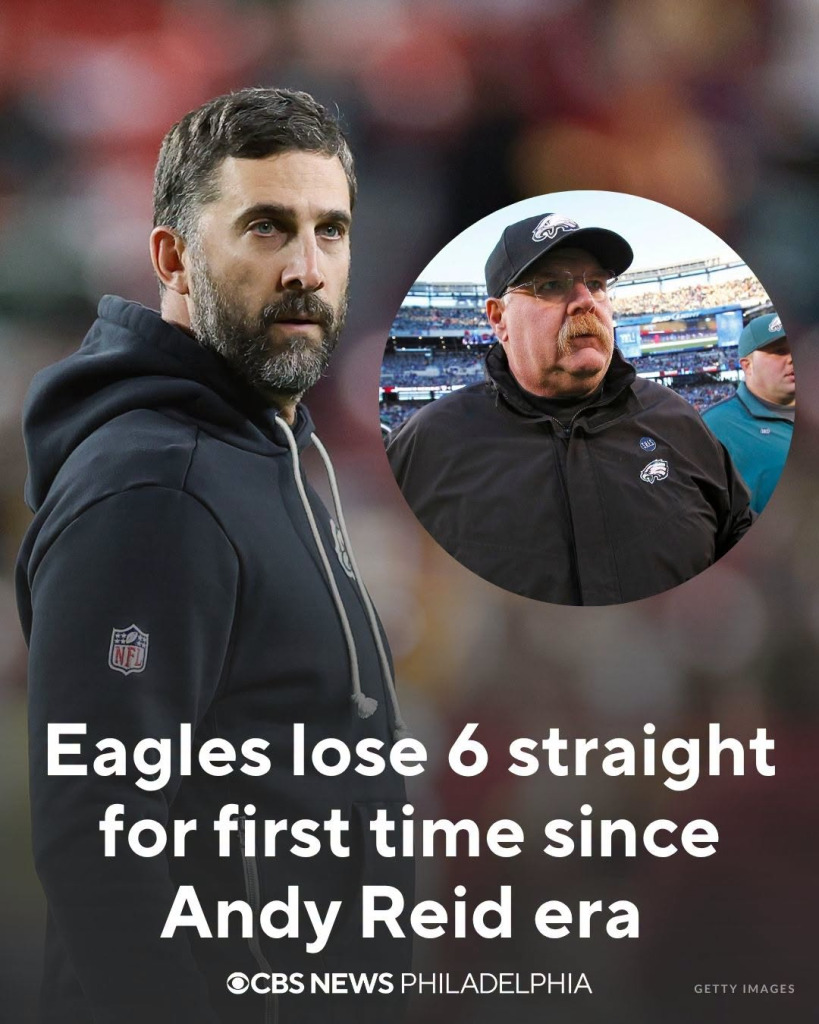
The Philadelphia Eagles have officially entered territory their fans hoped they would never have to revisit.
Six consecutive losses.
For the first time since 2012, Philadelphia has dropped six games in a row, and the historical comparison attached to that number makes the situation even more uncomfortable.
The last time it happened was during Andy Reid’s final season as head coach of the Eagles.
Philadelphia’s latest setback came Sunday night in a 27–10 loss to the Washington Commanders, dropping the Eagles to 2–6 and extending a losing streak that has transformed what began as a season filled with expectations into one dominated by frustration and increasingly difficult questions.
Perhaps the most painful part was the way Philadelphia lost.
The Eagles actually started well.
They jumped ahead 10–0 in the first quarter, giving their fans at least temporary hope that this might finally be the night when the streak ended.
Saquon Barkley scored Philadelphia’s only touchdown.
Then everything changed.
Washington responded with 27 unanswered points.
By the time the game ended, the Eagles had gone from controlling the opening stages to walking off the field following another double-digit defeat.
And suddenly, that number was impossible to ignore.
Six.
Six straight losses.
Six weeks without experiencing the feeling of walking into the locker room after a victory.
For a franchise accustomed to competing for championships in recent years, the fall has been dramatic.
The comparison with 2012 only makes it more haunting.
That season, the Eagles finished 4–12 under Reid. Philadelphia endured an eight-game losing streak, and when the season ended, so did one of the longest and most important coaching tenures in franchise history. Reid departed Philadelphia after 14 seasons before eventually building another extraordinary chapter of his career with the Kansas City Chiefs.
Nobody should assume history will automatically repeat itself.
But when a current team begins producing numbers associated with one of the darkest seasons in recent franchise memory, questions naturally follow.
How did Philadelphia get here?
And more importantly:
How does it get out?
The problems against Washington were hardly isolated to one position.
Quarterback Tanner McKee, starting in place of the injured Jalen Hurts, completed 23 of 34 passes for 212 yards but threw an interception and lost a fumble.
He was also sacked five times.
The running game struggled to provide relief.
Barkley managed only 30 rushing yards on 13 carries despite scoring the Eagles’ lone touchdown.
Philadelphia finished with 268 total yards compared with Washington’s 339. The Eagles also committed two turnovers while their opponent committed one.
Those numbers paint the picture of a team struggling to establish control in almost every important area.
There were opportunities.
There were moments when Philadelphia could have shifted momentum.
But those moments repeatedly disappeared.
One particularly frustrating sequence came in the fourth quarter.
Jake Elliott initially converted a field goal, but an illegal formation penalty wiped it away. After Philadelphia was moved backward, Elliott’s second attempt hit the upright.
Instead of closing the gap, the Eagles remained behind.
It was the kind of sequence that feels almost symbolic during a long losing streak.
Even when something finally goes right, another mistake arrives immediately afterward.
Head coach Nick Sirianni did not attempt to distance himself from the responsibility afterward.
He acknowledged that what happens on the field ultimately falls on him and said he needs to do a better job finding solutions.
That accountability matters.
But Eagles fans understandably want more than accountability now.
They want answers.
Philadelphia entered this season carrying expectations shaped by recent success. This is a franchise that knows what championship football looks like.
That makes 2–6 particularly difficult to process.
The Eagles are not dealing with one strange upset.
They are dealing with a pattern.
Offensive inconsistency.
Protection problems.
Turnovers.
Defensive breakdowns.
Penalties at damaging moments.
Missed opportunities.
And most troubling of all, an inability to stop one disappointing result from becoming another.
Losing streaks can become psychological battles.
At two losses, everyone talks about fixing mistakes.
At three, pressure grows.
At four, confidence begins to shake.
At five, every mistake feels magnified.
At six, history starts entering the conversation.
And Philadelphia now has history staring directly back at it.
The Eagles’ 2–6 record also carries another remarkable Andy Reid connection.
According to NBC Sports, the last time Philadelphia started a season 2–6 was 1999 — Reid’s first season coaching the Eagles.
The last time the franchise lost six consecutive games was 2012 — Reid’s final season coaching Philadelphia.
That symmetry is almost impossible to believe.
But the Eagles cannot fix 2026 by thinking about 1999 or 2012.
Their decisions now have to be about what comes next.
That could mean examining personnel.
It could mean reconsidering responsibilities on the coaching staff.
It could mean difficult roster decisions.
And with the trade deadline approaching, the organization must determine whether the current season can realistically be rescued or whether some decisions should be made with 2027 in mind.
There is one encouraging piece of history.
Philadelphia has recovered quickly from terrible seasons before.
After finishing 4–12 in 2012, the Eagles went 10–6 the following year under Chip Kelly and returned to the playoffs.
After going 4–11–1 in 2020, Philadelphia reached the postseason the next year in Sirianni’s first season.
NFL fortunes can change remarkably quickly.
But none of that makes the present easier.
Right now, Eagles fans are watching a team searching desperately for an answer.
The next victory would not erase six consecutive defeats.
It would not instantly repair the offense.
It would not solve every defensive problem.
And it certainly would not eliminate the questions surrounding the direction of the franchise.
But it would stop the bleeding.
Because six straight losses are no longer just a rough patch.
They have become a historical warning.
The last Eagles team to fall this far was playing through the final season of the Andy Reid era.
Fourteen years later, Philadelphia has reached that painful number again.
Now the question hanging over the entire organization is painfully simple:
What changes before loss number seven arrives?