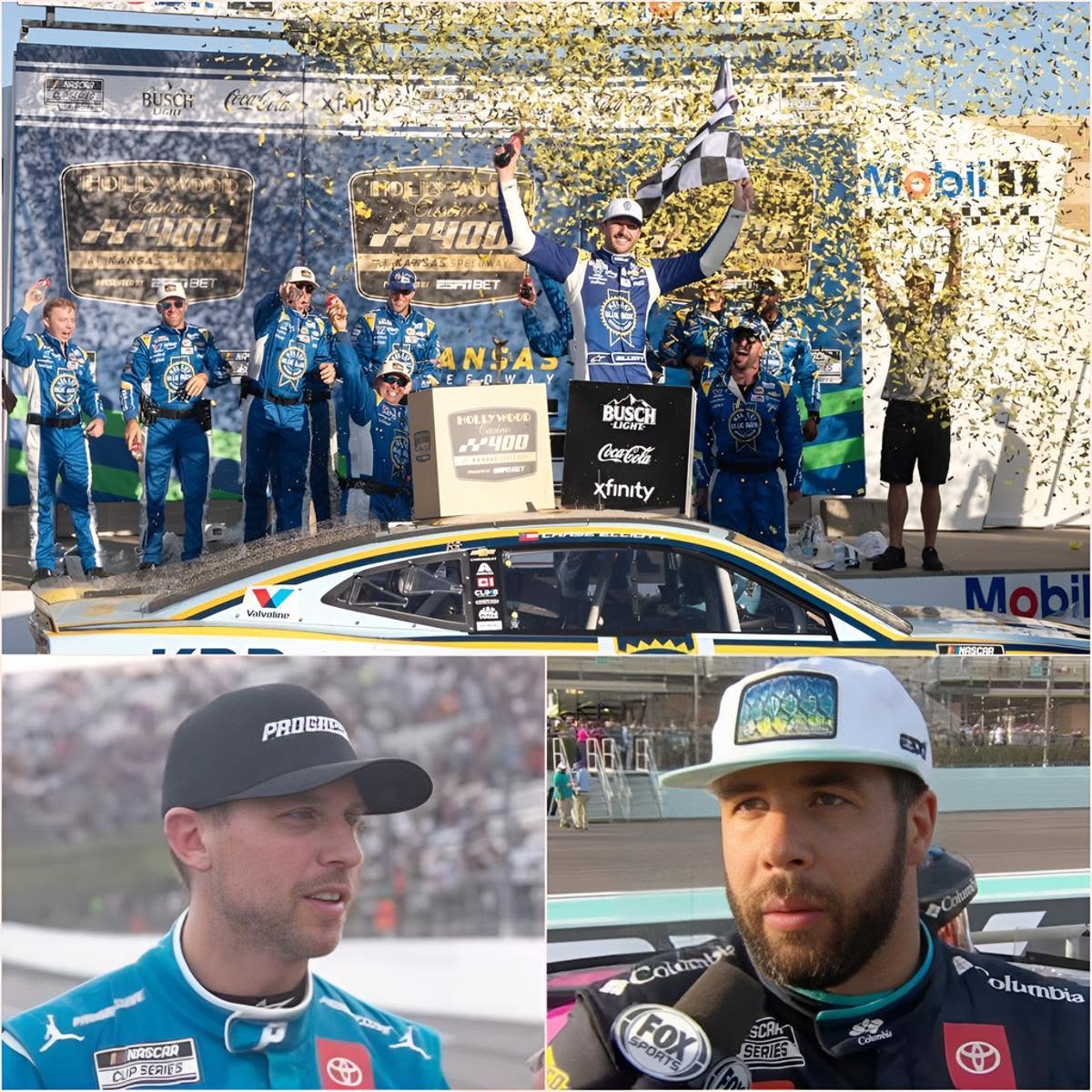
🚨🔥 NASCAR EXPLOSION! DENNY HAMLIN & BUBBA WALLACE WATCH VICTORY SLIP AWAY AS CHASE ELLIOTT STEALS THE SHOW IN A WILD FINAL-CORNER KANSAS SHOCKER 🏁😱
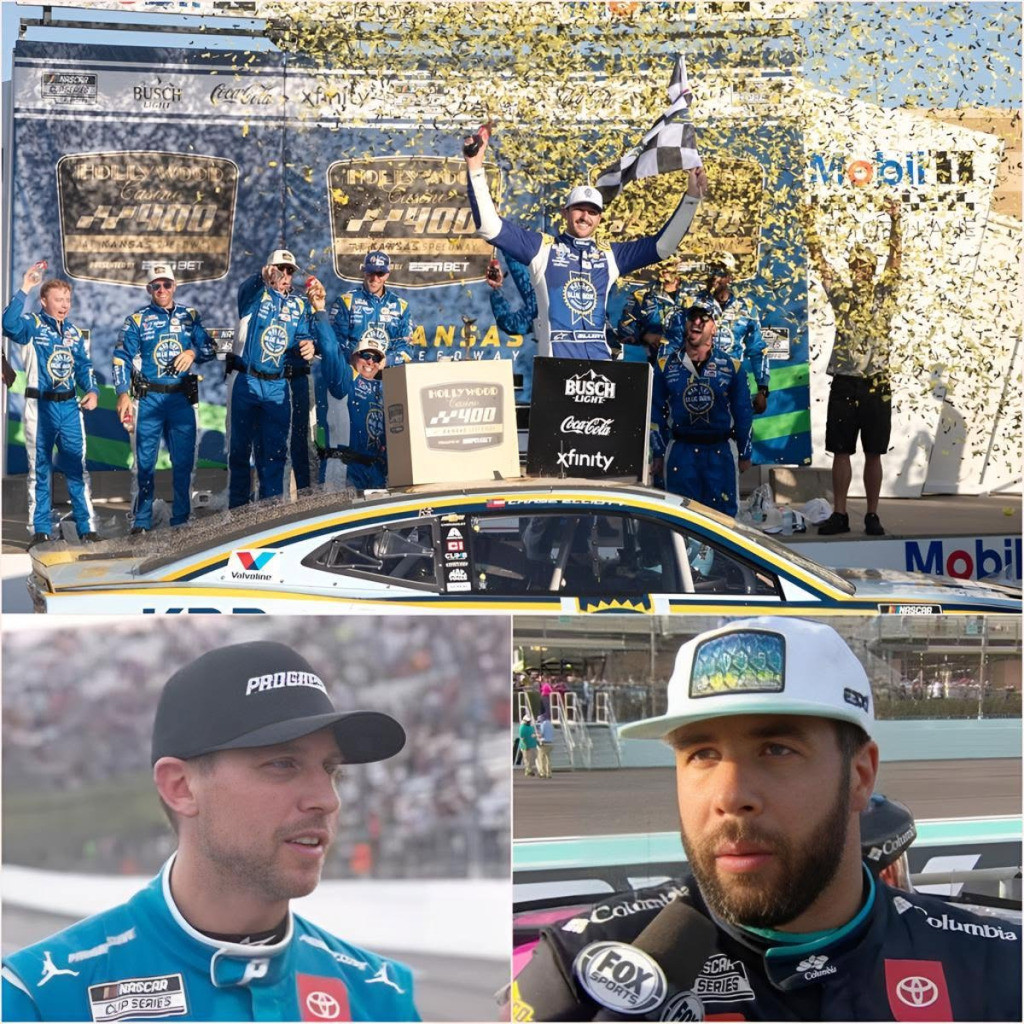
For Denny Hamlin and Bubba Wallace, this was the kind of finish that could replay in their minds for a very long time.
One moment, two Toyotas were fighting for control of the race.
Seconds later, Chase Elliott was celebrating.
The extraordinary finish at Kansas Speedway turned what appeared to be a battle between Wallace and Hamlin into one of the most dramatic late-race reversals of the season—and Elliott needed only one opening to make it happen.
Hamlin had every reason to believe the victory could be his.
He had dominated much of the afternoon, leading a race-high 159 laps and sweeping both stages. Even more remarkably, Hamlin was fighting through a power-steering problem late in the race, forcing him to physically wrestle his No. 11 Toyota around Kansas while trying to secure what would have been the 60th Cup Series victory of his career.
But NASCAR Overtime changed everything.
Wallace found himself at the front.
Hamlin was charging.
Elliott was lurking behind them.
And when the white flag arrived, the race suddenly became less about everything that had happened during the previous hours and more about surviving one final lap.
Wallace held the advantage.
Hamlin closed.
Then the No. 11 attacked.
Entering the final corners, Hamlin went to the inside of Wallace in an attempt to take the victory.
The move didn’t unfold cleanly.
Hamlin’s Toyota moved toward Wallace, pushing the No. 23 high as the two cars fought for space.
For both Toyota drivers, that contact proved devastating.
Their momentum disappeared at precisely the wrong moment.
And Elliott saw everything.
The Hendrick Motorsports driver had restarted deep enough in the field that victory looked unlikely.
But chaos has a way of creating opportunities.
Elliott drove into the opening.
Suddenly, three cars were converging on the finish.
Wallace’s chance was disappearing.
Hamlin was desperately trying to recover.
Elliott kept coming.
Then the checkered flag flew.
Chase Elliott had won.
The margin over Hamlin?
Just 0.069 seconds.
For Elliott and Hendrick Motorsports, it was an extraordinary comeback.
For Hamlin and Wallace, it was brutal.
Neither needed an invented accusation about Elliott “stealing” the race to explain the frustration.
The finish itself told the story.
Hamlin had led 159 laps.
Wallace had been leading late.
Yet neither left Kansas with the trophy.
Elliott did.
Afterward, Hamlin acknowledged that his own final-corner approach had contributed to what happened.
Rather than accusing Elliott of crossing a line, Hamlin reflected on his move against Wallace and admitted he would have approached it differently if given another opportunity.
That detail makes the ending even more fascinating.
Hamlin wasn’t simply racing another competitor.
Wallace drives for 23XI Racing, the organization Hamlin co-owns.
But when the checkered flag is one lap away, ownership relationships become complicated.
Hamlin was driving for Joe Gibbs Racing.
Wallace was driving for 23XI.
Both needed the victory.
Neither could simply surrender it.
That created the opening Elliott needed.
The result became a perfect illustration of NASCAR’s most unforgiving reality:
You can dominate nearly the entire race and still lose everything in a matter of seconds.
Elliott didn’t lead 159 laps.
He didn’t control the afternoon.
He simply positioned himself close enough to capitalize when the drivers ahead of him collided.
And sometimes that is exactly what winning requires.
For Wallace, the ending was particularly painful.
He had an opportunity to grab a major victory and instead found himself shoved high while battling the man who co-owned his race team.
That dynamic immediately became one of the most fascinating elements of the finish.
Imagine the emotions involved.
Wallace wants to win for 23XI.
Hamlin wants Wallace and 23XI to succeed.
But Hamlin is also sitting inside the No. 11 car with his own career, championship ambitions and personal milestone on the line.
At nearly 200 mph, those relationships don’t disappear.
They become more complicated.
And Elliott needed no invitation twice.
The moment he saw the Toyotas lose momentum, he attacked.
That is why describing the finish as Elliott “stealing” the victory can make sense in racing language—as long as it isn’t confused with an accusation of wrongdoing.
Nothing in NASCAR’s official account indicates Elliott illegally took the victory.
He took advantage of the opportunity in front of him.
That’s racing.
And that distinction matters.
The emotional aftermath doesn’t require fabricated quotes or accusations to be dramatic.
Hamlin had just watched win No. 60 disappear after dominating the race.
Wallace had watched a potential victory vanish while fighting his own team owner.
And Elliott had transformed what appeared to be somebody else’s race into his own celebration.
Three drivers.
One corner.
One opening.
0.069 seconds.
That’s all it took.
The finish also created a question NASCAR fans could debate endlessly:
Should Hamlin have given Wallace more room?
Should Wallace have defended differently?
Or did Elliott simply execute exactly what an elite driver is supposed to do when the leaders start battling?
There may never be one answer everyone accepts.
But there is one undeniable lesson from Kansas:
Never assume a NASCAR race is over before the checkered flag.
Because Hamlin appeared capable of winning.
Wallace appeared capable of winning.
And while the two Toyota drivers fought over who would take the trophy home, Chase Elliott arrived from behind and took it from both of them.
Not through an established rules controversy.
Not through a verified scandal.
But by being in exactly the right place when everything ahead of him exploded.
And for Hamlin and Wallace, that may be what made the defeat sting most of all.
They were fighting each other for the victory—and Chase Elliott was the one who drove away with it. 🏁🔥