Bubba Wallace Blames Kyle Larson for Late-Race Incident, Setting Off a Garage Debate Over Aggressive Racing
Bubba Wallace climbed from his car frustrated after a late-race incident cost him several positions, then pointed directly toward Kyle Larson when asked what had happened.
Wallace argued that Larson had moved across his path before completing the pass, leaving him with a choice between lifting abruptly and risking contact.
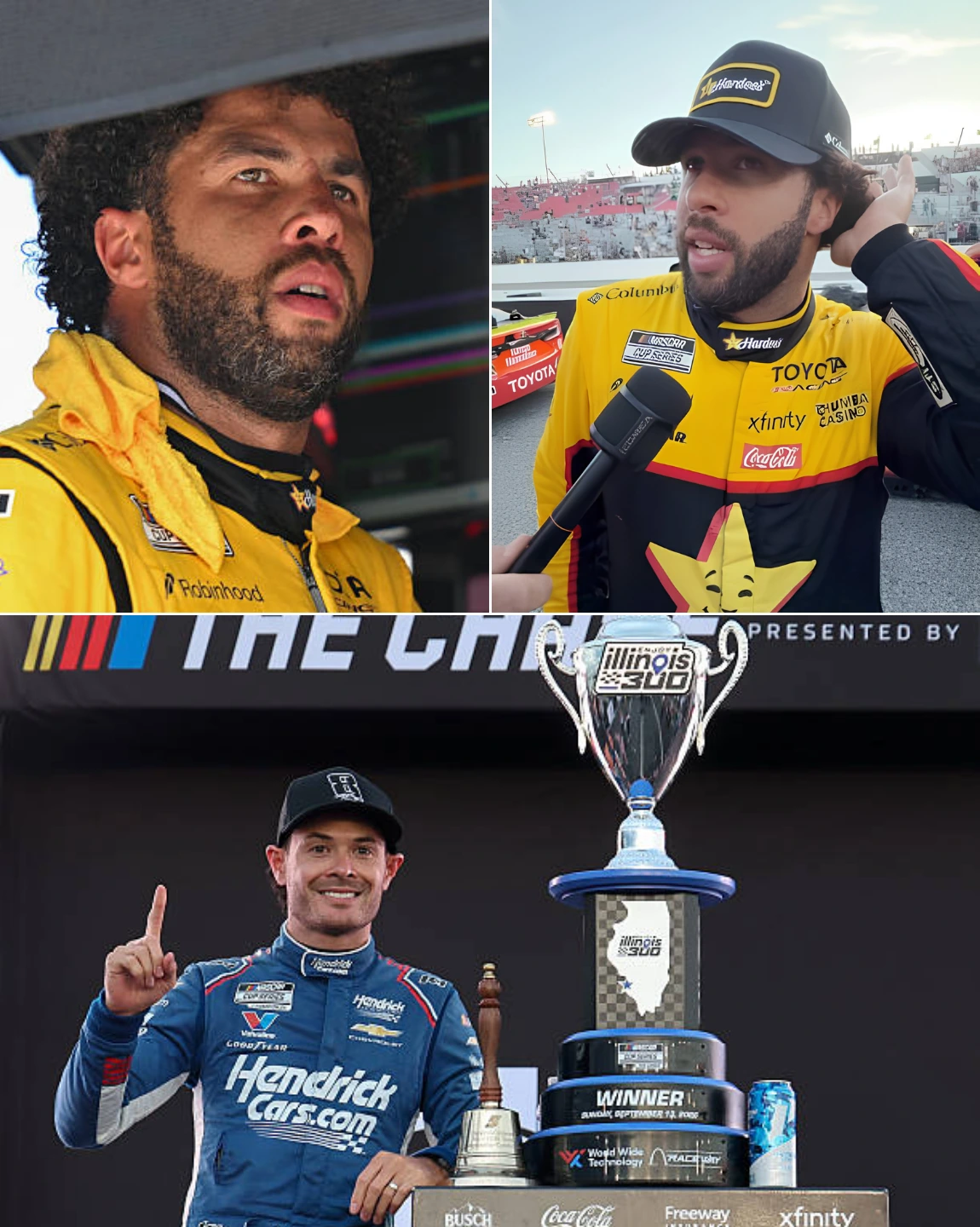
He lifted, lost momentum, and watched several cars move past before he could regain his rhythm.
By the time he reached the interview area, Wallace had already discussed the sequence with his team and wanted his criticism understood clearly.
“That wasn’t making me race harder,” he said.
“That was making me choose how much damage I was willing to take.”
The accusation centered on a move entering the corner, where Wallace believed Larson had claimed space that was not yet available.
He said the closing laps explained the urgency of the attempt but did not excuse placing the consequences of an unfinished pass on another driver.
Wallace acknowledged that Larson was trying to improve his position.
His objection was that the move required Wallace to surrender his own race to prevent the situation from becoming worse.
A reporter asked whether he believed Larson had intentionally tried to ruin his finish.
Wallace stopped short of making that claim.
He said he could not describe Larson’s intentions, but believed the driver making the move remained responsible for understanding what the other car would need to do.
The distinction did little to soften the tone of his criticism.
“You don’t get to call it clean just because the other guy saved it.”
That sentence became the center of the discussion as reporters approached Larson for his account.
Larson said he understood why Wallace was upset but disagreed with the description of the move.
From inside his car, he believed he had established enough of an advantage to take the line, although he acknowledged that Wallace’s position might have looked different from another angle.
He said he wanted to review the footage before accepting a definitive explanation of where the overlap ended.
The response frustrated Wallace when it was relayed to him.
He argued that a driver should not need a replay to recognize when another car was being forced to abandon its approach to the corner.
Larson answered that split-second judgments sometimes produced different accounts, especially when both drivers were measuring the available space while managing traffic around them.
“I made an aggressive move,” Larson said.
“I’m not going to pretend otherwise, but aggressive doesn’t automatically mean I had no right to try it.”
Their disagreement quickly drew attention from other people in the garage, where the incident raised a familiar question about responsibility between an attacking driver and a defending one.
Some sided with Wallace’s argument that avoiding contact should not become evidence that the move had been acceptable.
A driver who lifted to protect both cars could still lose positions because someone else had placed him in an unreasonable situation.
Others believed late-race competition required drivers to accept a narrower margin, particularly when opportunities were disappearing and the cars behind were equally determined to advance.
Those competing expectations made the footage central to the discussion.
A television replay showed Wallace slowing as Larson moved ahead, but the angle did not clearly establish the precise overlap at the moment the disputed move began.
Wallace’s team wanted additional footage considered before anyone dismissed his reaction as frustration over a poor result.
Larson also requested another view, saying the initial replay did not fully show what he could see when he committed to the corner.
Neither driver claimed that a formal ruling had settled the argument.
The debate remained about judgment and racing standards, rather than a confirmed penalty or an announced disciplinary decision.
Wallace said his frustration extended beyond the positions lost in that single sequence.
He wanted to know whether drivers were expected to accept increasingly forceful moves as long as the opponent managed to prevent a collision.
In his view, that standard rewarded the person creating the risk while leaving the more cautious driver to absorb the competitive cost.
Larson challenged the suggestion that his approach depended on Wallace backing out.
He said he had expected the cars to complete the sequence without contact and accepted that reviewing the footage could reveal less room than he had believed.
That acknowledgment was narrower than the apology Wallace’s supporters wanted, but it left open the possibility that Larson’s initial judgment had been wrong.
As the discussion continued, reporters asked Wallace whether the incident would affect how he raced Larson in the future.
Wallace said trust mattered when drivers were competing closely, and that an unresolved disagreement could influence how much room either expected to receive.
He did not announce plans for retaliation.
Larson likewise said he preferred a direct conversation to an exchange conducted entirely through interviews, particularly before another race placed them alongside each other.
They eventually spoke near their transporters, away from the cluster of cameras that had followed their separate explanations.
The conversation did not produce an immediate agreement.
Wallace maintained that he had been forced out of a position he was entitled to contest, while Larson wanted the remaining footage reviewed before reaching a final conclusion.
Both agreed to examine the sequence with their teams rather than continue trading descriptions from memory.
That left the accusation unresolved, but gave the disagreement a practical next step.
The larger argument would remain familiar to everyone watching: how much responsibility belongs to the driver making a bold move, and how much compromise can reasonably be demanded from the person beside him.
Wallace believed he had paid for Larson’s misjudgment.
Larson believed the accusation had reached a conclusion before the full picture was available.
Until they could agree on the space that existed between their cars, neither explanation was likely to satisfy the other.