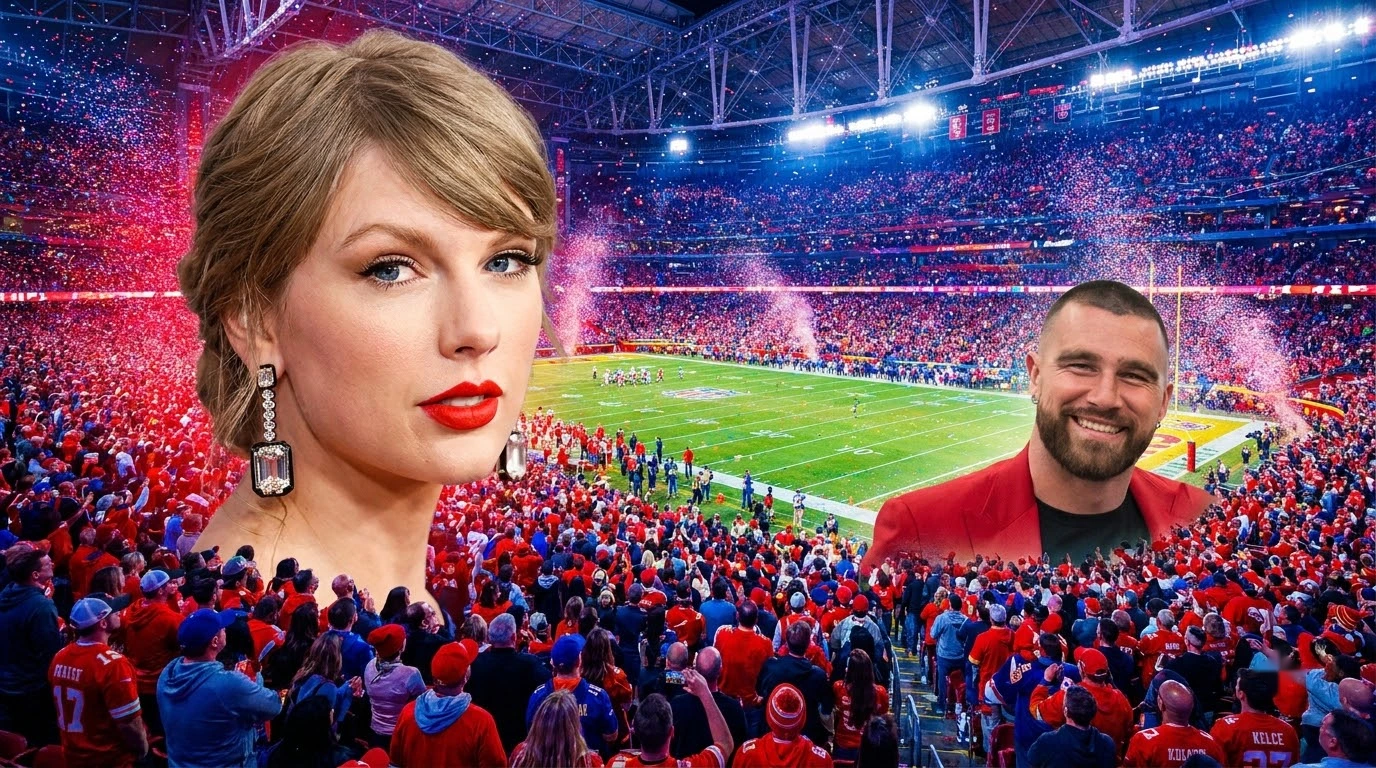
Taylor Swift’s relationship with Travis Kelce brought a new cultural conversation to NFL broadcasts, but audience figures need more care than a single viral claim can provide. Nielsen measured an average audience of 123.7 million for Super Bowl LVIII in February 2024, calling it a record at that time. Its dated measurement release provides the figure. It does not say that every additional viewer watched because of Swift, or that the 2024 record remains the current record in 2026.
That distinction is the starting point for a better discussion. The couple’s visibility created a compelling bridge between pop culture and football. Measuring the size and lasting effect of that bridge requires separating overall viewership, demographic changes, interest surveys and social attention.
An average audience is not every person who tuned in
An average audience measures viewing across the program. A reach figure counts people who watched some qualifying portion of it. Those measures answer different questions, so placing them side by side without labels can create a misleading comparison.
The same is true of television viewers and social-media views. A person scrolling past a short clip is not necessarily equivalent to a person watching a full game. Both forms of attention can matter, but adding their totals together does not produce a clean count of unique fans.
For readers, the practical check is simple: look for the unit, the time period and the definition. A number becomes useful when it says what was measured. Without those details, even an accurate figure can be used to support a claim it was never designed to establish.
Several reasons can bring viewers to the same game

Nielsen’s 2024 sports review discussed the Super Bowl’s audience alongside the overtime finish, Usher’s halftime performance and Swift’s appearance. That is a more complete framing than choosing one attraction and treating the entire audience as its result.
People can watch for different reasons at the same time. A household may include a longtime team supporter, someone interested in the halftime show and someone following the couple. The broadcast brings those interests together, but an aggregate total does not reveal the motive of every person in the room.
That is why a large audience is evidence of attention, while a claim about the cause of that attention requires additional research. The two ideas are related, but they are not interchangeable.
Interest surveys add a different kind of evidence
Morning Consult’s September 2024 analysis examined interest in the NFL among women, including younger women, and discussed Swift’s role in the broader trend. Survey research can ask questions a television count cannot, such as how interested a group says it is in a league.
It still measures something different from a game audience. A person can report interest without watching every broadcast, or watch a major event without becoming a regular fan. The strongest analysis keeps those differences visible instead of using whichever figure produces the largest headline.
It also avoids treating women as a new or uniform audience. Many women followed football long before this relationship became public. Others entered through a specific player, team, family connection or cultural moment. A change within a demographic does not erase the fans who were already there.

A further distinction concerns correlation and a measured cause. Two things can rise during the same period without the available data showing exactly how much one produced the other. Stronger evidence might compare similar events, ask viewers about their motives or follow the same audience over time. Each approach has limits, but each answers a more specific question than a broad headline does.
Readers do not need to dismiss the cultural connection to ask for that precision. They can recognize that Swift drew attention while remaining careful about the size of the effect. That combination makes the discussion more credible: the crossover is visible, and the measurement should be equally clear about what it can establish.
The more interesting question is what lasts
A first visit and a lasting habit are different outcomes. Someone might tune in to see a familiar face and then become interested in the rules, a team’s personalities or the weekly competition. Whether that happens is a better long-term question than how many seconds a broadcast showed a celebrity.
There are useful signs to look for: continued viewing, repeat engagement and a growing understanding of the game. But those signs need measurement across time. A single high-profile weekend cannot establish a permanent change in behavior.
For publishers and fans alike, that makes the story more interesting rather than less exciting. A cultural crossover can create an introduction. The sport, the community and the viewing experience influence whether people return after the introduction is over.
Swift and Kelce gave the NFL a highly recognizable connection to another enormous audience. The evidence supports discussing that connection; it does not justify assigning every record to one person. The better story is how different interests meet inside the same broadcast—and whether a moment of curiosity develops into a habit after the most shareable headline has passed.
Photo credits: Taylor Swift at the 2023 MTV Video Music Awards 4.png — iHeartRadioCA, CC BY 3.0; photographed 2023-09-13. Aerial view of Arrowhead Stadium 08-31-2013.jpg — Ichabod, CC BY-SA 3.0; photographed 2013-08-31. Taylor Swift The Eras Tour Midnights Era Set (53109798059).jpg — Paolo V, CC BY 2.0; photographed 2023-08-09. Archival photographs illustrate the people and settings discussed; they do not depict every reported event.


.jpg)