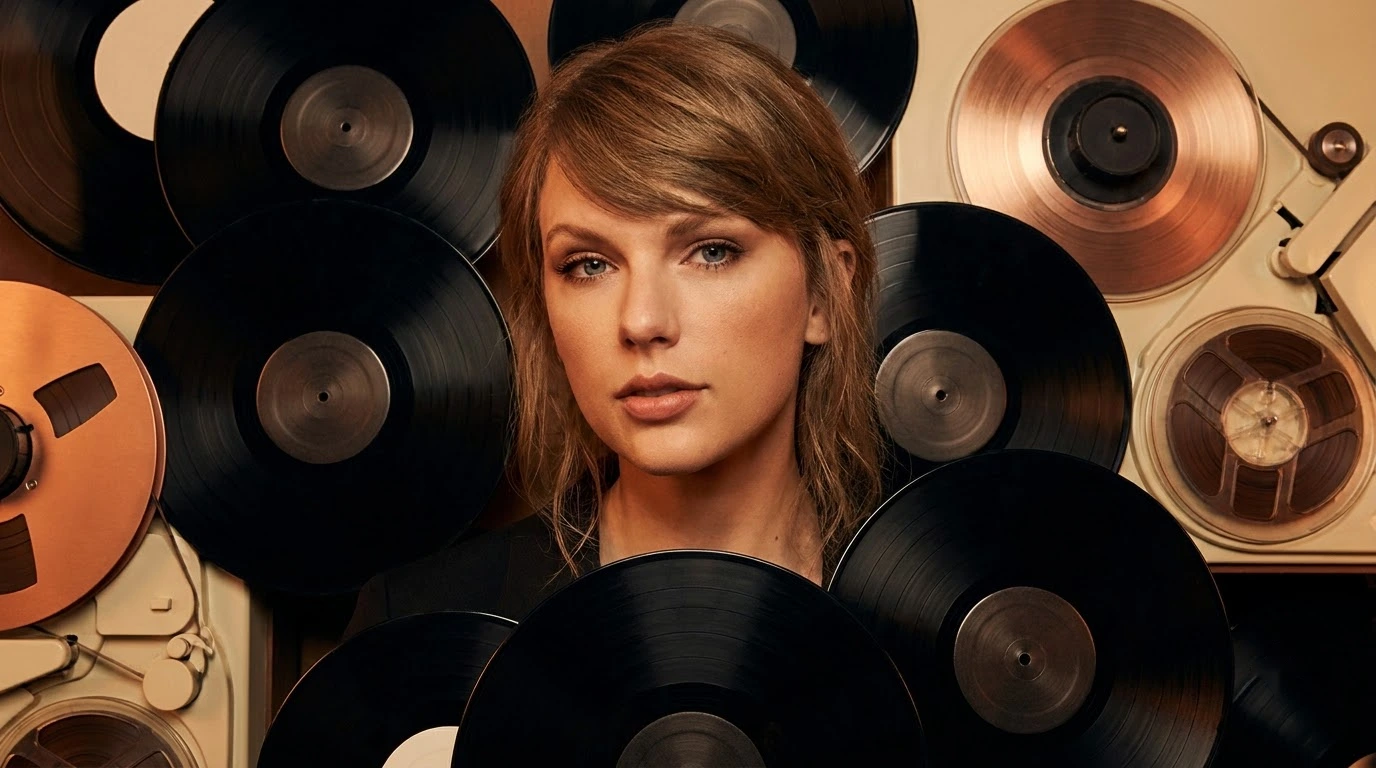
Taylor Swift announced in May 2025 that she had acquired the master recordings of her first six albums, a major ownership milestone that continues to shape how fans understand her career. In her letter to fans, she described gaining control of earlier recordings and associated creative materials. Shamrock Capital’s dated announcement also acknowledged the outcome. This is a look back at that acquisition, not a report that another catalog sale has just occurred.
For readers who mainly follow Swift through her relationship with Travis Kelce, the story offers a different kind of dramatic arc. It concerns work made across years, the ownership of that work and the audience that supported it. Understanding the distinction makes later interviews and album releases easier to place in context.
A recording and a song are different things
In everyday conversation, people use the word song for both a composition and a particular recorded performance. The music business distinguishes them. A composition concerns the underlying musical and lyrical work; a master recording is a specific recorded version. That is why two recordings of the same song can exist as separate releases.
The distinction helps explain rerecording without reducing it to a duplicate playlist. A new performance can recreate a familiar composition while producing a different recording. For listeners, the versions may carry emotional, sonic or historical differences even when they share a title and core structure.
This is general background for understanding the news, rather than advice about anyone’s contract. The key reading habit is to ask which kind of right or asset a report is discussing. A headline about recordings should not automatically be expanded into every imaginable right associated with a career.

Why the original catalog mattered to the audience
Early albums often carry a particular emotional weight because listeners connect them with their own lives. A recording may remind someone of a school year, a friendship or a first concert. Ownership news can therefore become personally meaningful to fans even though the transaction happens in a business setting.
That is part of what made Swift’s announcement easy to understand beyond industry specialists. The catalog was not an abstract set of files to the people who had listened to it for years. It was a collection of familiar performances with a history attached.
The business outcome and the fan response still should not be confused. Enjoying a song is not the same as negotiating a transaction. The audience can be part of the broader story without a publication inventing the private terms or assigning a purchase price that the parties did not publicly confirm.
The rerecordings remain part of the story
Music Business Worldwide’s May 30 reporting documented the acquisition and the earlier catalog dispute. By the time the announcement arrived, the rerecording project had already given listeners alternate versions of several albums. The acquisition did not erase those releases or the time fans spent with them.
That leaves listeners with a richer catalog history. They can hear the earlier performance and the later interpretation as records of different moments in the same artist’s life. A change in ownership does not make the musical differences disappear, and a preferred version can still be a matter of listening taste.

The useful question is therefore broader than which version someone is supposed to choose. It is how the versions relate: what changed in delivery, production or the listener’s own expectations. Those comparisons can remain interesting after the central ownership conflict has changed.
There is also a practical listening distinction between historical importance and personal preference. A recording can matter because it captures a particular stage of an artist’s career, while a later version may offer a performance another listener prefers. Those judgments can coexist without turning every playlist choice into a statement about the entire business dispute.
Keeping the categories separate makes the catalog easier to explore. One question is who controls a recording. Another is how that recording sounds. A third is what it means to the person hearing it. Swift’s acquisition changed an important part of the first question, while leaving listeners free to keep considering the others. That is why the story continues to matter even after the announcement itself is no longer new.
Where the Kelce connection fits
Swift later discussed her masters on “New Heights,” placing the ownership story in a conversation hosted by Travis and Jason Kelce. Axios’s coverage of that episode noted the subject. The podcast gave another audience an entry point, but it did not turn the acquisition into a relationship achievement.
That distinction gives Swift’s professional work its proper scale. A supportive partner and a familiar interview setting can help tell a story. The underlying achievement still concerns the artist, her catalog and the people directly involved in the transaction.
Revisiting the May 2025 announcement is useful because it explains why ownership remains a recurring theme around Swift’s work. New songs attract attention to what comes next; a catalog acquisition changes how earlier work sits within the career. Both can matter at once. For readers arriving through the couple’s current headlines, the masters story supplies a substantial piece of the artist’s history that no date-night photograph can capture.
Photo credits: 191125 Taylor Swift at the 2019 American Music Awards (cropped).png — Cosmopolitan UK, CC BY 3.0; photographed 2019-11-24. Swift, Taylor (2007).jpg — minds-eye, CC BY-SA 2.0; photographed 2007-08-10. Taylor Swift Eras 08092023-589.jpg — Paolo V, CC BY 2.0; photographed 2023-08-09. Archival photographs illustrate the people and settings discussed; they do not depict every reported event.
.png)
.jpg)
