For more than two decades, Novak Djokovic has built a career defined by championships, records, relentless competitiveness, and an almost unmatched ability to survive pressure. But sometimes, the full weight of a sporting legacy is easier to understand in a few seconds than in an entire book of statistics.
A short video celebrating Djokovic’s journey does exactly that.
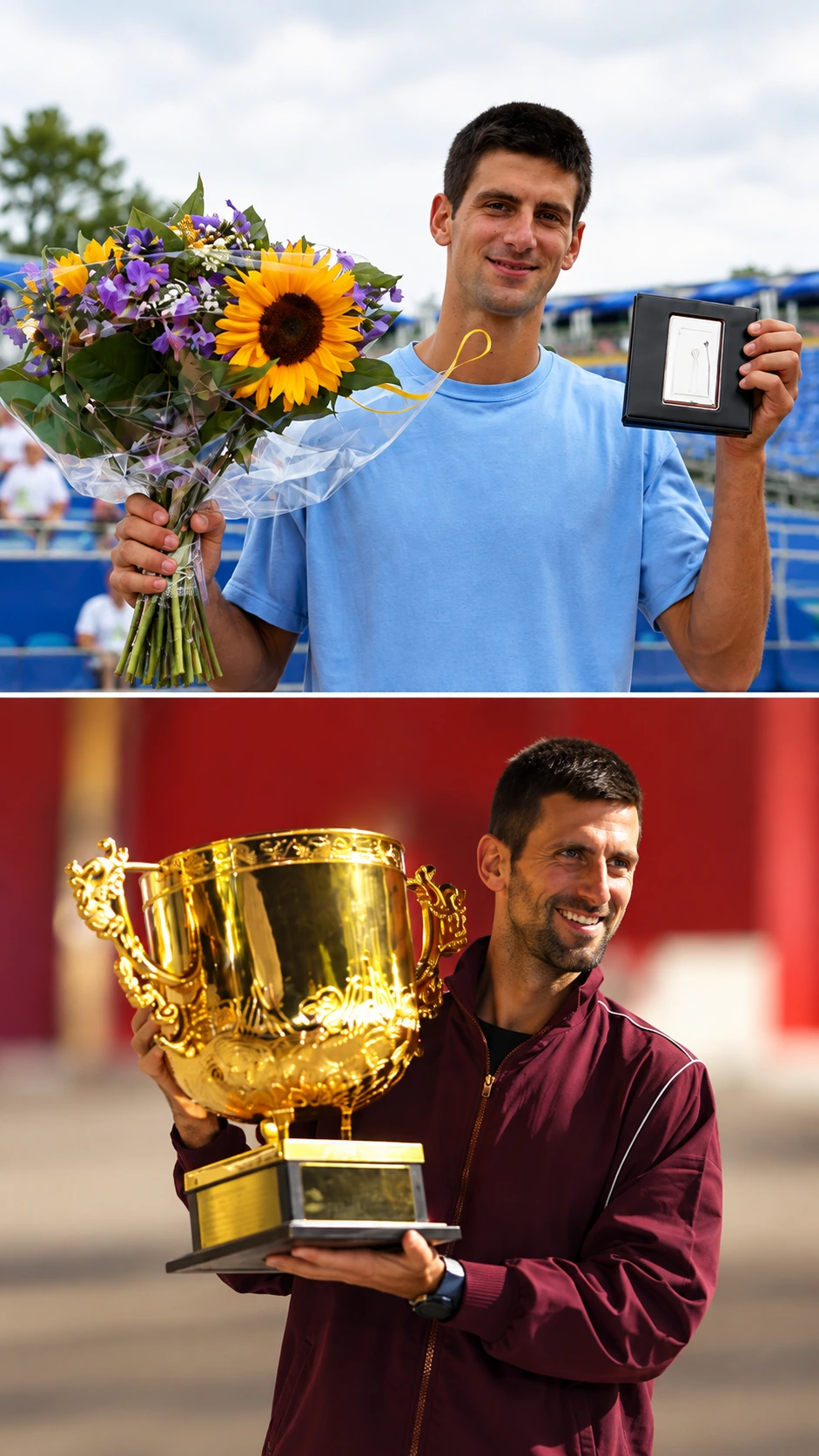
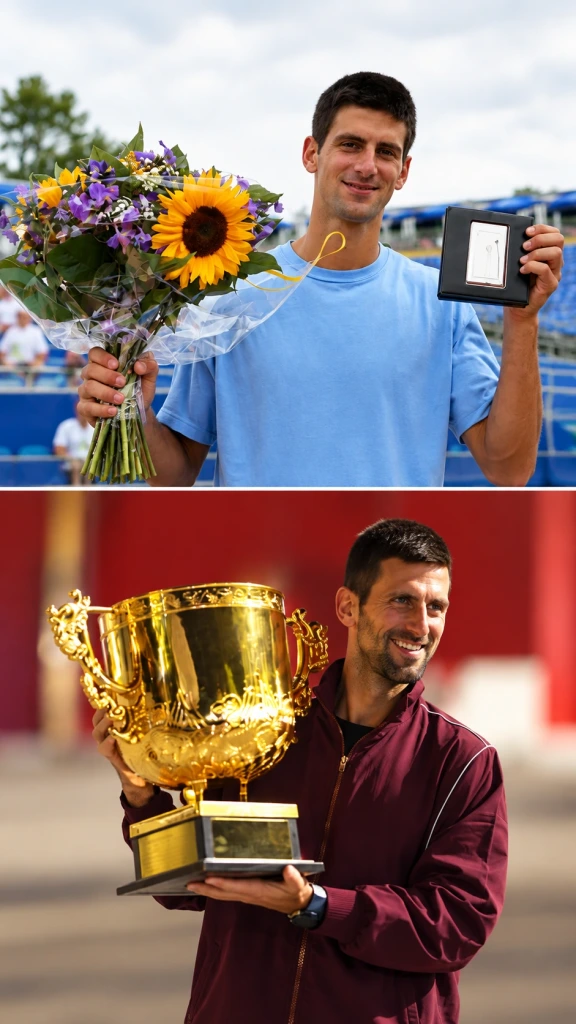
The clip places two striking images side by side: a younger Djokovic holding flowers and a modest award, and the modern-day champion smiling beside a massive golden trophy. The contrast is immediate. One image represents ambition, possibility, and the beginning of a remarkable climb. The other represents what happened after years of sacrifice, controversy, extraordinary victories, painful defeats, and an obsession with improvement.
It is more than a “then versus now” moment.
It is a visual summary of one of the most extraordinary careers tennis has ever witnessed.
From Promising Talent to Global Superstar
Long before Djokovic became one of the defining athletes of his generation, he was simply another highly talented player trying to break through in an era dominated by established giants.
The early image captures that feeling perfectly.
There is youth in his face, but also unmistakable confidence. He holds flowers in one hand and an award in the other, smiling like someone who understands that something important has happened — but who could never completely know how enormous the journey ahead would become.
At that stage of his career, Djokovic was not yet the player whose name would become synonymous with Grand Slam battles and historic milestones.
He was chasing the sport’s biggest names.
Eventually, the entire tennis world would be chasing him.
That transformation is what makes the video so compelling.
The transition from a relatively simple early-career celebration to the enormous golden trophy in the second half of the frame creates an emotional message without needing complicated narration:
Look how far he came.
A Career Built Under Extraordinary Pressure
Djokovic’s rise was never simple.
He emerged during an era featuring some of the most accomplished players the sport had ever seen. Instead of waiting for their dominance to disappear, Djokovic forced himself directly into the conversation.
That required more than talent.
It demanded physical reinvention, tactical intelligence, mental resilience, and a willingness to repeatedly enter stadiums where thousands of spectators might be supporting the player standing across the net.
Over time, that pressure became part of his identity.
Djokovic developed a reputation for performing especially well when matches appeared to be slipping away. Break points, deciding sets, hostile crowds, exhausting rallies — moments that could overwhelm other players often seemed to sharpen his concentration.
That quality helped turn him from a champion into something far more significant.
He became a symbol of competitive survival.
For many fans, that is the real reason his career resonates so strongly.
The trophies matter.
The records matter.
But the moments when he appeared nearly defeated and somehow found another level are what made countless supporters emotionally connected to his journey.
The Trophy Tells Only Half the Story
The golden trophy in the video is deliberately dramatic.
Its enormous size dominates the frame, instantly communicating success. Djokovic stands beside it smiling, appearing comfortable with the kind of victory scene that has become familiar throughout his career.
Yet ironically, the trophy itself is not the most powerful part of the image.
The contrast is.
When viewers see the younger Djokovic above the established champion below, the object in his hands becomes secondary. The real story is the time between the photographs.
Years of training.
Thousands of hours on court.
Physical pain.
Travel.
Public scrutiny.
Championship points.
Unexpected losses.
Comebacks.
Rivalries.
And the constant requirement to prove himself again after already achieving things most athletes could only dream about.
A trophy is the visible reward.
The invisible story is everything required to hold it.
Why Djokovic’s Legacy Continues to Fascinate Tennis Fans
Sports fans often debate greatness using numbers.
Who won more?
Who dominated longer?
Who faced stronger opponents?
Who performed better on different surfaces?
Those arguments are unlikely to disappear, particularly in tennis, where comparisons between generations are almost unavoidable.
But Djokovic’s legacy has always been especially difficult to reduce to a single number.
His story involves statistics, certainly, but also personality, resistance, adaptation, and longevity.
He has spent much of his career evolving.
When younger opponents arrived with explosive athleticism, Djokovic adjusted.
When matches became more physically demanding, he adjusted.
When pressure increased because every tournament carried historical significance, he adjusted again.
That ability to continue competing against new generations may eventually become one of the most important parts of his story.
Most champions dominate a particular era.
The rarest champions survive several.
One Image Represents Hope. The Other Represents History.
Perhaps the most emotional interpretation of the video comes from imagining what the younger Djokovic might think if he could see the second photograph.
Would he believe it?
Would he understand how many historic matches were coming?
Would he understand how many times people would doubt him?
Would he understand that his name would one day become inseparable from debates about the greatest tennis player in history?
Probably not.
And that is precisely why the video works.
The younger athlete appears to be celebrating one step.
The older athlete represents the result of thousands of steps.
For viewers, particularly longtime supporters who followed Djokovic throughout his career, that contrast creates nostalgia. They remember the early tournaments, the rivalries, the dramatic finals and the seasons when every major tournament seemed to become another chapter in tennis history.
The video therefore becomes more than a highlight.
It becomes a memory trigger.
The Final Chapter Is Still Being Written
There is another reason these images feel especially powerful.
Whenever a legendary athlete reaches the later stages of a career, every appearance begins to carry additional meaning.
Fans understand that the number of remaining tournaments is no longer unlimited.
Every victory may become historic.
Every celebration might eventually become one of the final great images.
That changes how supporters watch.
Instead of simply asking whether Djokovic will win the next match, many now ask a larger question:
How much more history can he create?
That question gives even ordinary moments additional emotional weight.
A smile beside a trophy is no longer merely a victory photograph.
It becomes part of the closing chapters of an extraordinary sporting career.
And yet Djokovic’s story has repeatedly demonstrated the danger of declaring anything finished too early.
Again and again, when expectations shifted away from him, he found another way to surprise people.
That is why fans continue watching.
More Than a Champion
Ultimately, Djokovic’s career will be remembered through trophies, rankings, championship matches and records.
But legacy is not created by numbers alone.
Legacy is created by the emotional memories surrounding those numbers.
It is created by the rallies people replay years later.
It is created by the celebrations, the heartbreak, the rivalries and the moments when millions of viewers felt that they were witnessing something historic.
The short video captures that idea beautifully.
At the top is a young player with flowers and an award, still climbing.
At the bottom is an established legend holding a trophy almost impossibly large.
Between those two images lies an entire generation of tennis history.
And perhaps that is the strongest message of all.
Novak Djokovic did not simply collect trophies.
He transformed himself from a young contender chasing greatness into one of the athletes whose career now defines what greatness looks like.