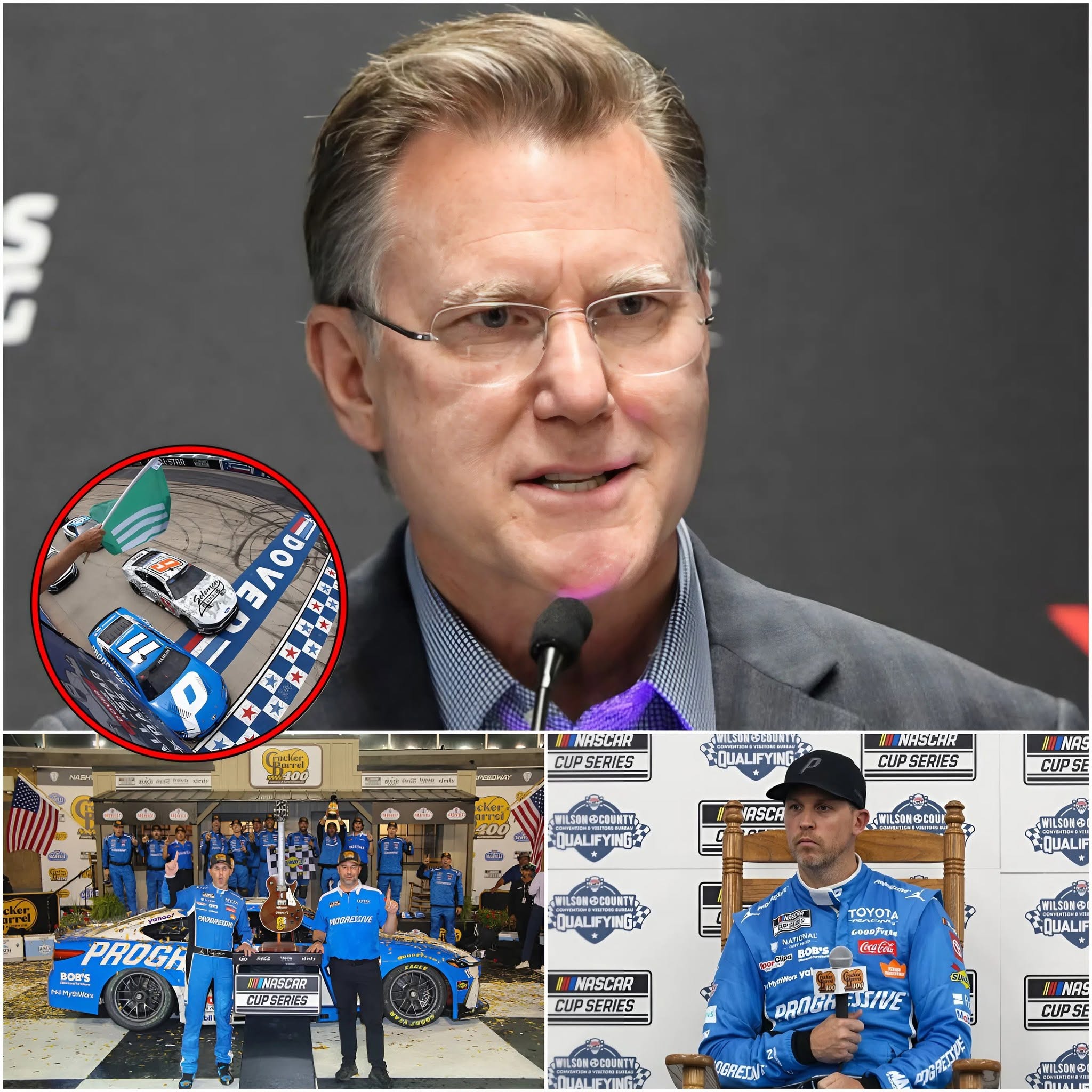
🚨 OFFICIAL NASCAR PENALTY: DENNY HAMLIN’S NASHVILLE VICTORY SPARKS CONTROVERSY AFTER EARLY-RACE VIOLATION — WAS THE CRACKER BARREL 400 WIN LEGITIMATE? 🏁🔥
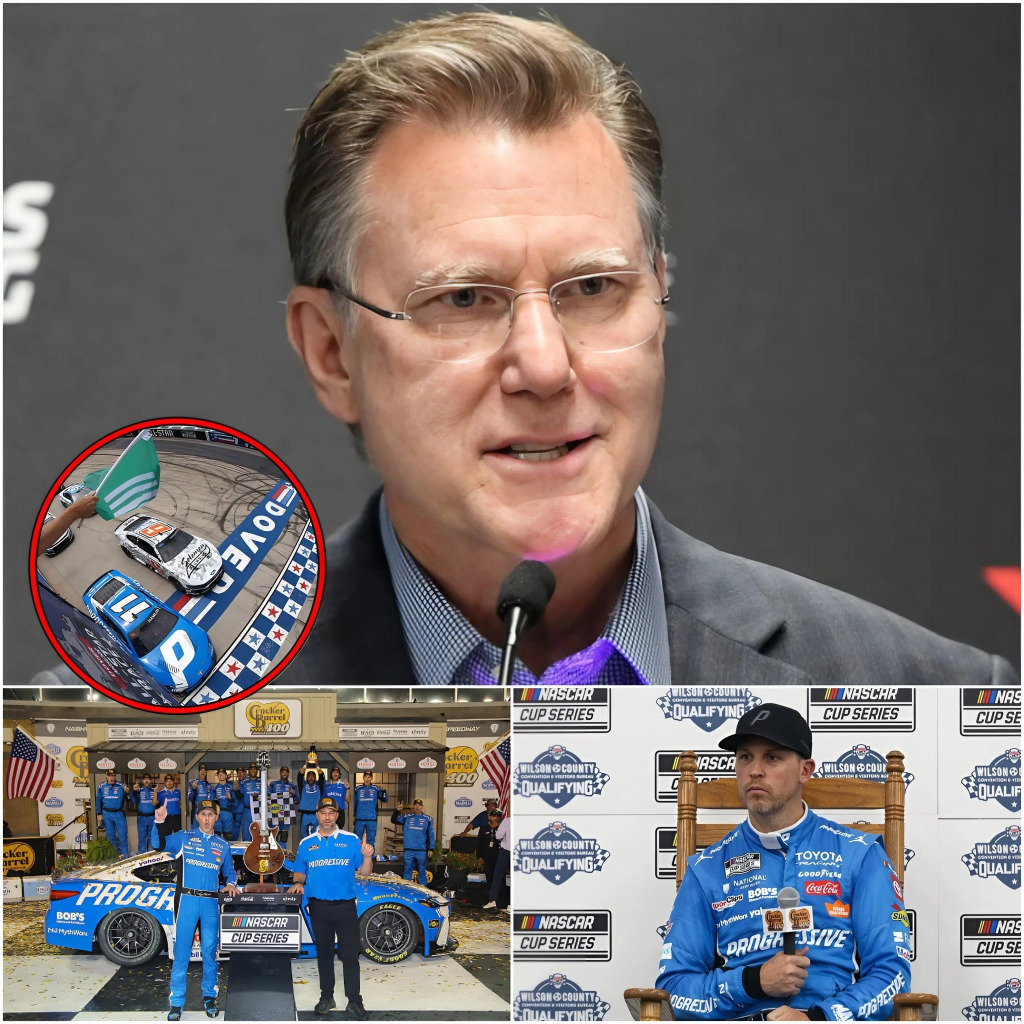
A dramatic NASCAR penalty, an extraordinary comeback, and a breathtaking three-wide finish have placed Denny Hamlin’s victory at Nashville Superspeedway under renewed scrutiny. What should have been a straightforward celebration for the Joe Gibbs Racing veteran instead became one of the most fascinating stories of the 2026 NASCAR Cup Series season.
At the center of the controversy was a penalty NASCAR officials issued to Hamlin during the opening moments of the Cracker Barrel 400.
The violation was real.
The punishment was immediate.
But the circumstances surrounding the penalty have also generated questions about racing rules, competitive fairness, and how a driver can recover from a disastrous start to claim victory.
For fans who witnessed the incredible finish, the biggest question was simple: How did Hamlin go from first place to the back of the field and somehow return to Victory Lane?
The answer begins before the opening lap was even completed.
On May 31, 2026, Hamlin entered the Cracker Barrel 400 at Nashville Superspeedway as the pole sitter, positioning his No. 11 Joe Gibbs Racing Toyota at the front of the 38-car field.
Expectations were high.
The veteran driver had already demonstrated impressive speed throughout the weekend, and starting from the pole offered a significant advantage on Nashville’s demanding concrete racing surface.
But that advantage disappeared almost immediately.
As the green flag signaled the beginning of the 300-lap race, NASCAR officials determined that Hamlin had jumped the start.
The violation triggered a penalty that sent him from the front of the field to the rear.
In a matter of moments, the race favorite found himself facing an enormous challenge.
Instead of controlling the pace from the opening laps, Hamlin would have to fight through traffic, manage his equipment, and recover the positions he had lost.
For many drivers, such a setback could destroy an otherwise promising afternoon.
But Hamlin refused to surrender.
Over the following laps, the Joe Gibbs Racing veteran began working his way through the field, combining aggressive overtaking with calculated strategy.
His crew played a crucial role in the recovery.
Every pit stop mattered.
Every adjustment became important.
And every opportunity to gain track position brought Hamlin closer to the leaders.
As the race progressed, it became increasingly clear that the No. 11 Toyota remained one of the strongest cars on the circuit.
The early penalty had complicated his afternoon, but it had not eliminated his ability to compete.
By the closing stages, Hamlin had returned to contention.
And then came the moment that transformed the race into an unforgettable NASCAR spectacle.
With four laps remaining, the competition intensified between three Joe Gibbs Racing teammates.
Hamlin, Christopher Bell, and Chase Briscoe were all fighting for the victory.
The tension was extraordinary.
Bell appeared capable of taking control of the race, while Briscoe remained close enough to challenge.
Hamlin, however, recognized an opportunity.
As his teammates battled for position, he maneuvered his Toyota into contention and began challenging Bell for the lead.
The final lap produced a spectacular three-wide confrontation that left spectators watching every move.
Hamlin and Bell raced side by side, neither willing to surrender.
Briscoe remained involved in the fight as the cars charged through the corners.
Then Hamlin found the opening he needed.
He cleared Bell exiting Turn 2 and held his position through the final stretch.
When the checkered flag waved, Hamlin had completed one of the most remarkable recoveries of the season.
His winning margin was just 0.115 seconds.
The victory marked the 62nd NASCAR Cup Series win of his career and delivered Toyota its first Cup Series triumph at Nashville Superspeedway.
But the early penalty remained an important talking point.
NASCAR’s decision to penalize Hamlin for jumping the start was an official ruling made during the race.
It was not a post-race finding that his vehicle had been illegally modified.
Nor did it establish that he had used prohibited equipment to gain an advantage.
That distinction is essential.
In NASCAR, an early-race procedural violation and a technical cheating violation are fundamentally different matters.
A driver who jumps a start may receive a penalty for failing to follow restart procedures.
A team found using illegal modifications could face a different set of consequences depending on the nature and severity of the violation.
In Hamlin’s case, NASCAR imposed the appropriate in-race punishment, and he subsequently recovered to win.
Following the event, the Cup Series garage completed its inspection procedures without reporting issues that invalidated the result.
Hamlin was confirmed as the official winner.
That finding is particularly important because online speculation can sometimes blur the distinction between a legitimate penalty and allegations of cheating.
The fact that Hamlin was penalized does not automatically mean his eventual victory was illegal.
Indeed, the remarkable nature of his comeback is part of what made the Nashville result so compelling.
The driver who started first, fell to last, and returned to first had overcome a setback that could easily have ended his hopes.
Christopher Bell’s reaction also provided insight into the competitive intensity of the finish.
Rather than publicly accusing Hamlin of wrongdoing, Bell acknowledged his disappointment and took responsibility for failing to convert his strong position into victory.
He believed he had possessed the best car during the decisive moments.
But NASCAR victories are not determined by speed alone.
Positioning, timing, decision-making, and the ability to capitalize on an opponent’s mistake can be just as important.
Hamlin demonstrated those qualities when the pressure was greatest.
The finish also highlighted the extraordinary depth of Joe Gibbs Racing.
Three teammates battling for victory in the final moments represented an impressive achievement for the organization.
At the same time, the race illustrated how fiercely teammates can compete when a trophy is on the line.
There was no guarantee that one driver would sacrifice his own opportunity for another.
Each competitor wanted the win.
And Hamlin ultimately emerged victorious.
For NASCAR officials, the race provided a clear example of how penalties can be enforced without necessarily determining the final outcome.
Hamlin violated the starting procedure.
He received a punishment.
He served that punishment and continued racing.
And he ultimately won under the established competition rules.
The result remained official after post-race inspection.
That sequence does not eliminate debate about whether NASCAR’s penalty rules are sufficiently strict.
Fans may reasonably disagree about the consequences drivers should face for jumping a start.
Some may argue that losing track position is an adequate punishment.
Others may believe additional penalties would discourage competitors from attempting to gain an early advantage.
But those are discussions about enforcement policy, not evidence that Hamlin’s victory was fraudulent.
As the 2026 NASCAR season continued, Nashville remained a defining example of Hamlin’s resilience and ability to perform under pressure.
From the front row to the rear of the field, and finally back to Victory Lane, his afternoon contained nearly every emotion a race car driver can experience.
Frustration.
Determination.
Uncertainty.
And ultimately, triumph.
🔥 NASCAR PENALIZED DENNY HAMLIN — BUT HE FOUGHT BACK FROM LAST PLACE TO WIN THE CRACKER BARREL 400 IN ONE OF THE SEASON’S MOST DRAMATIC FINISHES!
🏁 THE PENALTY WAS REAL. THE COMEBACK WAS REAL. AND NASCAR OFFICIALLY CONFIRMED THE VICTORY.
👇 NASCAR FANS, SHOULD A DRIVER WHO JUMPS THE START FACE A TOUGHER PENALTY, OR DID DENNY HAMLIN EARN HIS NASHVILLE VICTORY FAIR AND SQUARE? SHARE YOUR OPINION BELOW!