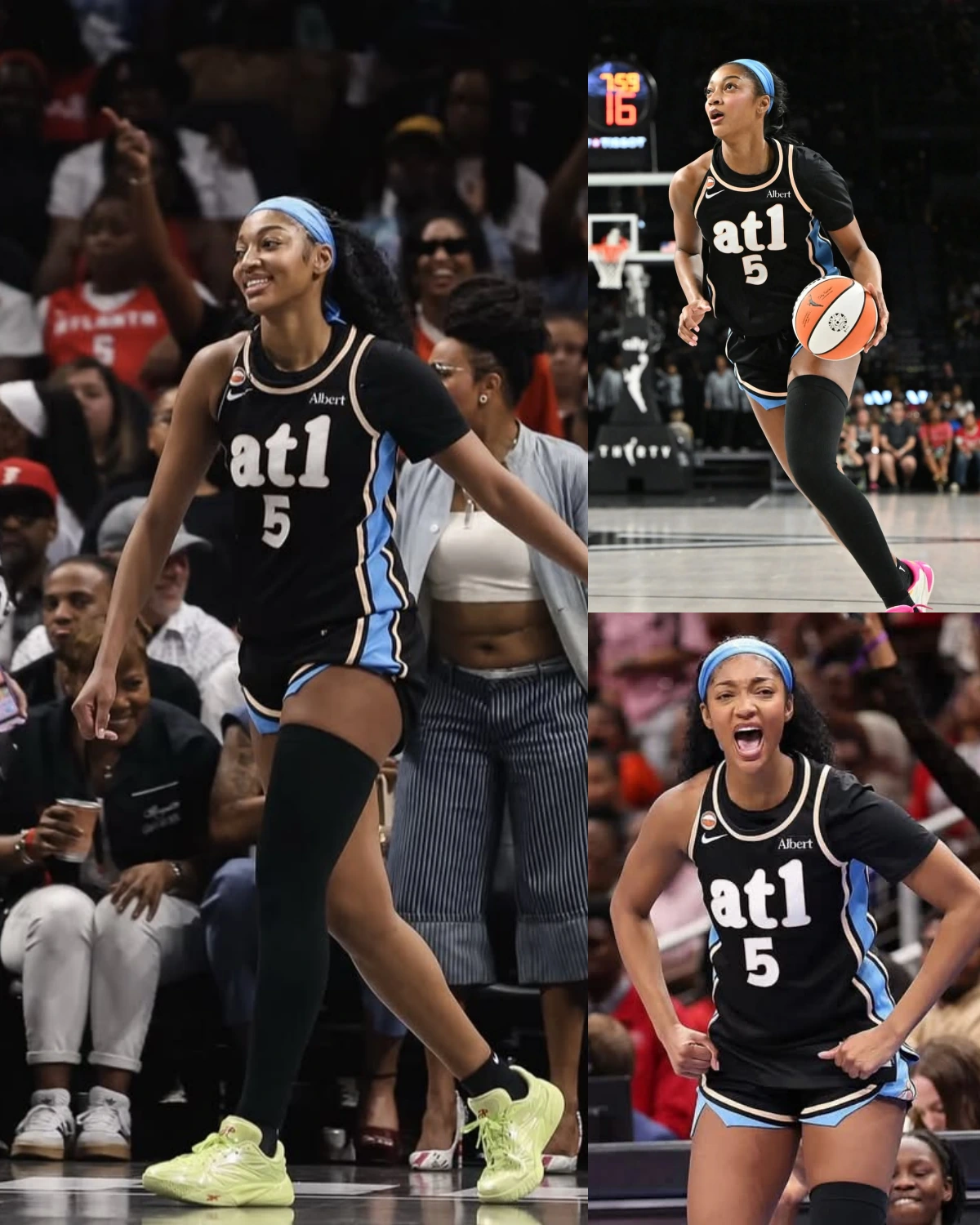
“AS LONG AS IT TAKES.” Angel Reese Fires Back at Critics After WNBA Salary Fight Explodes — And She Refuses to Back Down
“As long as it takes.” Angel Reese fires back at critics after hinting she might sit out the WNBA over a $75K-a-year contract. The rising star refuses to back down, making it clear she knows her worth—and won’t settle for less.
Angel Reese has never been afraid to say exactly what she thinks.
On the basketball court, that confidence shows up in rebounds, physical defense and the relentless energy that has made her one of the most recognizable players of her generation.
Away from it, Reese has demonstrated the same willingness to challenge narratives she believes are unfair.
And few subjects have produced more controversy than WNBA salaries.
The argument exploded in March 2025 when Reese and DiJonai Carrington discussed the league’s upcoming collective bargaining negotiations.
Reese said she had heard players talking about potentially sitting out if they didn’t receive what they wanted in the next agreement.
Carrington acknowledged that possibility.
The comments immediately traveled across social media.
Critics accused Reese of threatening the league.
Others mocked the approximately $75,000 salary she was earning under her rookie-scale contract.
Then the conversation became even more heated when Reese responded to an online critic.
She rejected the suggestion that she had demanded NBA-level salaries and delivered the line that quickly became the center of the debate:
“We are prepared to stay at the negotiating table for as long as it takes.”
That distinction matters.
Reese wasn’t announcing that she personally planned to abandon the WNBA because she earned $75,000.
She was talking about collective bargaining and the possibility that players could use their leverage if negotiations failed.
And now, with the benefit of hindsight, the story looks very different.
The approximately $75,000 figure belongs to the WNBA’s previous compensation structure.
Under Reese’s original four-year rookie contract with Chicago, worth roughly $324,000 overall, her annual base salary was indeed in that neighborhood during her first seasons.
But 2026 changed everything.
The WNBA and players’ union reached a transformative new collective bargaining agreement in March.
The league announced that the 2026 salary cap would rise from $1.5 million to $7 million.
Maximum salaries could reach $1.4 million.
Average compensation was projected to exceed $583,000.
And minimum salaries jumped into the $270,000-$300,000 range.
Existing rookie contracts were adjusted as well.
For Reese, that meant a dramatic increase.
After Atlanta acquired her from Chicago in April, her 2026 base salary was projected at approximately $350,692—far removed from the $75,000 number still circulating in viral posts.
And Reese hasn’t disappeared from the WNBA.
Quite the opposite.
Atlanta exercised her fourth-year option, with Dream general manager Dan Padover calling the decision an easy one and describing Reese as an important part of the franchise’s core.
Then Reese went out and produced.
In her first season with Atlanta, she averaged a career-high 16.4 points and a league-leading 12.1 rebounds across 43 games.
She recorded 521 rebounds.
She finished with 32 double-doubles.
And on October 1, she was named the 2026 WNBA Defensive Player of the Year.
That’s where the original salary controversy becomes much more interesting.
Reese’s argument was never simply that one player deserved more money.
The larger fight centered on how much of the WNBA’s growth should flow back to the athletes creating the product.
Players had watched attendance rise.
Television audiences were expanding.
Commercial interest was increasing.
New stars were bringing enormous attention to women’s basketball.
And the players wanted the economics of their league to evolve with that growth.
Reese became one of the loudest voices associated with that conversation.
That made her an easy target.
Some critics argued that WNBA economics couldn’t support the salary expectations being discussed.
Others pointed toward the league’s historical financial challenges.
And some simply believed young players such as Reese should focus on basketball instead of publicly discussing compensation.
But professional sports have never worked that way.
Salary caps, revenue sharing, free agency, pensions, travel standards and roster rules are fundamental parts of the business.
Male professional athletes have negotiated aggressively over those issues for decades.
WNBA players doing the same shouldn’t be surprising.
And Reese’s career adds another layer.
She entered professional basketball with substantial visibility already attached to her name.
She had won a national championship at LSU.
She had built a massive social-media audience.
She attracted endorsement deals.
Then she immediately became one of the WNBA’s premier rebounders.
By 2026, she was a two-time All-Star before even beginning her third season.
Now she’s a Defensive Player of the Year.
That doesn’t mean every demand she or any other player makes must automatically be accepted.
Collective bargaining involves competing interests.
Owners want financial sustainability.
Players want compensation reflecting their value.
The league wants continued growth.
Broadcasters and sponsors want an attractive product.
Negotiation exists because those interests aren’t always identical.
But something important happened between Reese’s controversial comments and the 2026 season.
The economic structure changed.
The new CBA established revenue sharing and dramatically increased salaries across the league.
In other words, the conversation Reese was participating in wasn’t meaningless noise.
It was part of a much larger labor battle that eventually produced historic changes.
That’s why the viral version of the story—“Angel Reese threatens to quit because she only makes $75K”—misses the most interesting part.
She didn’t simply walk away.
She kept playing.
She kept negotiating through the collective process.
And when the economics changed, she entered the next chapter of her career under a radically different salary structure.
Now the basketball question becomes even bigger.
Reese’s 2026 performance has potentially positioned her for something much more lucrative.
Under the new CBA, elite young players can gain expedited pathways toward maximum-level contracts depending on their honors.
And maximum salaries can reach seven figures.
Suddenly, a player once associated with a $75,000 salary debate is competing in a league where top players can earn $1.4 million in base salary.
That transformation happened remarkably quickly.
So when Reese says players know their value, the statement carries more weight today than it did during the original controversy.
Not because every criticism disappeared.
Not because every negotiation went perfectly.
But because the economics changed.
The league grew.
The players pushed.
A new agreement arrived.
And Reese kept producing.
She didn’t need to prove her point by leaving basketball.
She had another option.
Stay on the court—and make herself impossible to ignore.