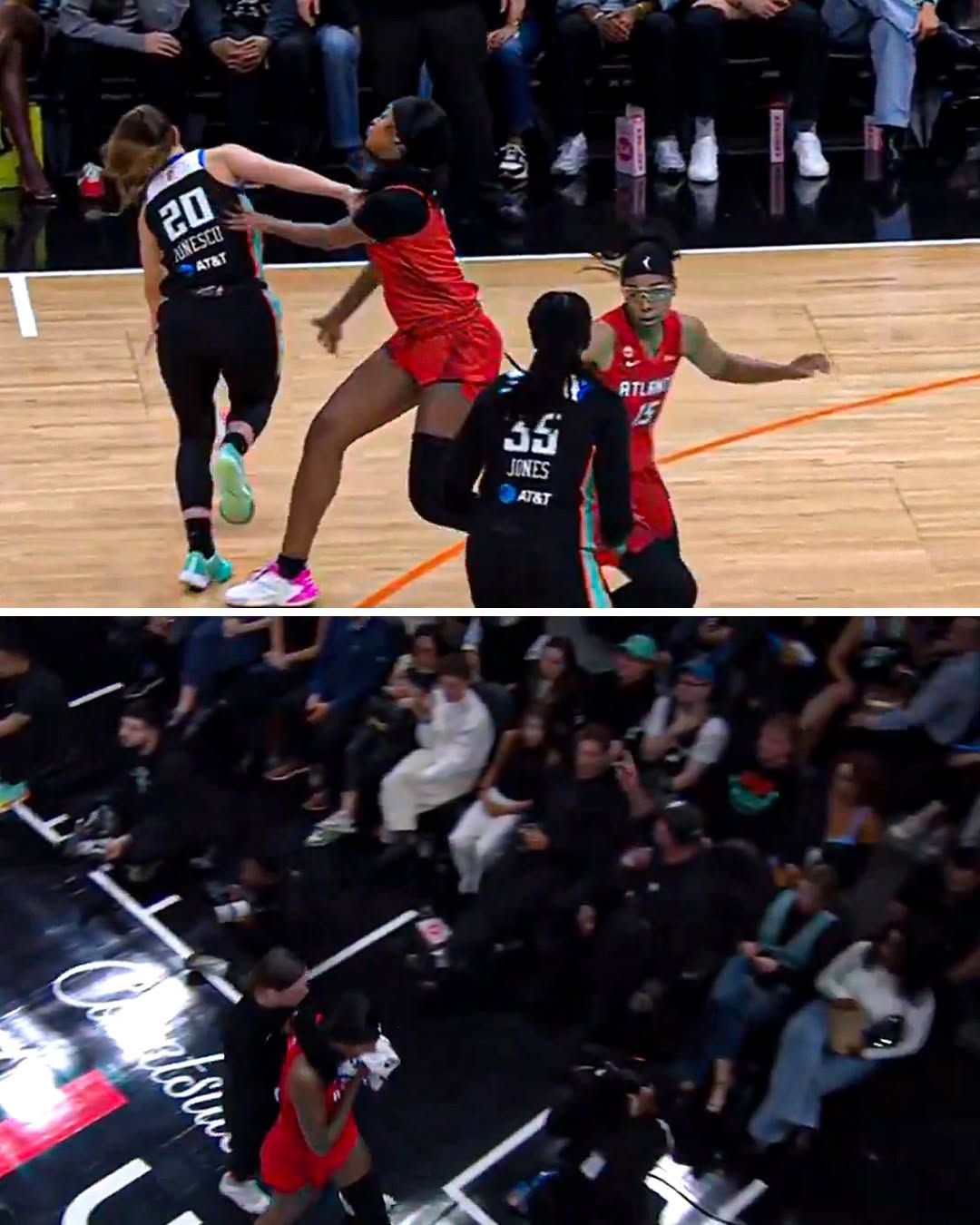
🚨 “SHE WALKED STRAIGHT TO THE LOCKER ROOM” — Angel Reese Took a Shot to the Face, Then What Happened 5.6 Seconds Before Halftime Changed Everything
Angel Reese suddenly headed toward the locker room after taking contact to the face from Sabrina Ionescu — and within moments, officials were standing at the monitor reviewing a play that completely changed the atmosphere inside Barclays Center.
Only 5.6 seconds remained before halftime.
The Atlanta Dream were battling the New York Liberty in a game carrying major playoff implications when one possession suddenly became the moment everyone was watching.
Sabrina Ionescu had the basketball.
Angel Reese stepped into position and drew an offensive foul.
But the collision immediately looked serious.
As Ionescu moved through the play, her arm made contact with Reese’s face.
Reese went down.
The whistle blew.
And almost immediately, attention shifted away from the scoreboard.
Reese eventually got up and headed toward the locker room while officials went to the replay monitor.
For Atlanta, that sight was concerning.
This wasn’t simply another player leaving the floor.
Reese had become a central part of the Dream’s frontcourt, and Atlanta was approaching the postseason.
Losing her — even temporarily — could potentially change everything.
Then came the ruling.
After reviewing the play, officials upgraded the foul on Ionescu to a Flagrant 1.
But the sequence wasn’t finished.
Reese emerged from the locker room.
With the half still technically unfinished, she returned to the floor to take the two free throws awarded following the flagrant foul.
The building watched.
Reese stepped to the line.
First free throw.
Good.
Second free throw.
Good.
Then she headed back toward the locker room.
It was an extraordinary ending to the half.
Atlanta walked into the break leading New York 41–26, but suddenly the biggest question wasn’t about the Dream’s 15-point advantage.
It was about No. 5.
Would Angel Reese return?
At halftime, Reese had six points and six rebounds.
But when the third quarter began, she wasn’t on Atlanta’s bench.
DeWanna Bonner started the second half in her place.
The uncertainty continued.
Every minute Reese remained away from the bench added another layer of concern.
Then, with 6:19 remaining in the third quarter, Reese reappeared.
She returned to Atlanta’s bench.
That was an encouraging sight.
But she did not check back into the game.
Her night was finished.
Reese ended with six points and six rebounds as Atlanta continued without her.
Fortunately for the Dream, her teammates didn’t allow the incident to derail what they had built.
New York attempted to fight back, but Atlanta maintained control.
Allisha Gray led the way with 24 points.
Naz Hillmon contributed 16.
And when the final buzzer sounded, the scoreboard read:
Atlanta Dream 83.
New York Liberty 65.
The victory carried major significance.
Atlanta secured the No. 4 seed, putting itself in position for home-court advantage in the opening round of the playoffs.
But even after the win, attention remained on Reese.
The timing of the incident made it particularly concerning.
The regular season was ending.
The playoffs were beginning.
At this stage of the year, teams don’t have much time to recover from unexpected problems.
One injury can alter a rotation.
One unavailable starter can change an entire matchup.
And one physical play can suddenly become far more important than anyone expected when the possession began.
There is also an important distinction surrounding Ionescu’s foul.
Officials ruled the contact a Flagrant 1 after reviewing it, but that classification by itself doesn’t establish that Ionescu deliberately tried to injure Reese.
Basketball is played at enormous speed.
Arms move.
Bodies collide.
Players attempt to create space.
And sometimes contact that wasn’t necessarily intended can still meet the standard for a flagrant foul.
The officials’ job was to evaluate the contact.
They did.
And after seeing the replay, they determined it warranted the upgrade.
What happened afterward may say even more about Reese.
She had already gone toward the locker room.
Yet she returned to the court because there was still basketball business to finish.
Two free throws.
Two makes.
Then back to the locker room.
That sequence immediately became one of the night’s defining images.
For a player known for her competitiveness and physical approach, it was another example of Reese refusing to leave a possession unfinished.
Atlanta ultimately didn’t need her again that night.
The Dream protected the lead.
They closed the regular season with a convincing victory.
And they secured their playoff position.
But now the focus shifts forward.
Atlanta’s postseason ambitions are much bigger than one regular-season win.
The Dream need their rotation.
They need their frontcourt.
And they certainly want Angel Reese available.
That’s why those final 5.6 seconds before halftime became so much more than another whistle.
One moment began with an offensive foul.
Then came the replay.
Then the Flagrant 1.
Then Reese disappeared down the tunnel.
Then she came back.
Two free throws.
Two makes.
And another trip to the locker room.
Atlanta got the victory it desperately wanted.
But the image everyone remembered was Angel Reese walking away from the floor — just as the playoffs were about to begin.