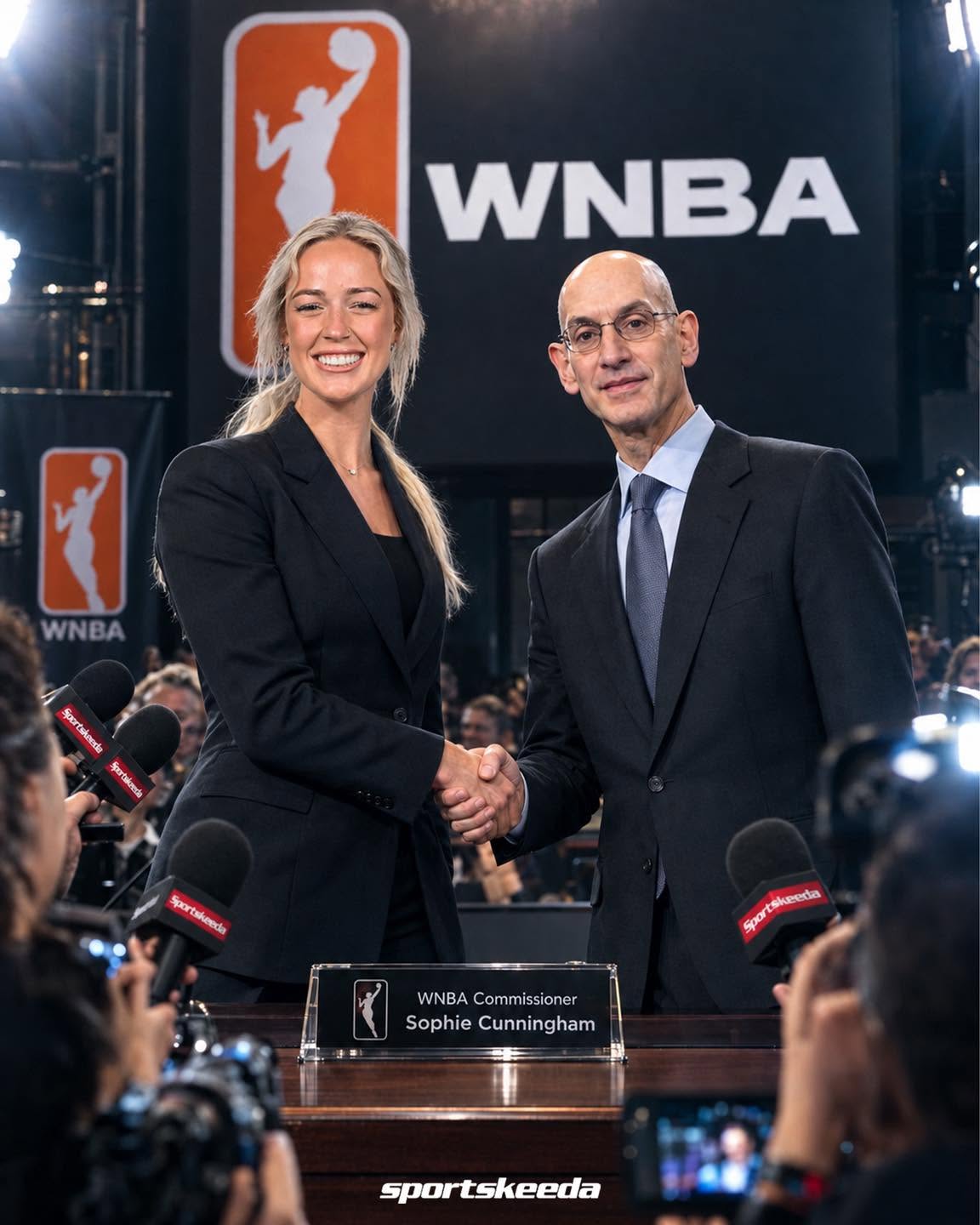
😳 JASON WHITLOCK SAYS SOPHIE CUNNINGHAM SHOULD BE THE NEW WNBA COMMISSIONER — AND HE INSISTS HE’S DEAD SERIOUS
Jason Whitlock has thrown one of the most unexpected names into the conversation surrounding the future leadership of the WNBA: Sophie Cunningham.
And according to Whitlock, this isn’t a joke.
The sports commentator argued that Cunningham possesses something he believes the league desperately needs from its next leader — toughness, personality, conviction and the willingness to absorb criticism without backing down.
“I’m not joking. No, no, I’m dead serious,” Whitlock said while making his case for the Indiana Fever guard. “She’s the only one with the chops to handle the job.”
It is the kind of suggestion almost guaranteed to create debate.
Cunningham is an active WNBA player, not a longtime league executive. She hasn’t spent decades running a major sports organization or negotiating billion-dollar media agreements.
Whitlock’s argument, however, wasn’t based on a traditional executive résumé.
Instead, he focused on personality.
He argued that running the WNBA requires someone capable of handling enormous pressure, making difficult decisions and surviving criticism from players, fans and the media.
In his view, Cunningham has demonstrated those qualities throughout her playing career.
“You don’t need a law degree to run the WNBA. You don’t need endless business experience to run the WNBA,” Whitlock said before making his colorful argument that what the job really requires is toughness and “skin thick enough to withstand the heat.”
That description certainly fits the public image Cunningham has developed.
She has become one of the league’s most outspoken personalities.
She isn’t known for disappearing when controversy arrives.
If Cunningham has an opinion, fans often hear it.
Sometimes people agree with her.
Sometimes they strongly disagree.
Either way, she has demonstrated a willingness to deal with the reaction.
That characteristic appears to be central to Whitlock’s argument.
But there is a major difference between being an outspoken professional athlete and running an entire sports league.
A commissioner must navigate relationships with team owners, players, sponsors, broadcasters, league employees and business partners.
Collective bargaining matters.
Expansion matters.
Player safety matters.
Officiating matters.
Scheduling matters.
Media rights matter.
Revenue growth matters.
The job involves far more than being willing to make controversial decisions.
That is why Whitlock’s suggestion is likely to remain divisive even among people who admire Cunningham.
Still, the idea didn’t emerge from absolutely nowhere.
Cunningham herself has recently entertained the commissioner conversation.
During an episode of her No Hesitation podcast, she joked that the more she thought about the possibility, the more she believed she could take on the job.
That immediately caught attention.
Then Whitlock took the conversation much further.
He argued that Cunningham already possesses an important advantage: she understands the league from inside a WNBA locker room.
She knows what players experience.
She understands travel, practices, officiating, physical play and the everyday demands of being a professional women’s basketball player.
And there is another element impossible to ignore.
Caitlin Clark.
Cunningham’s connection to Clark through the Indiana Fever places her close to one of the biggest stars and most influential commercial forces in women’s basketball.
Whitlock specifically pointed toward Cunningham’s ability to maintain a relationship with Clark while still expressing independent opinions about other players.
That distinction matters to his argument.
A commissioner cannot simply represent one superstar.
The job requires balancing competing interests across an entire league.
Clark may attract enormous attention, but the WNBA consists of hundreds of players, multiple franchises and stakeholders with very different priorities.
That makes Cunningham’s relationships inside the league interesting, even if they don’t automatically qualify her for an executive position.
There is also something larger happening here.
The fact that people are even debating whether a current player could someday lead the league demonstrates how rapidly the WNBA conversation is evolving.
Women’s basketball has experienced tremendous attention.
More people are watching.
More people are debating.
More personalities are becoming recognizable outside traditional basketball audiences.
And Cunningham has become one of those personalities.
Her reputation isn’t built entirely on statistics.
It is also built on attitude.
She plays physically.
She speaks directly.
She doesn’t appear particularly interested in giving carefully sanitized answers simply because they would generate less controversy.
For supporters, that can look refreshing.
For critics, it can look unnecessarily provocative.
For Whitlock, it apparently looks like leadership potential.
Whether Cunningham would actually want to exchange a basketball uniform for an executive office is an entirely different question.
Being commissioner would mean leaving behind the daily competition that has defined her professional career.
No practices.
No games.
No sharing the floor with teammates.
Instead, she would become responsible for decisions affecting everyone else.
That transition would be enormous.
And even if Cunningham were interested, there would be legitimate questions about executive preparation and experience.
Those questions shouldn’t be dismissed simply because someone possesses charisma or courage.
Leadership at the professional-sports level requires both interpersonal strength and technical expertise.
But Whitlock’s argument has succeeded in one undeniable way:
People are talking.
A suggestion that initially sounds almost impossible becomes more interesting once the underlying question is considered.
What exactly should the next WNBA commissioner look like?
Should the league prioritize someone with extensive corporate experience?
Someone who understands basketball operations?
A former player?
An established sports executive?
Or someone capable of combining several of those worlds?
Whitlock has made his preference clear.
He sees Cunningham’s toughness and willingness to speak her mind as qualities the league needs.
Others will reasonably argue that running a major professional league demands experience that cannot be replaced by personality alone.
And Cunningham?
She is still playing basketball.
For now, the commissioner’s chair remains a conversation rather than a career change.
But if Sophie Cunningham wanted people talking about what she might bring to the future of the WNBA, she certainly has their attention now.
Sophie Cunningham: WNBA player today, commissioner someday?
Jason Whitlock says he is completely serious.
Now the basketball world gets to debate just how serious the idea itself should be. 😳🏀🔥
❤️ Follow our page for more daily Sophie Cunningham photos, videos, and WNBA highlights!